

IONIC REACTIONS
169
single electron, and is termed a carbanion. In this
case, carbon carries a full octet of electrons and is
tetrahedral, as if it had four single bonds. The lone
pair electrons occupy the fourth sp
3 orbital.
Remember, carbon cannot form more than four
bonds!
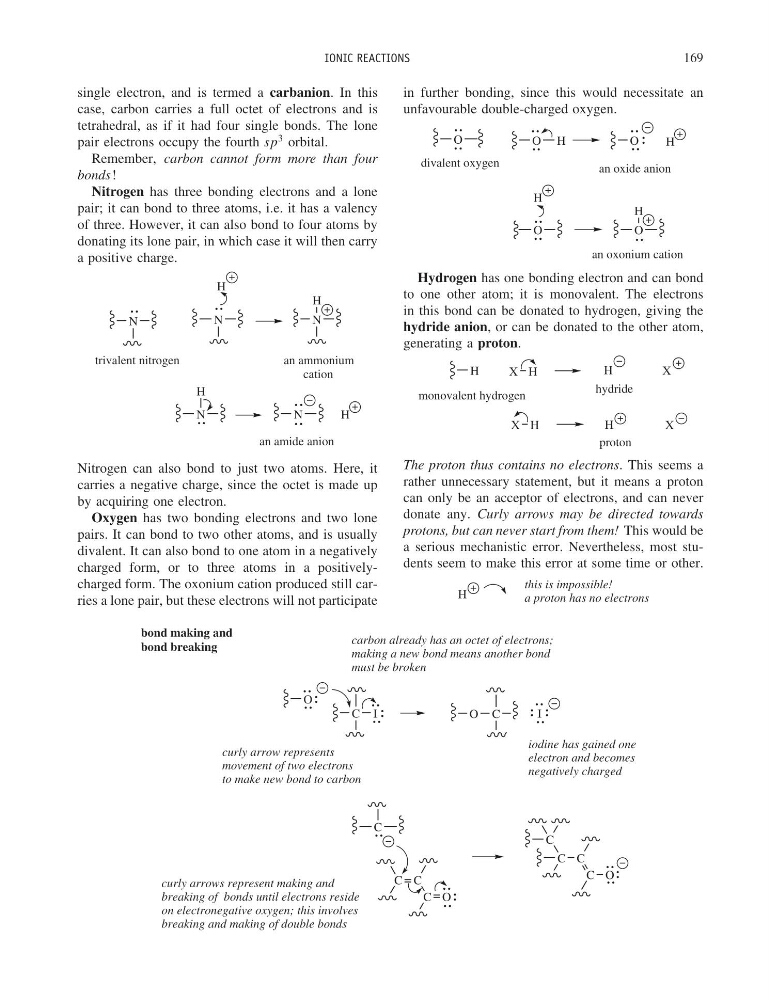
Nitrogen has three bonding electrons and a lone
pair; it can bond to three atoms, i.e. it has a valency
of three. However, it can also bond to four atoms by
donating its lone pair, in which case it will then carry
a positive charge.
N
N
N
H
N
N
H
trivalent nitrogen
an amide anion
an ammonium
cation
H
H
Nitrogen can also bond to just two atoms. Here, it
carries a negative charge, since the octet is made up
by acquiring one electron.
Oxygen has two bonding electrons and two lone
pairs. It can bond to two other atoms, and is usually
divalent. It can also bond to one atom in a negatively
charged form, or to three atoms in a positivelycharged form. The oxonium cation produced still carries a lone pair, but these electrons will not participate
in further bonding, since this would necessitate an
unfavourable double-charged oxygen.
O
O H
O
O
O
divalent oxygen
an oxide anion
an oxonium cation
H
H
H
Hydrogen has one bonding electron and can bond
to one other atom; it is monovalent. The electrons
in this bond can be donated to hydrogen, giving the
hydride anion, or can be donated to the other atom,
generating a proton.
H
X H
X H
monovalent hydrogen
hydride
proton
H
H
X
X
The proton thus contains no electrons. This seems a
rather unnecessary statement, but it means a proton
can only be an acceptor of electrons, and can never
donate any. Curly arrows may be directed towards
protons, but can never start from them! This would be
a serious mechanistic error. Nevertheless, most students seem to make this error at some time or other.
this is impossible!
a proton has no electrons
H
C I
C
O
O
C C
C O
C C
C O
C
C
bond making and
bond breaking
curly arrow represents
movement of two electrons
to make new bond to carbon
carbon already has an octet of electrons;
making a new bond means another bond
must be broken
iodine has gained one
electron and becomes
negatively charged
curly arrows represent making and
breaking of bonds until electrons reside
on electronegative oxygen; this involves
breaking and making of double bonds
I
169
single electron, and is termed a carbanion. In this
case, carbon carries a full octet of electrons and is
tetrahedral, as if it had four single bonds. The lone
pair electrons occupy the fourth sp
3 orbital.
Remember, carbon cannot form more than four
bonds!
Nitrogen has three bonding electrons and a lone
pair; it can bond to three atoms, i.e. it has a valency
of three. However, it can also bond to four atoms by
donating its lone pair, in which case it will then carry
a positive charge.
N
N
N
H
N
N
H
trivalent nitrogen
an amide anion
an ammonium
cation
H
H
Nitrogen can also bond to just two atoms. Here, it
carries a negative charge, since the octet is made up
by acquiring one electron.
Oxygen has two bonding electrons and two lone
pairs. It can bond to two other atoms, and is usually
divalent. It can also bond to one atom in a negatively
charged form, or to three atoms in a positivelycharged form. The oxonium cation produced still carries a lone pair, but these electrons will not participate
in further bonding, since this would necessitate an
unfavourable double-charged oxygen.
O
O H
O
O
O
divalent oxygen
an oxide anion
an oxonium cation
H
H
H
Hydrogen has one bonding electron and can bond
to one other atom; it is monovalent. The electrons
in this bond can be donated to hydrogen, giving the
hydride anion, or can be donated to the other atom,
generating a proton.
H
X H
X H
monovalent hydrogen
hydride
proton
H
H
X
X
The proton thus contains no electrons. This seems a
rather unnecessary statement, but it means a proton
can only be an acceptor of electrons, and can never
donate any. Curly arrows may be directed towards
protons, but can never start from them! This would be
a serious mechanistic error. Nevertheless, most students seem to make this error at some time or other.
this is impossible!
a proton has no electrons
H
C I
C
O
O
C C
C O
C C
C O
C
C
bond making and
bond breaking
curly arrow represents
movement of two electrons
to make new bond to carbon
carbon already has an octet of electrons;
making a new bond means another bond
must be broken
iodine has gained one
electron and becomes
negatively charged
curly arrows represent making and
breaking of bonds until electrons reside
on electronegative oxygen; this involves
breaking and making of double bonds
I