

168
REACTION MECHANISMS
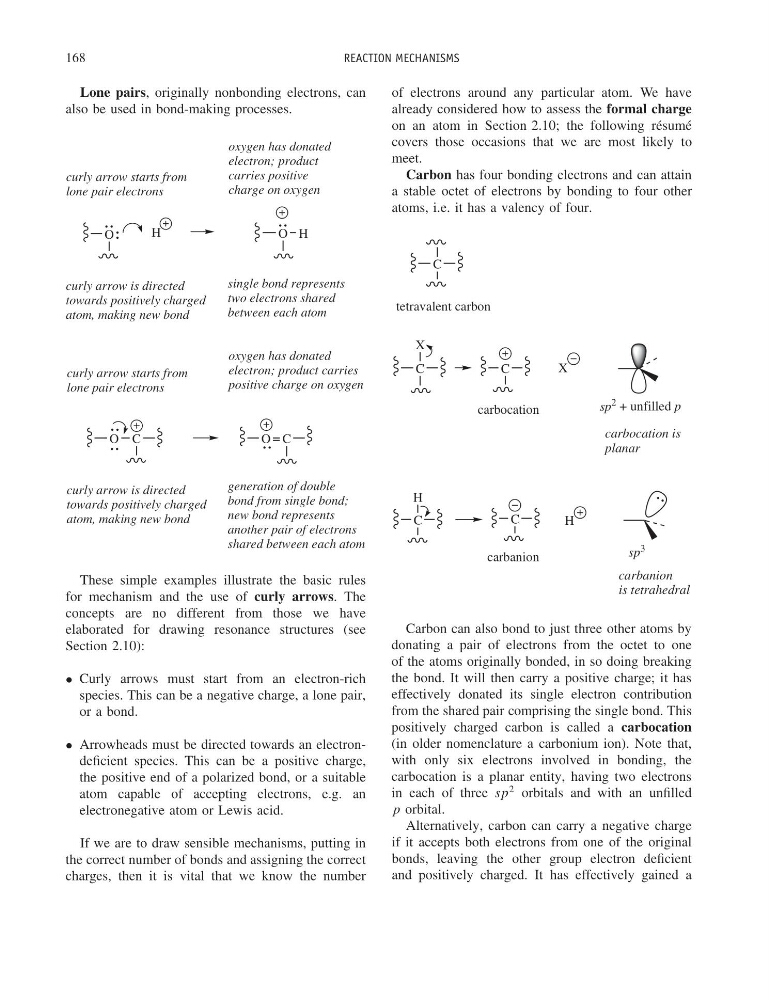
Lone pairs, originally nonbonding electrons, can
also be used in bond-making processes.
O
O H
O C
O C
curly arrow starts from
lone pair electrons
curly arrow is directed
towards positively charged
atom, making new bond
oxygen has donated
electron; product
carries positive
charge on oxygen
single bond represents
two electrons shared
between each atom
curly arrow starts from
lone pair electrons
curly arrow is directed
towards positively charged
atom, making new bond
oxygen has donated
electron; product carries
positive charge on oxygen
generation of double
bond from single bond;
new bond represents
another pair of electrons
shared between each atom
H
These simple examples illustrate the basic rules
for mechanism and the use of curly arrows. The
concepts are no different from those we have
elaborated for drawing resonance structures (see
Section 2.10):
• Curly arrows must start from an electron-rich
species. This can be a negative charge, a lone pair,
or a bond.
• Arrowheads must be directed towards an electrondeficient species. This can be a positive charge,
the positive end of a polarized bond, or a suitable
atom capable of accepting electrons, e.g. an
electronegative atom or Lewis acid.
If we are to draw sensible mechanisms, putting in
the correct number of bonds and assigning the correct
charges, then it is vital that we know the number
of electrons around any particular atom. We have
already considered how to assess the formal charge
on an atom in Section 2.10; the following r´ esum´ e
covers those occasions that we are most likely to
meet.
Carbon has four bonding electrons and can attain
a stable octet of electrons by bonding to four other
atoms, i.e. it has a valency of four.
C
C
X
C
C
H
C
carbocation
carbanion
tetravalent carbon
carbocation is
planar
sp
2 + unfilled p
carbanion
is tetrahedral
sp 3
X
H
Carbon can also bond to just three other atoms by
donating a pair of electrons from the octet to one
of the atoms originally bonded, in so doing breaking
the bond. It will then carry a positive charge; it has
effectively donated its single electron contribution
from the shared pair comprising the single bond. This
positively charged carbon is called a carbocation
(in older nomenclature a carbonium ion). Note that,
with only six electrons involved in bonding, the
carbocation is a planar entity, having two electrons
in each of three sp
2 orbitals and with an unfilled
p orbital.
Alternatively, carbon can carry a negative charge
if it accepts both electrons from one of the original
bonds, leaving the other group electron deficient
and positively charged. It has effectively gained a
REACTION MECHANISMS
Lone pairs, originally nonbonding electrons, can
also be used in bond-making processes.
O
O H
O C
O C
curly arrow starts from
lone pair electrons
curly arrow is directed
towards positively charged
atom, making new bond
oxygen has donated
electron; product
carries positive
charge on oxygen
single bond represents
two electrons shared
between each atom
curly arrow starts from
lone pair electrons
curly arrow is directed
towards positively charged
atom, making new bond
oxygen has donated
electron; product carries
positive charge on oxygen
generation of double
bond from single bond;
new bond represents
another pair of electrons
shared between each atom
H
These simple examples illustrate the basic rules
for mechanism and the use of curly arrows. The
concepts are no different from those we have
elaborated for drawing resonance structures (see
Section 2.10):
• Curly arrows must start from an electron-rich
species. This can be a negative charge, a lone pair,
or a bond.
• Arrowheads must be directed towards an electrondeficient species. This can be a positive charge,
the positive end of a polarized bond, or a suitable
atom capable of accepting electrons, e.g. an
electronegative atom or Lewis acid.
If we are to draw sensible mechanisms, putting in
the correct number of bonds and assigning the correct
charges, then it is vital that we know the number
of electrons around any particular atom. We have
already considered how to assess the formal charge
on an atom in Section 2.10; the following r´ esum´ e
covers those occasions that we are most likely to
meet.
Carbon has four bonding electrons and can attain
a stable octet of electrons by bonding to four other
atoms, i.e. it has a valency of four.
C
C
X
C
C
H
C
carbocation
carbanion
tetravalent carbon
carbocation is
planar
sp
2 + unfilled p
carbanion
is tetrahedral
sp 3
X
H
Carbon can also bond to just three other atoms by
donating a pair of electrons from the octet to one
of the atoms originally bonded, in so doing breaking
the bond. It will then carry a positive charge; it has
effectively donated its single electron contribution
from the shared pair comprising the single bond. This
positively charged carbon is called a carbocation
(in older nomenclature a carbonium ion). Note that,
with only six electrons involved in bonding, the
carbocation is a planar entity, having two electrons
in each of three sp
2 orbitals and with an unfilled
p orbital.
Alternatively, carbon can carry a negative charge
if it accepts both electrons from one of the original
bonds, leaving the other group electron deficient
and positively charged. It has effectively gained a