

5
Reaction mechanisms
A reaction mechanism is a detailed step-by-step
description of a chemical process in which reactants are converted into products. It consists of a
sequence of bond-making and bond-breaking steps
involving the movement of electrons, and provides
a rationalization for chemical reactions. Above all,
by following a few basic principles, it allows one to
predict the likely outcome of a reaction. On the other
hand, it must be appreciated that there will be times
when it can be rather difficult to actually ‘prove’ the
mechanism proposed, and in such instances we are
suggesting a reasonable mechanism that is consistent
with experimental data.
The basic layout of this book classifies chemical
reactions according to the type of reaction mechanism
involved, not by the reactions undergone within
any specific group of compounds. As we proceed,
we shall meet several types of general reaction
mechanism. Initially, however, reactions can be
classified as ionic or radical, according to whether
bond-making and bond-breaking processes involve
two electrons or one electron respectively.
5.1 Ionic reactions
As the name implies, ionic reactions involve the
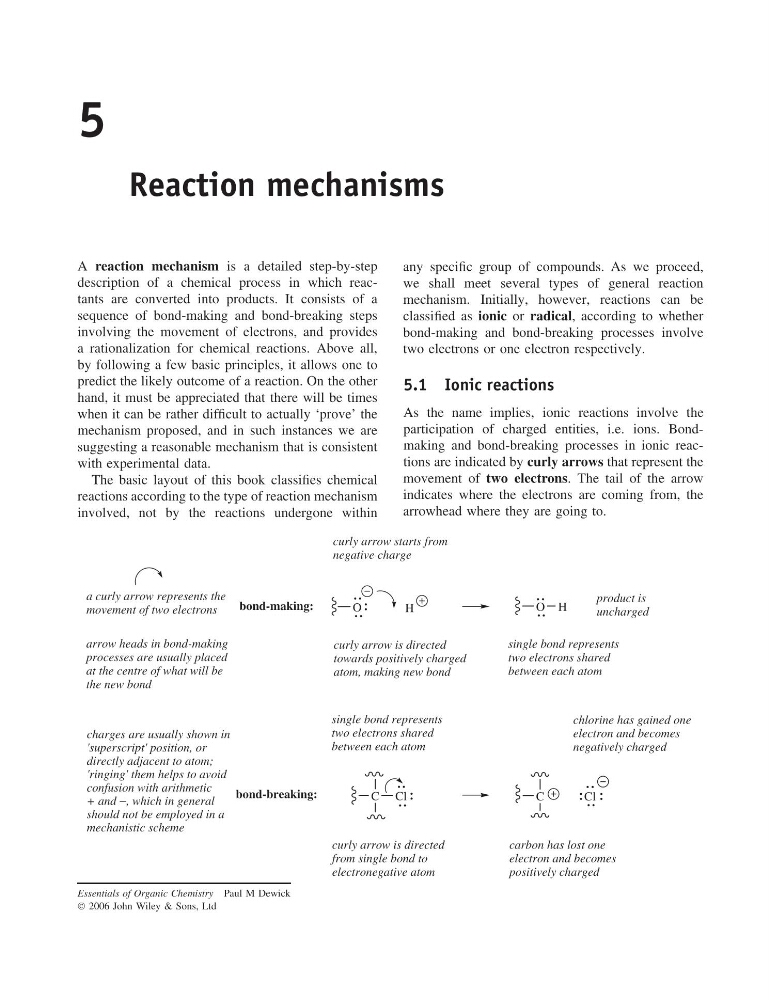
participation of charged entities, i.e. ions. Bondmaking and bond-breaking processes in ionic reactions are indicated by curly arrows that represent the
movement of two electrons. The tail of the arrow
indicates where the electrons are coming from, the
arrowhead where they are going to.
O
O H
C Cl
C
Cl
a curly arrow represents the
movement of two electrons
bond-making:
bond-breaking:
curly arrow starts from
negative charge
curly arrow is directed
towards positively charged
atom, making new bond
product is
uncharged
carbon has lost one
electron and becomes
positively charged
single bond represents
two electrons shared
between each atom
single bond represents
two electrons shared
between each atom
chlorine has gained one
electron and becomes
negatively charged
charges are usually shown in
'superscript' position, or
directly adjacent to atom;
'ringing' them helps to avoid
confusion with arithmetic
+ and −, which in general
should not be employed in a
mechanistic scheme
curly arrow is directed
from single bond to
electronegative atom
arrow heads in bond-making
processes are usually placed
at the centre of what will be
the new bond
H
Essentials of Organic Chemistry Paul M Dewick
2006 John Wiley & Sons, Ltd
Reaction mechanisms
A reaction mechanism is a detailed step-by-step
description of a chemical process in which reactants are converted into products. It consists of a
sequence of bond-making and bond-breaking steps
involving the movement of electrons, and provides
a rationalization for chemical reactions. Above all,
by following a few basic principles, it allows one to
predict the likely outcome of a reaction. On the other
hand, it must be appreciated that there will be times
when it can be rather difficult to actually ‘prove’ the
mechanism proposed, and in such instances we are
suggesting a reasonable mechanism that is consistent
with experimental data.
The basic layout of this book classifies chemical
reactions according to the type of reaction mechanism
involved, not by the reactions undergone within
any specific group of compounds. As we proceed,
we shall meet several types of general reaction
mechanism. Initially, however, reactions can be
classified as ionic or radical, according to whether
bond-making and bond-breaking processes involve
two electrons or one electron respectively.
5.1 Ionic reactions
As the name implies, ionic reactions involve the
participation of charged entities, i.e. ions. Bondmaking and bond-breaking processes in ionic reactions are indicated by curly arrows that represent the
movement of two electrons. The tail of the arrow
indicates where the electrons are coming from, the
arrowhead where they are going to.
O
O H
C Cl
C
Cl
a curly arrow represents the
movement of two electrons
bond-making:
bond-breaking:
curly arrow starts from
negative charge
curly arrow is directed
towards positively charged
atom, making new bond
product is
uncharged
carbon has lost one
electron and becomes
positively charged
single bond represents
two electrons shared
between each atom
single bond represents
two electrons shared
between each atom
chlorine has gained one
electron and becomes
negatively charged
charges are usually shown in
'superscript' position, or
directly adjacent to atom;
'ringing' them helps to avoid
confusion with arithmetic
+ and −, which in general
should not be employed in a
mechanistic scheme
curly arrow is directed
from single bond to
electronegative atom
arrow heads in bond-making
processes are usually placed
at the centre of what will be
the new bond
H
Essentials of Organic Chemistry Paul M Dewick
2006 John Wiley & Sons, Ltd