

RADICAL REACTIONS
171
5.1.2 Nucleophiles, electrophiles, and leaving
groups
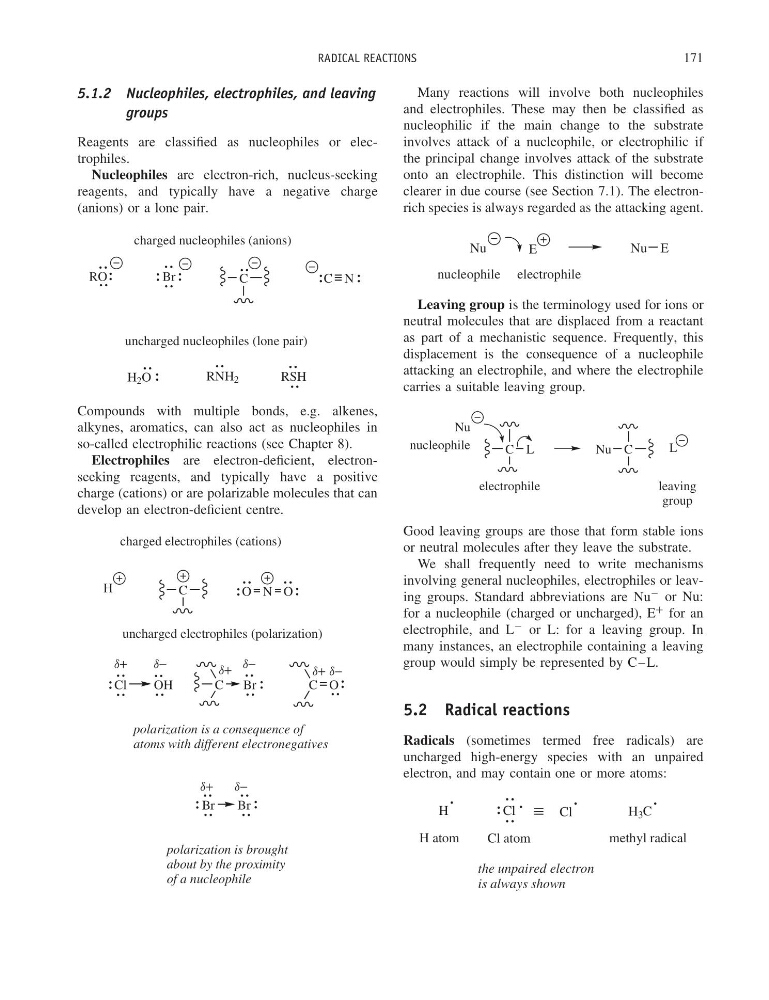
Reagents are classified as nucleophiles or electrophiles.
Nucleophiles are electron-rich, nucleus-seeking
reagents, and typically have a negative charge
(anions) or a lone pair.
C
RO
charged nucleophiles (anions)
uncharged nucleophiles (lone pair)
C N
Br
H 2 O
RNH 2
RSH
Compounds with multiple bonds, e.g. alkenes,
alkynes, aromatics, can also act as nucleophiles in
so-called electrophilic reactions (see Chapter 8).
Electrophiles are electron-deficient, electronseeking reagents, and typically have a positive
charge (cations) or are polarizable molecules that can
develop an electron-deficient centre.
C
Br
Br
Cl
OH
C O
d+
d−
d+
d−
polarization is brought
about by the proximity
of a nucleophile
O N O
d+ d−
polarization is a consequence of
atoms with different electronegatives
charged electrophiles (cations)
uncharged electrophiles (polarization)
C Br
d+ d−
H
Many reactions will involve both nucleophiles
and electrophiles. These may then be classified as
nucleophilic if the main change to the substrate
involves attack of a nucleophile, or electrophilic if
the principal change involves attack of the substrate
onto an electrophile. This distinction will become
clearer in due course (see Section 7.1). The electronrich species is always regarded as the attacking agent.
Nu E
Nu
E
nucleophile electrophile
Leaving group is the terminology used for ions or
neutral molecules that are displaced from a reactant
as part of a mechanistic sequence. Frequently, this
displacement is the consequence of a nucleophile
attacking an electrophile, and where the electrophile
carries a suitable leaving group.
C L
C
Nu
L
Nu
nucleophile
leaving
group
electrophile
Good leaving groups are those that form stable ions
or neutral molecules after they leave the substrate.
We shall frequently need to write mechanisms
involving general nucleophiles, electrophiles or leaving groups. Standard abbreviations are Nu
− or Nu:
for a nucleophile (charged or uncharged), E
+ for an
electrophile, and L
− or L: for a leaving group. In
many instances, an electrophile containing a leaving
group would simply be represented by C–L.
5.2 Radical reactions
Radicals (sometimes termed free radicals) are
uncharged high-energy species with an unpaired
electron, and may contain one or more atoms:
H atom
Cl atom
methyl radical
Cl
≡
the unpaired electron
is always shown
H
Cl
H 3 C
171
5.1.2 Nucleophiles, electrophiles, and leaving
groups
Reagents are classified as nucleophiles or electrophiles.
Nucleophiles are electron-rich, nucleus-seeking
reagents, and typically have a negative charge
(anions) or a lone pair.
C
RO
charged nucleophiles (anions)
uncharged nucleophiles (lone pair)
C N
Br
H 2 O
RNH 2
RSH
Compounds with multiple bonds, e.g. alkenes,
alkynes, aromatics, can also act as nucleophiles in
so-called electrophilic reactions (see Chapter 8).
Electrophiles are electron-deficient, electronseeking reagents, and typically have a positive
charge (cations) or are polarizable molecules that can
develop an electron-deficient centre.
C
Br
Br
Cl
OH
C O
d+
d−
d+
d−
polarization is brought
about by the proximity
of a nucleophile
O N O
d+ d−
polarization is a consequence of
atoms with different electronegatives
charged electrophiles (cations)
uncharged electrophiles (polarization)
C Br
d+ d−
H
Many reactions will involve both nucleophiles
and electrophiles. These may then be classified as
nucleophilic if the main change to the substrate
involves attack of a nucleophile, or electrophilic if
the principal change involves attack of the substrate
onto an electrophile. This distinction will become
clearer in due course (see Section 7.1). The electronrich species is always regarded as the attacking agent.
Nu E
Nu
E
nucleophile electrophile
Leaving group is the terminology used for ions or
neutral molecules that are displaced from a reactant
as part of a mechanistic sequence. Frequently, this
displacement is the consequence of a nucleophile
attacking an electrophile, and where the electrophile
carries a suitable leaving group.
C L
C
Nu
L
Nu
nucleophile
leaving
group
electrophile
Good leaving groups are those that form stable ions
or neutral molecules after they leave the substrate.
We shall frequently need to write mechanisms
involving general nucleophiles, electrophiles or leaving groups. Standard abbreviations are Nu
− or Nu:
for a nucleophile (charged or uncharged), E
+ for an
electrophile, and L
− or L: for a leaving group. In
many instances, an electrophile containing a leaving
group would simply be represented by C–L.
5.2 Radical reactions
Radicals (sometimes termed free radicals) are
uncharged high-energy species with an unpaired
electron, and may contain one or more atoms:
H atom
Cl atom
methyl radical
Cl
≡
the unpaired electron
is always shown
H
Cl
H 3 C