

USING pK a VALUES
163
phenolic group. The acidity of this group can be exploited for the preferential extraction of morphine from an
organic solvent by partitioning with aqueous base.
Thus, if a solution of opium alkaloids in an organic solvent, e.g. dichloromethane, is shaken with aqueous
NaOH, only morphine will ionize at this pH, and it will form the water-soluble phenolate anion. The other
alkaloids will remain non-ionized and stay in the organic layer, allowing their separation from the aqueous
morphine phenolate fraction. By adding acid to the aqueous fraction, the phenolate will become protonated to
give the non-ionized phenol, which may be extracted by shaking with organic solvent. Care is needed during the
acidification, since addition of too much acid would ionize the amine and create another water-soluble ion, the
protonated amine. This would stay in the aqueous phase and not be extracted by an organic solvent.
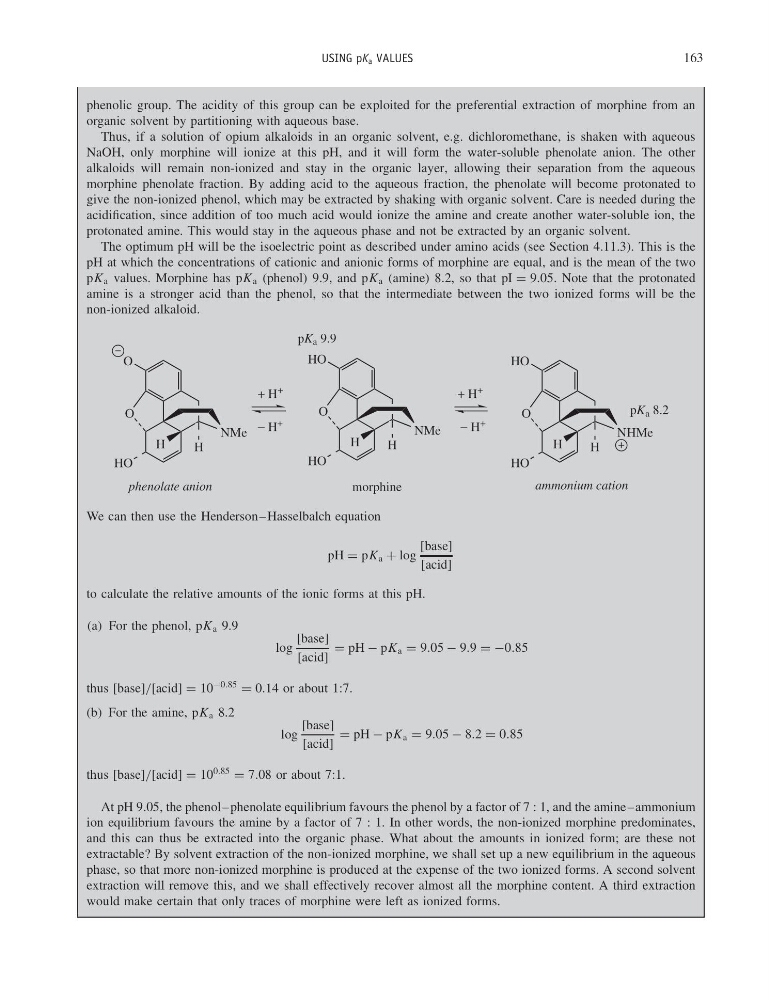
The optimum pH will be the isoelectric point as described under amino acids (see Section 4.11.3). This is the
pH at which the concentrations of cationic and anionic forms of morphine are equal, and is the mean of the two
pK a values. Morphine has pK a (phenol) 9.9, and pK a (amine) 8.2, so that pI = 9.05. Note that the protonated
amine is a stronger acid than the phenol, so that the intermediate between the two ionized forms will be the
non-ionized alkaloid.
morphine
HO
O
HO
H
NMe
H
pK a 9.9
O
O
HO
H
NMe
H
HO
O
HO
H
NHMe
H
+ H
+
+ H
+
− H
+
− H
+
pK a 8.2
phenolate anion
ammonium cation
We can then use the Henderson–Hasselbalch equation
pH = pK a + log
[base]
[acid]
to calculate the relative amounts of the ionic forms at this pH.
(a) For the phenol, pK a 9.9
log
[base]
[acid]
= pH − pK a = 9.05 − 9.9 = −0.85
thus [base]/[acid] = 10
−0.85
= 0.14 or about 1:7.
(b) For the amine, pK a 8.2
log
[base]
[acid]
= pH − pK a = 9.05 − 8.2 = 0.85
thus [base]/[acid] = 10
0.85
= 7.08 or about 7:1.
At pH 9.05, the phenol–phenolate equilibrium favours the phenol by a factor of 7 : 1, and the amine–ammonium
ion equilibrium favours the amine by a factor of 7 : 1. In other words, the non-ionized morphine predominates,
and this can thus be extracted into the organic phase. What about the amounts in ionized form; are these not
extractable? By solvent extraction of the non-ionized morphine, we shall set up a new equilibrium in the aqueous
phase, so that more non-ionized morphine is produced at the expense of the two ionized forms. A second solvent
extraction will remove this, and we shall effectively recover almost all the morphine content. A third extraction
would make certain that only traces of morphine were left as ionized forms.
163
phenolic group. The acidity of this group can be exploited for the preferential extraction of morphine from an
organic solvent by partitioning with aqueous base.
Thus, if a solution of opium alkaloids in an organic solvent, e.g. dichloromethane, is shaken with aqueous
NaOH, only morphine will ionize at this pH, and it will form the water-soluble phenolate anion. The other
alkaloids will remain non-ionized and stay in the organic layer, allowing their separation from the aqueous
morphine phenolate fraction. By adding acid to the aqueous fraction, the phenolate will become protonated to
give the non-ionized phenol, which may be extracted by shaking with organic solvent. Care is needed during the
acidification, since addition of too much acid would ionize the amine and create another water-soluble ion, the
protonated amine. This would stay in the aqueous phase and not be extracted by an organic solvent.
The optimum pH will be the isoelectric point as described under amino acids (see Section 4.11.3). This is the
pH at which the concentrations of cationic and anionic forms of morphine are equal, and is the mean of the two
pK a values. Morphine has pK a (phenol) 9.9, and pK a (amine) 8.2, so that pI = 9.05. Note that the protonated
amine is a stronger acid than the phenol, so that the intermediate between the two ionized forms will be the
non-ionized alkaloid.
morphine
HO
O
HO
H
NMe
H
pK a 9.9
O
O
HO
H
NMe
H
HO
O
HO
H
NHMe
H
+ H
+
+ H
+
− H
+
− H
+
pK a 8.2
phenolate anion
ammonium cation
We can then use the Henderson–Hasselbalch equation
pH = pK a + log
[base]
[acid]
to calculate the relative amounts of the ionic forms at this pH.
(a) For the phenol, pK a 9.9
log
[base]
[acid]
= pH − pK a = 9.05 − 9.9 = −0.85
thus [base]/[acid] = 10
−0.85
= 0.14 or about 1:7.
(b) For the amine, pK a 8.2
log
[base]
[acid]
= pH − pK a = 9.05 − 8.2 = 0.85
thus [base]/[acid] = 10
0.85
= 7.08 or about 7:1.
At pH 9.05, the phenol–phenolate equilibrium favours the phenol by a factor of 7 : 1, and the amine–ammonium
ion equilibrium favours the amine by a factor of 7 : 1. In other words, the non-ionized morphine predominates,
and this can thus be extracted into the organic phase. What about the amounts in ionized form; are these not
extractable? By solvent extraction of the non-ionized morphine, we shall set up a new equilibrium in the aqueous
phase, so that more non-ionized morphine is produced at the expense of the two ionized forms. A second solvent
extraction will remove this, and we shall effectively recover almost all the morphine content. A third extraction
would make certain that only traces of morphine were left as ionized forms.