

162
ACIDS AND BASES
be present as a cation, with the amino group
protonated. As the pH is raised, a proton will be
lost from the most acidic group, namely the 1carboxyl (pK a 2.19), followed by the γ-carboxyl
(pK a 4.25). Lastly, the proton from the α-ammonium
cation (pK a 9.67) will be removed. Yet again,
there is no intermediate with uncharged functional
groups.
The isoelectric point for glutamic acid is that pH
at which the compound is in an electrically neutral
form, and this will be the average of pK a1 (the
cation) and pK a2 (the dipolar ion). For glutamic acid,
pK a1 = 2.19 and pK a2 = 4.25, so pI = 3.22.
Isoelectric points are useful concepts for the
separation and purification of amino acids and
proteins using electrophoresis. Under the influence
of an electric field, compounds migrate according to
their overall charge. As we have just seen for amino
acids, this very much depends upon the pH of the
solution. At the isoelectric point, there will be no net
charge, and, therefore, no migration towards either
anode or cathode.
Box 4.10
Ionization of morphine: extraction from opium
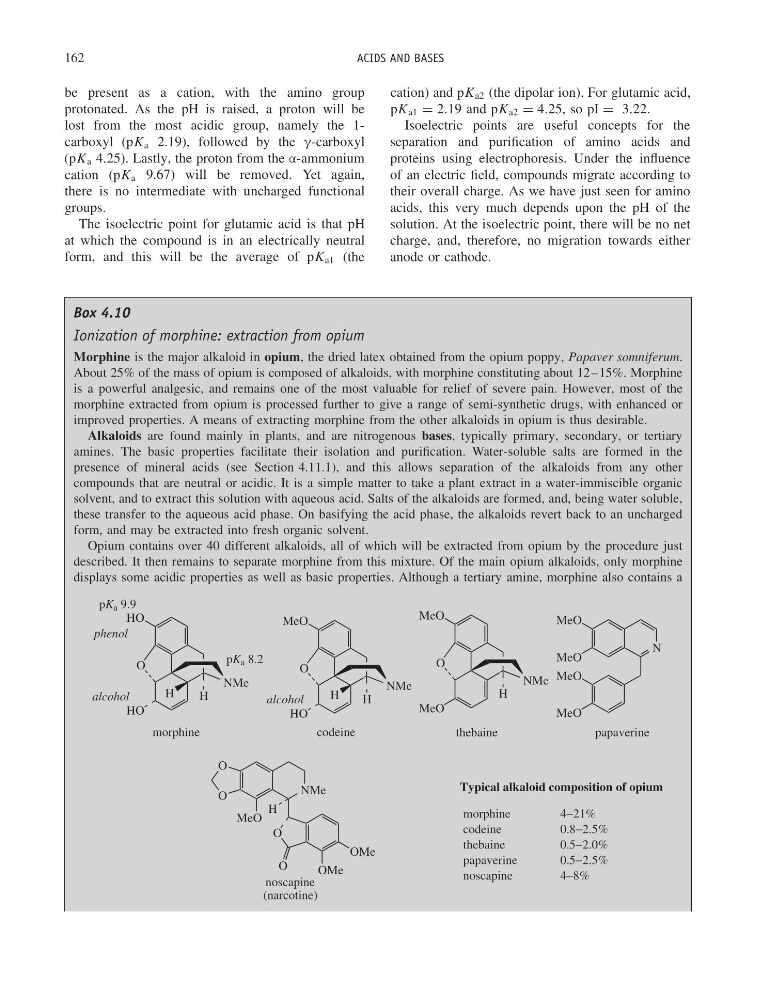
Morphine is the major alkaloid in opium, the dried latex obtained from the opium poppy, Papaver somniferum.
About 25% of the mass of opium is composed of alkaloids, with morphine constituting about 12–15%. Morphine
is a powerful analgesic, and remains one of the most valuable for relief of severe pain. However, most of the
morphine extracted from opium is processed further to give a range of semi-synthetic drugs, with enhanced or
improved properties. A means of extracting morphine from the other alkaloids in opium is thus desirable.
Alkaloids are found mainly in plants, and are nitrogenous bases, typically primary, secondary, or tertiary
amines. The basic properties facilitate their isolation and purification. Water-soluble salts are formed in the
presence of mineral acids (see Section 4.11.1), and this allows separation of the alkaloids from any other
compounds that are neutral or acidic. It is a simple matter to take a plant extract in a water-immiscible organic
solvent, and to extract this solution with aqueous acid. Salts of the alkaloids are formed, and, being water soluble,
these transfer to the aqueous acid phase. On basifying the acid phase, the alkaloids revert back to an uncharged
form, and may be extracted into fresh organic solvent.
Opium contains over 40 different alkaloids, all of which will be extracted from opium by the procedure just
described. It then remains to separate morphine from this mixture. Of the main opium alkaloids, only morphine
displays some acidic properties as well as basic properties. Although a tertiary amine, morphine also contains a
morphine
MeO
O
HO
H
NMe
HO
O
HO
H
NMe
H
H
codeine
MeO
O
MeO
H
NMe
thebaine
NMe
O
O
H
O
O
OMe
OMe
MeO
noscapine
(narcotine)
MeO
N
MeO
MeO
MeO
papaverine
4−21%
0.8−2.5%
0.5−2.0%
0.5−2.5%
4−8%
morphine
codeine
thebaine
papaverine
noscapine
pK a 8.2
phenol
alcohol
alcohol
pK a 9.9
Typical alkaloid composition of opium
ACIDS AND BASES
be present as a cation, with the amino group
protonated. As the pH is raised, a proton will be
lost from the most acidic group, namely the 1carboxyl (pK a 2.19), followed by the γ-carboxyl
(pK a 4.25). Lastly, the proton from the α-ammonium
cation (pK a 9.67) will be removed. Yet again,
there is no intermediate with uncharged functional
groups.
The isoelectric point for glutamic acid is that pH
at which the compound is in an electrically neutral
form, and this will be the average of pK a1 (the
cation) and pK a2 (the dipolar ion). For glutamic acid,
pK a1 = 2.19 and pK a2 = 4.25, so pI = 3.22.
Isoelectric points are useful concepts for the
separation and purification of amino acids and
proteins using electrophoresis. Under the influence
of an electric field, compounds migrate according to
their overall charge. As we have just seen for amino
acids, this very much depends upon the pH of the
solution. At the isoelectric point, there will be no net
charge, and, therefore, no migration towards either
anode or cathode.
Box 4.10
Ionization of morphine: extraction from opium
Morphine is the major alkaloid in opium, the dried latex obtained from the opium poppy, Papaver somniferum.
About 25% of the mass of opium is composed of alkaloids, with morphine constituting about 12–15%. Morphine
is a powerful analgesic, and remains one of the most valuable for relief of severe pain. However, most of the
morphine extracted from opium is processed further to give a range of semi-synthetic drugs, with enhanced or
improved properties. A means of extracting morphine from the other alkaloids in opium is thus desirable.
Alkaloids are found mainly in plants, and are nitrogenous bases, typically primary, secondary, or tertiary
amines. The basic properties facilitate their isolation and purification. Water-soluble salts are formed in the
presence of mineral acids (see Section 4.11.1), and this allows separation of the alkaloids from any other
compounds that are neutral or acidic. It is a simple matter to take a plant extract in a water-immiscible organic
solvent, and to extract this solution with aqueous acid. Salts of the alkaloids are formed, and, being water soluble,
these transfer to the aqueous acid phase. On basifying the acid phase, the alkaloids revert back to an uncharged
form, and may be extracted into fresh organic solvent.
Opium contains over 40 different alkaloids, all of which will be extracted from opium by the procedure just
described. It then remains to separate morphine from this mixture. Of the main opium alkaloids, only morphine
displays some acidic properties as well as basic properties. Although a tertiary amine, morphine also contains a
morphine
MeO
O
HO
H
NMe
HO
O
HO
H
NMe
H
H
codeine
MeO
O
MeO
H
NMe
thebaine
NMe
O
O
H
O
O
OMe
OMe
MeO
noscapine
(narcotine)
MeO
N
MeO
MeO
MeO
papaverine
4−21%
0.8−2.5%
0.5−2.0%
0.5−2.5%
4−8%
morphine
codeine
thebaine
papaverine
noscapine
pK a 8.2
phenol
alcohol
alcohol
pK a 9.9
Typical alkaloid composition of opium