

USING pK a VALUES
161
and by taking negative logarithms, it follows that
pH =
pK a1 + pK a2
2
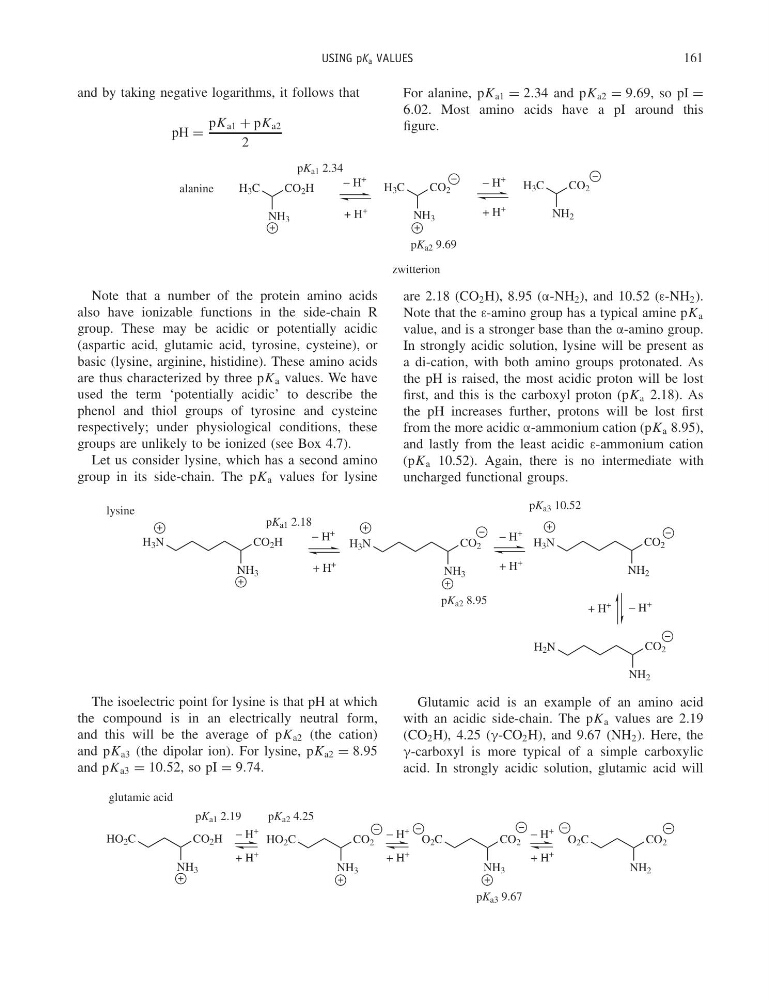
For alanine, pK a1 = 2.34 and pK a2 = 9.69, so pI =
6.02. Most amino acids have a pI around this
figure.
NH 3
H 3 C
NH 3
H 3 C
NH 2
H 3 C
pK a1 2.34
pK a2 9.69
− H
+
− H
+
+ H +
+ H +
zwitterion
alanine
CO 2 H
CO 2
CO 2
Note that a number of the protein amino acids
also have ionizable functions in the side-chain R
group. These may be acidic or potentially acidic
(aspartic acid, glutamic acid, tyrosine, cysteine), or
basic (lysine, arginine, histidine). These amino acids
are thus characterized by three pK a values. We have
used the term ‘potentially acidic’ to describe the
phenol and thiol groups of tyrosine and cysteine
respectively; under physiological conditions, these
groups are unlikely to be ionized (see Box 4.7).
Let us consider lysine, which has a second amino
group in its side-chain. The pK a values for lysine
are 2.18 (CO 2 H), 8.95 (α-NH 2 ), and 10.52 (ε-NH 2 ).
Note that the ε-amino group has a typical amine pK a
value, and is a stronger base than the α-amino group.
In strongly acidic solution, lysine will be present as
a di-cation, with both amino groups protonated. As
the pH is raised, the most acidic proton will be lost
first, and this is the carboxyl proton (pK a 2.18). As
the pH increases further, protons will be lost first
from the more acidic α-ammonium cation (pK a 8.95),
and lastly from the least acidic ε-ammonium cation
(pK a 10.52). Again, there is no intermediate with
uncharged functional groups.
lysine
NH 3
NH 3
pK a1 2.18
pK a2 8.95
− H +
− H +
+ H +
+ H +
H 3 N
H 3 N
NH 2
H 3 N
NH 2
H 2 N
− H +
+ H +
pK a3 10.52
CO 2 H
CO 2
CO 2
CO 2
The isoelectric point for lysine is that pH at which
the compound is in an electrically neutral form,
and this will be the average of pK a2 (the cation)
and pK a3 (the dipolar ion). For lysine, pK a2 = 8.95
and pK a3 = 10.52, so pI = 9.74.
Glutamic acid is an example of an amino acid
with an acidic side-chain. The pK a values are 2.19
(CO 2 H), 4.25 (γ-CO 2 H), and 9.67 (NH 2 ). Here, the
γ-carboxyl is more typical of a simple carboxylic
acid. In strongly acidic solution, glutamic acid will
glutamic acid
NH 3
NH 3
pK a1 2.19
pK a3 9.67
− H
+
+ H +
HO 2 C
HO 2 C
NH 3
O 2 C
pK a2 4.25
CO 2 H
CO 2
CO 2
− H +
+ H +
− H +
+ H +
NH 2
O 2 C
CO 2
161
and by taking negative logarithms, it follows that
pH =
pK a1 + pK a2
2
For alanine, pK a1 = 2.34 and pK a2 = 9.69, so pI =
6.02. Most amino acids have a pI around this
figure.
NH 3
H 3 C
NH 3
H 3 C
NH 2
H 3 C
pK a1 2.34
pK a2 9.69
− H
+
− H
+
+ H +
+ H +
zwitterion
alanine
CO 2 H
CO 2
CO 2
Note that a number of the protein amino acids
also have ionizable functions in the side-chain R
group. These may be acidic or potentially acidic
(aspartic acid, glutamic acid, tyrosine, cysteine), or
basic (lysine, arginine, histidine). These amino acids
are thus characterized by three pK a values. We have
used the term ‘potentially acidic’ to describe the
phenol and thiol groups of tyrosine and cysteine
respectively; under physiological conditions, these
groups are unlikely to be ionized (see Box 4.7).
Let us consider lysine, which has a second amino
group in its side-chain. The pK a values for lysine
are 2.18 (CO 2 H), 8.95 (α-NH 2 ), and 10.52 (ε-NH 2 ).
Note that the ε-amino group has a typical amine pK a
value, and is a stronger base than the α-amino group.
In strongly acidic solution, lysine will be present as
a di-cation, with both amino groups protonated. As
the pH is raised, the most acidic proton will be lost
first, and this is the carboxyl proton (pK a 2.18). As
the pH increases further, protons will be lost first
from the more acidic α-ammonium cation (pK a 8.95),
and lastly from the least acidic ε-ammonium cation
(pK a 10.52). Again, there is no intermediate with
uncharged functional groups.
lysine
NH 3
NH 3
pK a1 2.18
pK a2 8.95
− H +
− H +
+ H +
+ H +
H 3 N
H 3 N
NH 2
H 3 N
NH 2
H 2 N
− H +
+ H +
pK a3 10.52
CO 2 H
CO 2
CO 2
CO 2
The isoelectric point for lysine is that pH at which
the compound is in an electrically neutral form,
and this will be the average of pK a2 (the cation)
and pK a3 (the dipolar ion). For lysine, pK a2 = 8.95
and pK a3 = 10.52, so pI = 9.74.
Glutamic acid is an example of an amino acid
with an acidic side-chain. The pK a values are 2.19
(CO 2 H), 4.25 (γ-CO 2 H), and 9.67 (NH 2 ). Here, the
γ-carboxyl is more typical of a simple carboxylic
acid. In strongly acidic solution, glutamic acid will
glutamic acid
NH 3
NH 3
pK a1 2.19
pK a3 9.67
− H
+
+ H +
HO 2 C
HO 2 C
NH 3
O 2 C
pK a2 4.25
CO 2 H
CO 2
CO 2
− H +
+ H +
− H +
+ H +
NH 2
O 2 C
CO 2