

160
ACIDS AND BASES
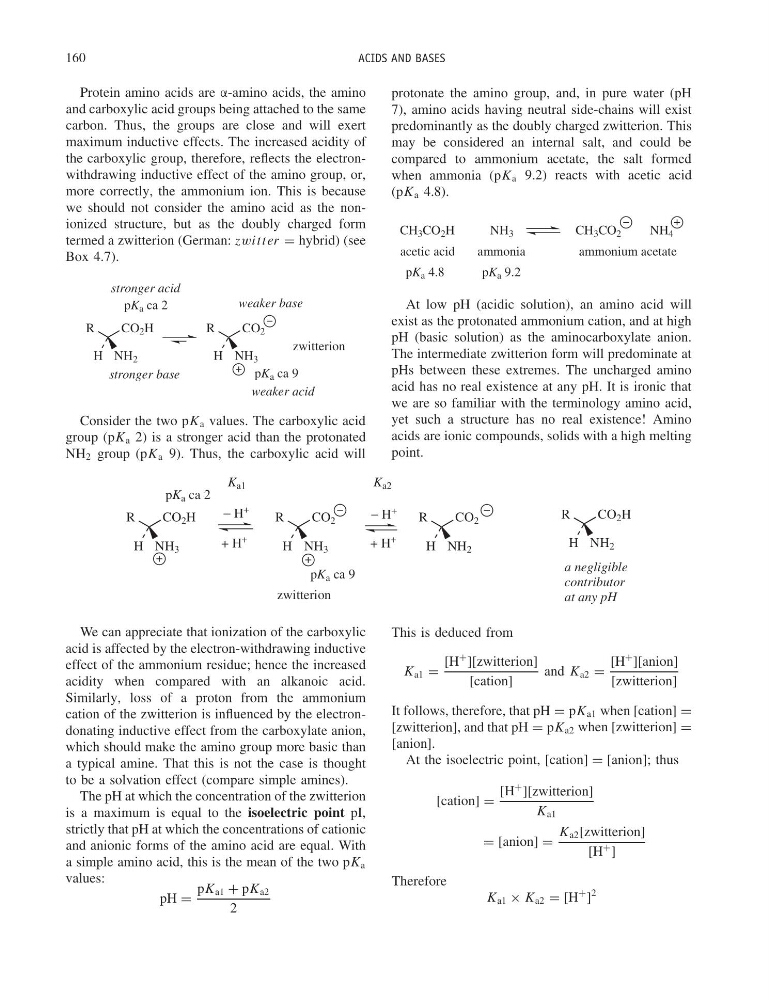
Protein amino acids are α-amino acids, the amino
and carboxylic acid groups being attached to the same
carbon. Thus, the groups are close and will exert
maximum inductive effects. The increased acidity of
the carboxylic group, therefore, reflects the electronwithdrawing inductive effect of the amino group, or,
more correctly, the ammonium ion. This is because
we should not consider the amino acid as the nonionized structure, but as the doubly charged form
termed a zwitterion (German: zwitter = hybrid) (see
Box 4.7).
R
CO 2 H
H NH 2
stronger acid
weaker acid
stronger base
weaker base
R
CO 2
H NH 3
zwitterion
pK a ca 9
pK a ca 2
Consider the two pK a values. The carboxylic acid
group (pK a 2) is a stronger acid than the protonated
NH 2 group (pK a 9). Thus, the carboxylic acid will
protonate the amino group, and, in pure water (pH
7), amino acids having neutral side-chains will exist
predominantly as the doubly charged zwitterion. This
may be considered an internal salt, and could be
compared to ammonium acetate, the salt formed
when ammonia (pK a 9.2) reacts with acetic acid
(pK a 4.8).
NH 3
CH 3 CO 2 H
C H 3 CO 2
NH 4
acetic acid
ammonia
ammonium acetate
pK a 4.8
pK a 9.2
At low pH (acidic solution), an amino acid will
exist as the protonated ammonium cation, and at high
pH (basic solution) as the aminocarboxylate anion.
The intermediate zwitterion form will predominate at
pHs between these extremes. The uncharged amino
acid has no real existence at any pH. It is ironic that
we are so familiar with the terminology amino acid,
yet such a structure has no real existence! Amino
acids are ionic compounds, solids with a high melting
point.
R
CO 2 H
H NH 3
R
CO 2
H NH 2
R
CO 2
H NH 3
− H +
+ H
+
pK a ca 9
pK a ca 2
zwitterion
a negligible
contributor
at any pH
R
CO 2 H
H NH 2
− H +
+ H
+
K a1
K a2
We can appreciate that ionization of the carboxylic
acid is affected by the electron-withdrawing inductive
effect of the ammonium residue; hence the increased
acidity when compared with an alkanoic acid.
Similarly, loss of a proton from the ammonium
cation of the zwitterion is influenced by the electrondonating inductive effect from the carboxylate anion,
which should make the amino group more basic than
a typical amine. That this is not the case is thought
to be a solvation effect (compare simple amines).
The pH at which the concentration of the zwitterion
is a maximum is equal to the isoelectric point pI,
strictly that pH at which the concentrations of cationic
and anionic forms of the amino acid are equal. With
a simple amino acid, this is the mean of the two pK a
values:
pH =
pK a1 + pK a2
2
This is deduced from
K a1 =
[H
+ ][zwitterion]
[cation]
and K a2 =
[H
+ ][anion]
[zwitterion]
It follows, therefore, that pH = pK a1 when [cation] =
[zwitterion], and that pH = pK a2 when [zwitterion] =
[anion].
At the isoelectric point, [cation] = [anion]; thus
[cation] =
[H
+ ][zwitterion]
K a1
= [anion] =
K a2 [zwitterion]
[H
+ ]
Therefore
K a1 × K a2 = [H
+ ]
2
ACIDS AND BASES
Protein amino acids are α-amino acids, the amino
and carboxylic acid groups being attached to the same
carbon. Thus, the groups are close and will exert
maximum inductive effects. The increased acidity of
the carboxylic group, therefore, reflects the electronwithdrawing inductive effect of the amino group, or,
more correctly, the ammonium ion. This is because
we should not consider the amino acid as the nonionized structure, but as the doubly charged form
termed a zwitterion (German: zwitter = hybrid) (see
Box 4.7).
R
CO 2 H
H NH 2
stronger acid
weaker acid
stronger base
weaker base
R
CO 2
H NH 3
zwitterion
pK a ca 9
pK a ca 2
Consider the two pK a values. The carboxylic acid
group (pK a 2) is a stronger acid than the protonated
NH 2 group (pK a 9). Thus, the carboxylic acid will
protonate the amino group, and, in pure water (pH
7), amino acids having neutral side-chains will exist
predominantly as the doubly charged zwitterion. This
may be considered an internal salt, and could be
compared to ammonium acetate, the salt formed
when ammonia (pK a 9.2) reacts with acetic acid
(pK a 4.8).
NH 3
CH 3 CO 2 H
C H 3 CO 2
NH 4
acetic acid
ammonia
ammonium acetate
pK a 4.8
pK a 9.2
At low pH (acidic solution), an amino acid will
exist as the protonated ammonium cation, and at high
pH (basic solution) as the aminocarboxylate anion.
The intermediate zwitterion form will predominate at
pHs between these extremes. The uncharged amino
acid has no real existence at any pH. It is ironic that
we are so familiar with the terminology amino acid,
yet such a structure has no real existence! Amino
acids are ionic compounds, solids with a high melting
point.
R
CO 2 H
H NH 3
R
CO 2
H NH 2
R
CO 2
H NH 3
− H +
+ H
+
pK a ca 9
pK a ca 2
zwitterion
a negligible
contributor
at any pH
R
CO 2 H
H NH 2
− H +
+ H
+
K a1
K a2
We can appreciate that ionization of the carboxylic
acid is affected by the electron-withdrawing inductive
effect of the ammonium residue; hence the increased
acidity when compared with an alkanoic acid.
Similarly, loss of a proton from the ammonium
cation of the zwitterion is influenced by the electrondonating inductive effect from the carboxylate anion,
which should make the amino group more basic than
a typical amine. That this is not the case is thought
to be a solvation effect (compare simple amines).
The pH at which the concentration of the zwitterion
is a maximum is equal to the isoelectric point pI,
strictly that pH at which the concentrations of cationic
and anionic forms of the amino acid are equal. With
a simple amino acid, this is the mean of the two pK a
values:
pH =
pK a1 + pK a2
2
This is deduced from
K a1 =
[H
+ ][zwitterion]
[cation]
and K a2 =
[H
+ ][anion]
[zwitterion]
It follows, therefore, that pH = pK a1 when [cation] =
[zwitterion], and that pH = pK a2 when [zwitterion] =
[anion].
At the isoelectric point, [cation] = [anion]; thus
[cation] =
[H
+ ][zwitterion]
K a1
= [anion] =
K a2 [zwitterion]
[H
+ ]
Therefore
K a1 × K a2 = [H
+ ]
2