

USING pK a VALUES
159
O
H
H
H
D OD
O
H
H
D
H
repeat
O
H
D
D
D
OD
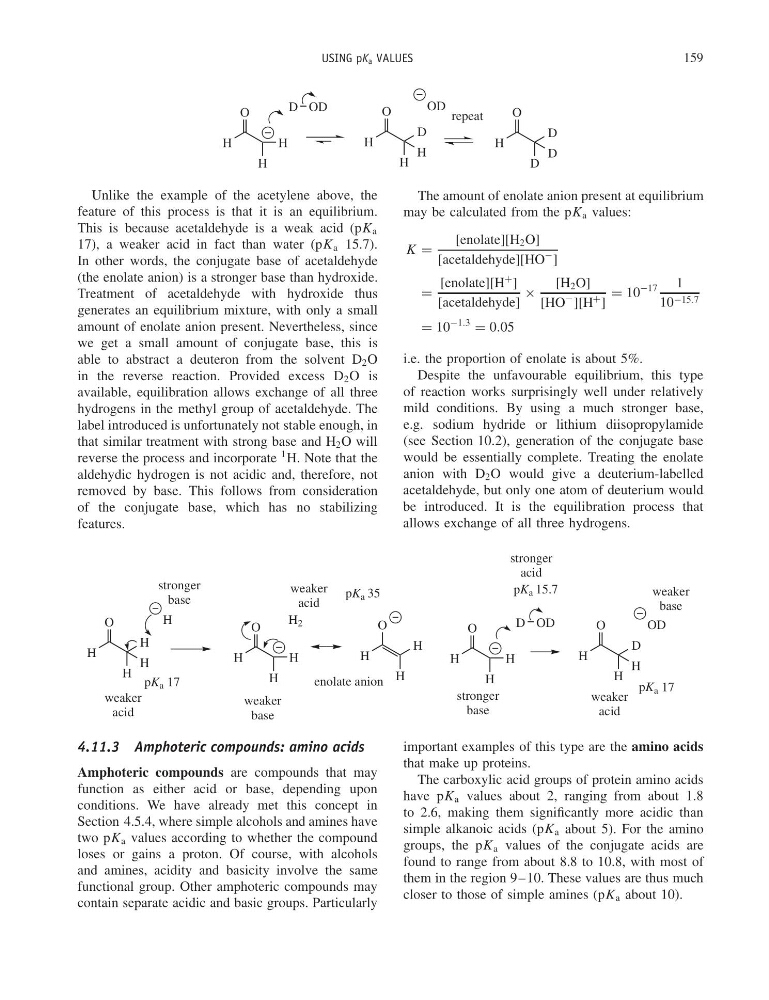
Unlike the example of the acetylene above, the
feature of this process is that it is an equilibrium.
This is because acetaldehyde is a weak acid (pK a
17), a weaker acid in fact than water (pK a 15.7).
In other words, the conjugate base of acetaldehyde
(the enolate anion) is a stronger base than hydroxide.
Treatment of acetaldehyde with hydroxide thus
generates an equilibrium mixture, with only a small
amount of enolate anion present. Nevertheless, since
we get a small amount of conjugate base, this is
able to abstract a deuteron from the solvent D 2 O
in the reverse reaction. Provided excess D 2 O is
available, equilibration allows exchange of all three
hydrogens in the methyl group of acetaldehyde. The
label introduced is unfortunately not stable enough, in
that similar treatment with strong base and H 2 O will
reverse the process and incorporate
1 H. Note that the
aldehydic hydrogen is not acidic and, therefore, not
removed by base. This follows from consideration
of the conjugate base, which has no stabilizing
features.
The amount of enolate anion present at equilibrium
may be calculated from the pK a values:
K =
[enolate][H 2 O]
[acetaldehyde][HO
− ]
=
[enolate][H
+ ]
[acetaldehyde]
×
[H 2 O]
[HO
− ][H
+ ]
= 10
−17
1
10 −15.7
= 10
−1.3
= 0.05
i.e. the proportion of enolate is about 5%.
Despite the unfavourable equilibrium, this type
of reaction works surprisingly well under relatively
mild conditions. By using a much stronger base,
e.g. sodium hydride or lithium diisopropylamide
(see Section 10.2), generation of the conjugate base
would be essentially complete. Treating the enolate
anion with D 2 O would give a deuterium-labelled
acetaldehyde, but only one atom of deuterium would
be introduced. It is the equilibration process that
allows exchange of all three hydrogens.
O
H
H
H
H
O
H
H
O
H
H
H
enolate anion
H
H
weaker
acid
stronger
base
weaker
base
H 2
weaker
acid
pK a 35
pK a 17
O
H
H
H
D OD
O
H
H
D
H
pK a 15.7
OD
stronger
base
weaker
base
weaker
acid
stronger
acid
pK a 17
4.11.3 Amphoteric compounds: amino acids
Amphoteric compounds are compounds that may
function as either acid or base, depending upon
conditions. We have already met this concept in
Section 4.5.4, where simple alcohols and amines have
two pK a values according to whether the compound
loses or gains a proton. Of course, with alcohols
and amines, acidity and basicity involve the same
functional group. Other amphoteric compounds may
contain separate acidic and basic groups. Particularly
important examples of this type are the amino acids
that make up proteins.
The carboxylic acid groups of protein amino acids
have pK a values about 2, ranging from about 1.8
to 2.6, making them significantly more acidic than
simple alkanoic acids (pK a about 5). For the amino
groups, the pK a values of the conjugate acids are
found to range from about 8.8 to 10.8, with most of
them in the region 9–10. These values are thus much
closer to those of simple amines (pK a about 10).
159
O
H
H
H
D OD
O
H
H
D
H
repeat
O
H
D
D
D
OD
Unlike the example of the acetylene above, the
feature of this process is that it is an equilibrium.
This is because acetaldehyde is a weak acid (pK a
17), a weaker acid in fact than water (pK a 15.7).
In other words, the conjugate base of acetaldehyde
(the enolate anion) is a stronger base than hydroxide.
Treatment of acetaldehyde with hydroxide thus
generates an equilibrium mixture, with only a small
amount of enolate anion present. Nevertheless, since
we get a small amount of conjugate base, this is
able to abstract a deuteron from the solvent D 2 O
in the reverse reaction. Provided excess D 2 O is
available, equilibration allows exchange of all three
hydrogens in the methyl group of acetaldehyde. The
label introduced is unfortunately not stable enough, in
that similar treatment with strong base and H 2 O will
reverse the process and incorporate
1 H. Note that the
aldehydic hydrogen is not acidic and, therefore, not
removed by base. This follows from consideration
of the conjugate base, which has no stabilizing
features.
The amount of enolate anion present at equilibrium
may be calculated from the pK a values:
K =
[enolate][H 2 O]
[acetaldehyde][HO
− ]
=
[enolate][H
+ ]
[acetaldehyde]
×
[H 2 O]
[HO
− ][H
+ ]
= 10
−17
1
10 −15.7
= 10
−1.3
= 0.05
i.e. the proportion of enolate is about 5%.
Despite the unfavourable equilibrium, this type
of reaction works surprisingly well under relatively
mild conditions. By using a much stronger base,
e.g. sodium hydride or lithium diisopropylamide
(see Section 10.2), generation of the conjugate base
would be essentially complete. Treating the enolate
anion with D 2 O would give a deuterium-labelled
acetaldehyde, but only one atom of deuterium would
be introduced. It is the equilibration process that
allows exchange of all three hydrogens.
O
H
H
H
H
O
H
H
O
H
H
H
enolate anion
H
H
weaker
acid
stronger
base
weaker
base
H 2
weaker
acid
pK a 35
pK a 17
O
H
H
H
D OD
O
H
H
D
H
pK a 15.7
OD
stronger
base
weaker
base
weaker
acid
stronger
acid
pK a 17
4.11.3 Amphoteric compounds: amino acids
Amphoteric compounds are compounds that may
function as either acid or base, depending upon
conditions. We have already met this concept in
Section 4.5.4, where simple alcohols and amines have
two pK a values according to whether the compound
loses or gains a proton. Of course, with alcohols
and amines, acidity and basicity involve the same
functional group. Other amphoteric compounds may
contain separate acidic and basic groups. Particularly
important examples of this type are the amino acids
that make up proteins.
The carboxylic acid groups of protein amino acids
have pK a values about 2, ranging from about 1.8
to 2.6, making them significantly more acidic than
simple alkanoic acids (pK a about 5). For the amino
groups, the pK a values of the conjugate acids are
found to range from about 8.8 to 10.8, with most of
them in the region 9–10. These values are thus much
closer to those of simple amines (pK a about 10).