

158
ACIDS AND BASES
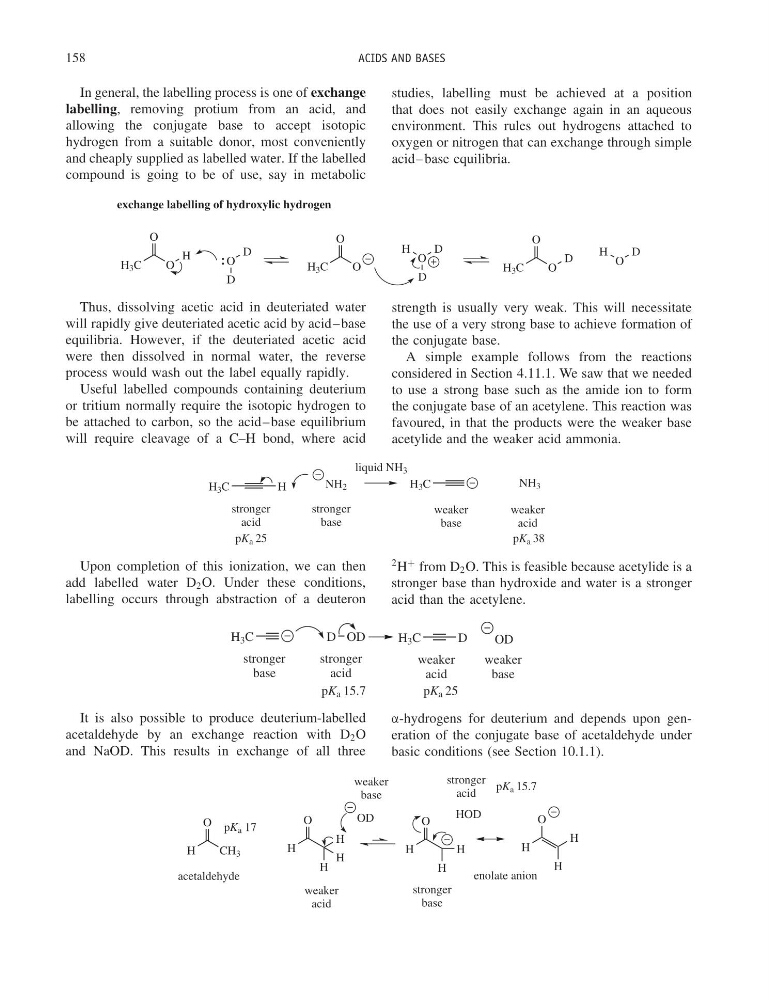
In general, the labelling process is one of exchange
labelling, removing protium from an acid, and
allowing the conjugate base to accept isotopic
hydrogen from a suitable donor, most conveniently
and cheaply supplied as labelled water. If the labelled
compound is going to be of use, say in metabolic
studies, labelling must be achieved at a position
that does not easily exchange again in an aqueous
environment. This rules out hydrogens attached to
oxygen or nitrogen that can exchange through simple
acid–base equilibria.
O
H 3 C
O
H
D
O
D
O
H 3 C
O
D
O
D
H
O
H 3 C
O
D
D
O
H
exchange labelling of hydroxylic hydrogen
Thus, dissolving acetic acid in deuteriated water
will rapidly give deuteriated acetic acid by acid–base
equilibria. However, if the deuteriated acetic acid
were then dissolved in normal water, the reverse
process would wash out the label equally rapidly.
Useful labelled compounds containing deuterium
or tritium normally require the isotopic hydrogen to
be attached to carbon, so the acid–base equilibrium
will require cleavage of a C–H bond, where acid
strength is usually very weak. This will necessitate
the use of a very strong base to achieve formation of
the conjugate base.
A simple example follows from the reactions
considered in Section 4.11.1. We saw that we needed
to use a strong base such as the amide ion to form
the conjugate base of an acetylene. This reaction was
favoured, in that the products were the weaker base
acetylide and the weaker acid ammonia.
H 3 C
H
NH 2
pK a 25
NH 3
pK a 38
stronger
acid
stronger
base
weaker
base
weaker
acid
H 3 C
liquid NH 3
Upon completion of this ionization, we can then
add labelled water D 2 O. Under these conditions,
labelling occurs through abstraction of a deuteron
2 H
+ from D 2 O. This is feasible because acetylide is a
stronger base than hydroxide and water is a stronger
acid than the acetylene.
H 3 C
D OD
H 3 C
D
OD
stronger
base
stronger
acid
weaker
base
weaker
acid
pK a 15.7
pK a 25
It is also possible to produce deuterium-labelled
acetaldehyde by an exchange reaction with D 2 O
and NaOD. This results in exchange of all three
α-hydrogens for deuterium and depends upon generation of the conjugate base of acetaldehyde under
basic conditions (see Section 10.1.1).
O
H
CH 3
O
H
H
H
H
O
H
H
O
H
H
H
enolate anion
H
acetaldehyde
pK a 17
OD
weaker
acid
weaker
base
stronger
base
HOD
stronger
acid
pK a 15.7
ACIDS AND BASES
In general, the labelling process is one of exchange
labelling, removing protium from an acid, and
allowing the conjugate base to accept isotopic
hydrogen from a suitable donor, most conveniently
and cheaply supplied as labelled water. If the labelled
compound is going to be of use, say in metabolic
studies, labelling must be achieved at a position
that does not easily exchange again in an aqueous
environment. This rules out hydrogens attached to
oxygen or nitrogen that can exchange through simple
acid–base equilibria.
O
H 3 C
O
H
D
O
D
O
H 3 C
O
D
O
D
H
O
H 3 C
O
D
D
O
H
exchange labelling of hydroxylic hydrogen
Thus, dissolving acetic acid in deuteriated water
will rapidly give deuteriated acetic acid by acid–base
equilibria. However, if the deuteriated acetic acid
were then dissolved in normal water, the reverse
process would wash out the label equally rapidly.
Useful labelled compounds containing deuterium
or tritium normally require the isotopic hydrogen to
be attached to carbon, so the acid–base equilibrium
will require cleavage of a C–H bond, where acid
strength is usually very weak. This will necessitate
the use of a very strong base to achieve formation of
the conjugate base.
A simple example follows from the reactions
considered in Section 4.11.1. We saw that we needed
to use a strong base such as the amide ion to form
the conjugate base of an acetylene. This reaction was
favoured, in that the products were the weaker base
acetylide and the weaker acid ammonia.
H 3 C
H
NH 2
pK a 25
NH 3
pK a 38
stronger
acid
stronger
base
weaker
base
weaker
acid
H 3 C
liquid NH 3
Upon completion of this ionization, we can then
add labelled water D 2 O. Under these conditions,
labelling occurs through abstraction of a deuteron
2 H
+ from D 2 O. This is feasible because acetylide is a
stronger base than hydroxide and water is a stronger
acid than the acetylene.
H 3 C
D OD
H 3 C
D
OD
stronger
base
stronger
acid
weaker
base
weaker
acid
pK a 15.7
pK a 25
It is also possible to produce deuterium-labelled
acetaldehyde by an exchange reaction with D 2 O
and NaOD. This results in exchange of all three
α-hydrogens for deuterium and depends upon generation of the conjugate base of acetaldehyde under
basic conditions (see Section 10.1.1).
O
H
CH 3
O
H
H
H
H
O
H
H
O
H
H
H
enolate anion
H
acetaldehyde
pK a 17
OD
weaker
acid
weaker
base
stronger
base
HOD
stronger
acid
pK a 15.7