

USING pK a VALUES
157
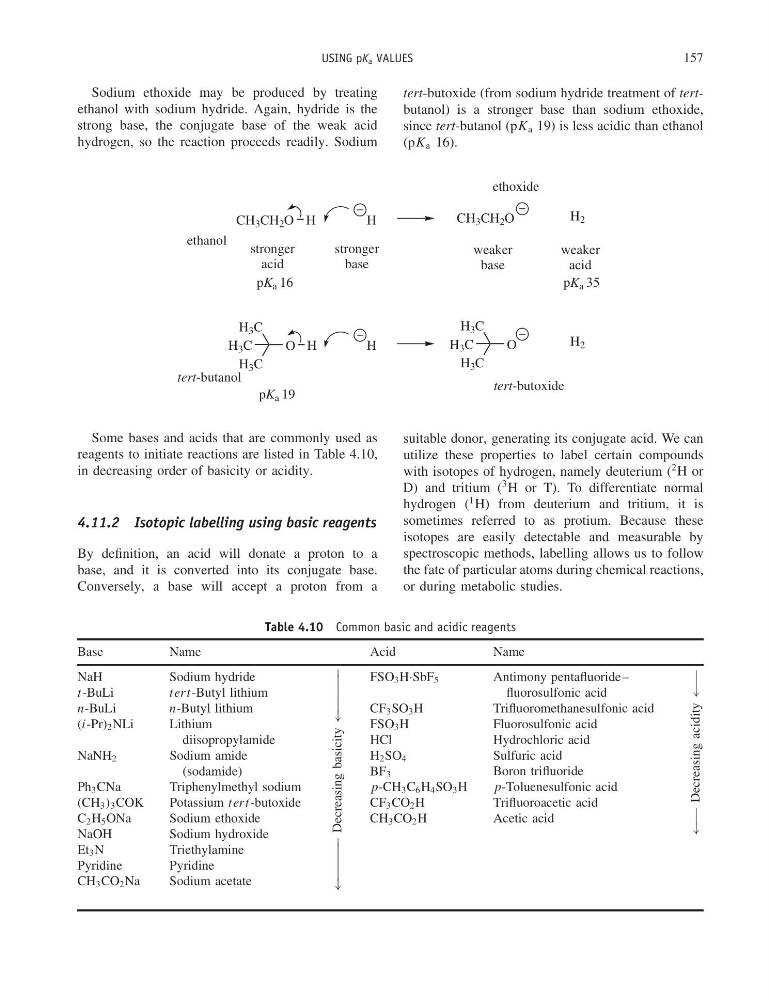
Sodium ethoxide may be produced by treating
ethanol with sodium hydride. Again, hydride is the
strong base, the conjugate base of the weak acid
hydrogen, so the reaction proceeds readily. Sodium
tert-butoxide (from sodium hydride treatment of tertbutanol) is a stronger base than sodium ethoxide,
since tert-butanol (pK a 19) is less acidic than ethanol
(pK a 16).
CH 3 CH 2 O H
H
CH 3 CH 2 O
H 2
pK a 16
pK a 35
stronger
acid
stronger
base
weaker
base
weaker
acid
O H
H 3 C
H 3 C
H 3 C
H
H 2
pK a 19
O
H 3 C
H 3 C
H 3 C
ethanol
tert-butanol
ethoxide
tert-butoxide
Some bases and acids that are commonly used as
reagents to initiate reactions are listed in Table 4.10,
in decreasing order of basicity or acidity.
4.11.2 Isotopic labelling using basic reagents
By definition, an acid will donate a proton to a
base, and it is converted into its conjugate base.
Conversely, a base will accept a proton from a
suitable donor, generating its conjugate acid. We can
utilize these properties to label certain compounds
with isotopes of hydrogen, namely deuterium (
2 H or
D) and tritium (
3 H or T). To differentiate normal
hydrogen (
1 H) from deuterium and tritium, it is
sometimes referred to as protium. Because these
isotopes are easily detectable and measurable by
spectroscopic methods, labelling allows us to follow
the fate of particular atoms during chemical reactions,
or during metabolic studies.
Table 4.10 Common basic and acidic reagents
Base
Name
Acid
Name
NaH
Sodium hydride
FSO 3 H·SbF 5
Antimony pentafluoride–
t-BuLi
tert-Butyl lithium
fluorosulfonic acid
n-BuLi
n-Butyl lithium
CF 3 SO 3 H
Trifluoromethanesulfonic acid
(i-Pr) 2 NLi
Lithium
FSO 3 H
Fluorosulfonic acid
diisopropylamide
HCl
Hydrochloric acid
NaNH 2
Sodium amide
H 2 SO 4
Sulfuric acid
(sodamide)
BF 3
Boron trifluoride
Ph 3 CNa
Triphenylmethyl sodium
p-CH 3 C 6 H 4 SO 3 H
p-Toluenesulfonic acid
(CH 3 ) 3 COK
Potassium tert-butoxide
CF 3 CO 2 H
Trifluoroacetic acid
C 2 H 5 ONa
Sodium ethoxide
CH 3 CO 2 H
Acetic acid
NaOH
Sodium hydroxide
Et 3 N
Triethylamine
Pyridine
Pyridine
CH 3 CO 2 Na
Sodium acetate
← −−−−− − Decreasing basicity
← −−−−− −
←−− Decreasing acidity
←−−
157
Sodium ethoxide may be produced by treating
ethanol with sodium hydride. Again, hydride is the
strong base, the conjugate base of the weak acid
hydrogen, so the reaction proceeds readily. Sodium
tert-butoxide (from sodium hydride treatment of tertbutanol) is a stronger base than sodium ethoxide,
since tert-butanol (pK a 19) is less acidic than ethanol
(pK a 16).
CH 3 CH 2 O H
H
CH 3 CH 2 O
H 2
pK a 16
pK a 35
stronger
acid
stronger
base
weaker
base
weaker
acid
O H
H 3 C
H 3 C
H 3 C
H
H 2
pK a 19
O
H 3 C
H 3 C
H 3 C
ethanol
tert-butanol
ethoxide
tert-butoxide
Some bases and acids that are commonly used as
reagents to initiate reactions are listed in Table 4.10,
in decreasing order of basicity or acidity.
4.11.2 Isotopic labelling using basic reagents
By definition, an acid will donate a proton to a
base, and it is converted into its conjugate base.
Conversely, a base will accept a proton from a
suitable donor, generating its conjugate acid. We can
utilize these properties to label certain compounds
with isotopes of hydrogen, namely deuterium (
2 H or
D) and tritium (
3 H or T). To differentiate normal
hydrogen (
1 H) from deuterium and tritium, it is
sometimes referred to as protium. Because these
isotopes are easily detectable and measurable by
spectroscopic methods, labelling allows us to follow
the fate of particular atoms during chemical reactions,
or during metabolic studies.
Table 4.10 Common basic and acidic reagents
Base
Name
Acid
Name
NaH
Sodium hydride
FSO 3 H·SbF 5
Antimony pentafluoride–
t-BuLi
tert-Butyl lithium
fluorosulfonic acid
n-BuLi
n-Butyl lithium
CF 3 SO 3 H
Trifluoromethanesulfonic acid
(i-Pr) 2 NLi
Lithium
FSO 3 H
Fluorosulfonic acid
diisopropylamide
HCl
Hydrochloric acid
NaNH 2
Sodium amide
H 2 SO 4
Sulfuric acid
(sodamide)
BF 3
Boron trifluoride
Ph 3 CNa
Triphenylmethyl sodium
p-CH 3 C 6 H 4 SO 3 H
p-Toluenesulfonic acid
(CH 3 ) 3 COK
Potassium tert-butoxide
CF 3 CO 2 H
Trifluoroacetic acid
C 2 H 5 ONa
Sodium ethoxide
CH 3 CO 2 H
Acetic acid
NaOH
Sodium hydroxide
Et 3 N
Triethylamine
Pyridine
Pyridine
CH 3 CO 2 Na
Sodium acetate
← −−−−− − Decreasing basicity
← −−−−− −
←−− Decreasing acidity
←−−