

156
ACIDS AND BASES
water-soluble
cation
H OH
pK a 4.6
NH 2
H O
H
H
NH 3
stronger
base
pK a −1.74
stronger
acid
weaker
acid
weaker
base
sparingly
soluble in
water
aniline
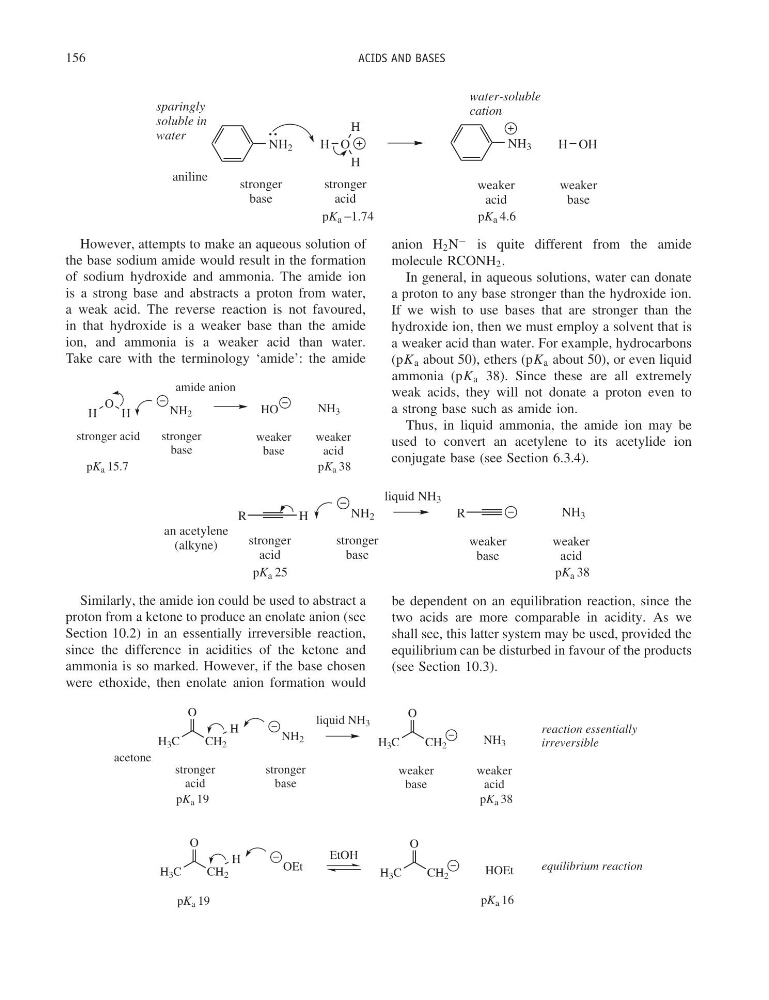
However, attempts to make an aqueous solution of
the base sodium amide would result in the formation
of sodium hydroxide and ammonia. The amide ion
is a strong base and abstracts a proton from water,
a weak acid. The reverse reaction is not favoured,
in that hydroxide is a weaker base than the amide
ion, and ammonia is a weaker acid than water.
Take care with the terminology ‘amide’: the amide
O
H
H
NH 2
HO
NH 3
pK a 15.7
pK a 38
stronger acid
stronger
base
weaker
base
weaker
acid
amide anion
anion H 2 N
− is quite different from the amide
molecule RCONH 2 .
In general, in aqueous solutions, water can donate
a proton to any base stronger than the hydroxide ion.
If we wish to use bases that are stronger than the
hydroxide ion, then we must employ a solvent that is
a weaker acid than water. For example, hydrocarbons
(pK a about 50), ethers (pK a about 50), or even liquid
ammonia (pK a 38). Since these are all extremely
weak acids, they will not donate a proton even to
a strong base such as amide ion.
Thus, in liquid ammonia, the amide ion may be
used to convert an acetylene to its acetylide ion
conjugate base (see Section 6.3.4).
R
H
NH 2
pK a 25
NH 3
pK a 38
stronger
acid
stronger
base
weaker
base
weaker
acid
R
liquid NH 3
an acetylene
(alkyne)
Similarly, the amide ion could be used to abstract a
proton from a ketone to produce an enolate anion (see
Section 10.2) in an essentially irreversible reaction,
since the difference in acidities of the ketone and
ammonia is so marked. However, if the base chosen
were ethoxide, then enolate anion formation would
be dependent on an equilibration reaction, since the
two acids are more comparable in acidity. As we
shall see, this latter system may be used, provided the
equilibrium can be disturbed in favour of the products
(see Section 10.3).
O
H 3 C
CH 2
O
H 3 C
CH 2
pK a 19
pK a 38
stronger
acid
stronger
base
weaker
base
weaker
acid
NH 2
H
NH 3
liquid NH 3
O
H 3 C
CH 2
O
H 3 C
CH 2
pK a 19
pK a 16
OEt
H
HOEt
EtOH
acetone
reaction essentially
irreversible
equilibrium reaction
ACIDS AND BASES
water-soluble
cation
H OH
pK a 4.6
NH 2
H O
H
H
NH 3
stronger
base
pK a −1.74
stronger
acid
weaker
acid
weaker
base
sparingly
soluble in
water
aniline
However, attempts to make an aqueous solution of
the base sodium amide would result in the formation
of sodium hydroxide and ammonia. The amide ion
is a strong base and abstracts a proton from water,
a weak acid. The reverse reaction is not favoured,
in that hydroxide is a weaker base than the amide
ion, and ammonia is a weaker acid than water.
Take care with the terminology ‘amide’: the amide
O
H
H
NH 2
HO
NH 3
pK a 15.7
pK a 38
stronger acid
stronger
base
weaker
base
weaker
acid
amide anion
anion H 2 N
− is quite different from the amide
molecule RCONH 2 .
In general, in aqueous solutions, water can donate
a proton to any base stronger than the hydroxide ion.
If we wish to use bases that are stronger than the
hydroxide ion, then we must employ a solvent that is
a weaker acid than water. For example, hydrocarbons
(pK a about 50), ethers (pK a about 50), or even liquid
ammonia (pK a 38). Since these are all extremely
weak acids, they will not donate a proton even to
a strong base such as amide ion.
Thus, in liquid ammonia, the amide ion may be
used to convert an acetylene to its acetylide ion
conjugate base (see Section 6.3.4).
R
H
NH 2
pK a 25
NH 3
pK a 38
stronger
acid
stronger
base
weaker
base
weaker
acid
R
liquid NH 3
an acetylene
(alkyne)
Similarly, the amide ion could be used to abstract a
proton from a ketone to produce an enolate anion (see
Section 10.2) in an essentially irreversible reaction,
since the difference in acidities of the ketone and
ammonia is so marked. However, if the base chosen
were ethoxide, then enolate anion formation would
be dependent on an equilibration reaction, since the
two acids are more comparable in acidity. As we
shall see, this latter system may be used, provided the
equilibrium can be disturbed in favour of the products
(see Section 10.3).
O
H 3 C
CH 2
O
H 3 C
CH 2
pK a 19
pK a 38
stronger
acid
stronger
base
weaker
base
weaker
acid
NH 2
H
NH 3
liquid NH 3
O
H 3 C
CH 2
O
H 3 C
CH 2
pK a 19
pK a 16
OEt
H
HOEt
EtOH
acetone
reaction essentially
irreversible
equilibrium reaction