

USING pK a VALUES
155
4.11 Using pK a values
4.11.1 Predicting acid–base interactions
With a knowledge of pK a values, or a rough idea
of relative values, one can predict the outcome of
acid–base interactions. This may form an essential
preliminary to many reactions, or provide us with
an understanding of whether a compound is ionized
under particular conditions, and whether or not it is
in a soluble form.
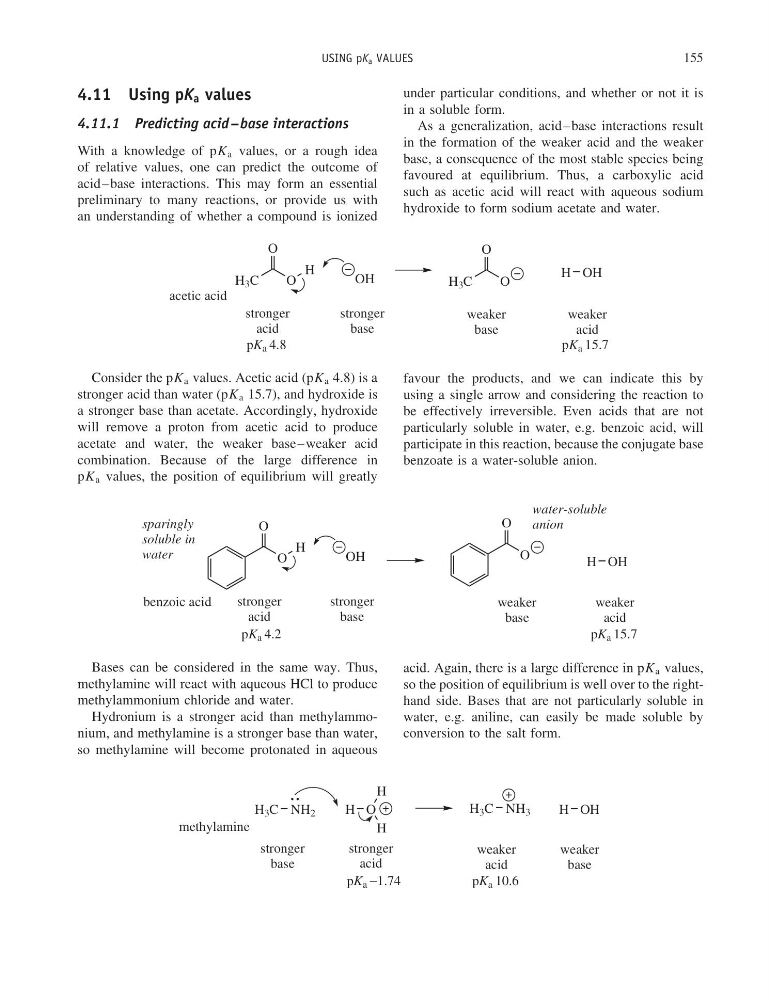
As a generalization, acid–base interactions result
in the formation of the weaker acid and the weaker
base, a consequence of the most stable species being
favoured at equilibrium. Thus, a carboxylic acid
such as acetic acid will react with aqueous sodium
hydroxide to form sodium acetate and water.
O
H 3 C
O
H
OH
O
H 3 C
O
H OH
pK a 4.8
pK a 15.7
stronger
acid
stronger
base
weaker
base
weaker
acid
acetic acid
Consider the pK a values. Acetic acid (pK a 4.8) is a
stronger acid than water (pK a 15.7), and hydroxide is
a stronger base than acetate. Accordingly, hydroxide
will remove a proton from acetic acid to produce
acetate and water, the weaker base–weaker acid
combination. Because of the large difference in
pK a values, the position of equilibrium will greatly
favour the products, and we can indicate this by
using a single arrow and considering the reaction to
be effectively irreversible. Even acids that are not
particularly soluble in water, e.g. benzoic acid, will
participate in this reaction, because the conjugate base
benzoate is a water-soluble anion.
O
O
H
OH
O
O
pK a 4.2
stronger
acid
stronger
base
weaker
base
H OH
pK a 15.7
weaker
acid
sparingly
soluble in
water
water-soluble
anion
benzoic acid
Bases can be considered in the same way. Thus,
methylamine will react with aqueous HCl to produce
methylammonium chloride and water.
Hydronium is a stronger acid than methylammonium, and methylamine is a stronger base than water,
so methylamine will become protonated in aqueous
acid. Again, there is a large difference in pK a values,
so the position of equilibrium is well over to the righthand side. Bases that are not particularly soluble in
water, e.g. aniline, can easily be made soluble by
conversion to the salt form.
H OH
pK a 10.6
H 3 C NH 2
H O
H
H
H 3 C NH 3
stronger
base
pK a −1.74
stronger
acid
weaker
acid
weaker
base
methylamine
155
4.11 Using pK a values
4.11.1 Predicting acid–base interactions
With a knowledge of pK a values, or a rough idea
of relative values, one can predict the outcome of
acid–base interactions. This may form an essential
preliminary to many reactions, or provide us with
an understanding of whether a compound is ionized
under particular conditions, and whether or not it is
in a soluble form.
As a generalization, acid–base interactions result
in the formation of the weaker acid and the weaker
base, a consequence of the most stable species being
favoured at equilibrium. Thus, a carboxylic acid
such as acetic acid will react with aqueous sodium
hydroxide to form sodium acetate and water.
O
H 3 C
O
H
OH
O
H 3 C
O
H OH
pK a 4.8
pK a 15.7
stronger
acid
stronger
base
weaker
base
weaker
acid
acetic acid
Consider the pK a values. Acetic acid (pK a 4.8) is a
stronger acid than water (pK a 15.7), and hydroxide is
a stronger base than acetate. Accordingly, hydroxide
will remove a proton from acetic acid to produce
acetate and water, the weaker base–weaker acid
combination. Because of the large difference in
pK a values, the position of equilibrium will greatly
favour the products, and we can indicate this by
using a single arrow and considering the reaction to
be effectively irreversible. Even acids that are not
particularly soluble in water, e.g. benzoic acid, will
participate in this reaction, because the conjugate base
benzoate is a water-soluble anion.
O
O
H
OH
O
O
pK a 4.2
stronger
acid
stronger
base
weaker
base
H OH
pK a 15.7
weaker
acid
sparingly
soluble in
water
water-soluble
anion
benzoic acid
Bases can be considered in the same way. Thus,
methylamine will react with aqueous HCl to produce
methylammonium chloride and water.
Hydronium is a stronger acid than methylammonium, and methylamine is a stronger base than water,
so methylamine will become protonated in aqueous
acid. Again, there is a large difference in pK a values,
so the position of equilibrium is well over to the righthand side. Bases that are not particularly soluble in
water, e.g. aniline, can easily be made soluble by
conversion to the salt form.
H OH
pK a 10.6
H 3 C NH 2
H O
H
H
H 3 C NH 3
stronger
base
pK a −1.74
stronger
acid
weaker
acid
weaker
base
methylamine