

154
ACIDS AND BASES
Box 4.8 (continued)
This contrasts with the effect of adding 0.001 M of
HCl to 1 litre of water (pH 7). The new [H 3 O
+ ] of
0.001 M gives pH = − log[H 3 O
+ ] = − log 0.001 =
3, i.e. a change of four pH units.
If 1 ml of 1 M NaOH was added to this buffer
solution, the pH change may be calculated similarly.
We are adding an additional [HO
− ] of 0.001 M,
and this reacts
HOAc + HO
H 2 O +
OAc
effectively increasing the amount of acetate base by
0.001 M and also decreasing the amount of acetic
acid by 0.001 M.
The Henderson–Hasselbalch equation becomes
pH = 4.75 + log
0.0575 + 0.001
0.0415 − 0.001
so
pH = 4.75 + log
0.0585
0.0405
= 4.75 + log 1.44
= 4.75 + 0.16 = 4.91
Again, the pH change is minimal, which is the whole
point of a buffer solution.
Note also that the pH of a buffer solution is essentially independent of dilution. An unbuffered solution
of an acid or base would suffer a pH change on
dilution because pH relates to hydronium ion concentration (see Section 4.8). Dilution of a buffered
solution does not affect pH because any such changes
are accommodated in the log([A
− ]/[HA]) component
and, therefore, cancel out. We have made certain
approximations in deriving the equations, and at very
high dilutions the pH does begin to deviate.
The sodium acetate–acetic acid combination is
one of the most widely used buffers, and is usually referred to simply as acetate buffer. Other buffer
combinations commonly employed in chemistry
and biochemistry include carbonate–bicarbonate
(sodium carbonate–sodium hydrogen carbonate),
citrate (citric acid–trisodium citrate), phosphate
(sodium dihydrogen phosphate–disodium hydrogen
phosphate), and tris [tris(hydroxymethyl)aminomethane–HCl].
Box 4.9
The buffering effect of blood plasma
In humans, the pH of blood is held at a remarkably
constant value of 7.4 ± 0.05. In severe diabetes, the
pH can drop to pH 7.0 or below, leading to death
from acidotic coma. Death may also occur at pH
7.7 or above, because the blood is unable to release
CO 2 into the lungs. The pH of blood is normally
controlled by a buffer system, within rather narrow
limits to maintain life and within even narrower
limits to maintain health.
The buffering system for blood is based on
carbonic acid (H 2 CO 3 ) and its conjugate base
bicarbonate (HCO 3
− ):
H 2 CO 3
H
HCO 3
+
From the Henderson–Hasselbalch equation
pH = pK a + log
[HCO 3
− ]
[H 2 CO 3 ]
we can see that maintaining the pH depends upon
the ratio of bicarbonate to carbonic acid concentrations. Large quantities of acid formed during normal metabolic processes react with bicarbonate to
form carbonic acid. This, however, dissociates and
rapidly loses water to form CO 2 that is removed via
the lungs.
H 2 CO 3
H 2 O + CO 2
The pH is maintained, therefore, in that a reduction in
[HCO 3
− ] is countered by a corresponding decrease
in [H 2 CO 3 ]. The increase in metabolic acid is
compensated by a corresponding increase in CO 2 .
If the pH of blood rises, [HCO 3
− ] temporarily
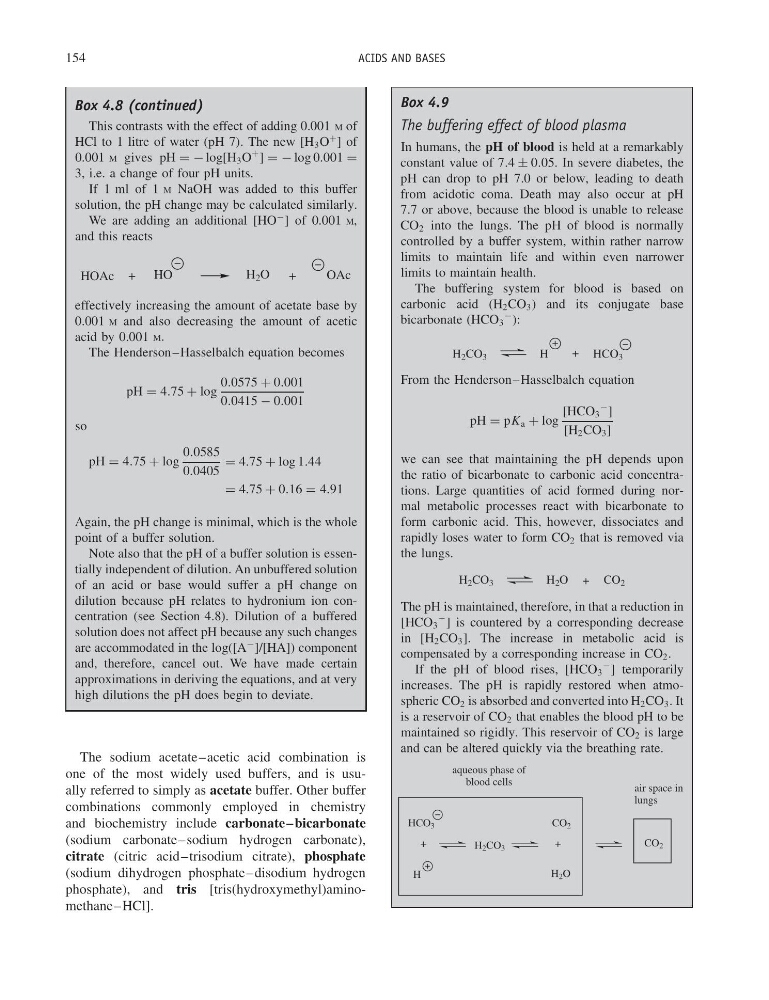
increases. The pH is rapidly restored when atmospheric CO 2 is absorbed and converted into H 2 CO 3 . It
is a reservoir of CO 2 that enables the blood pH to be
maintained so rigidly. This reservoir of CO 2 is large
and can be altered quickly via the breathing rate.
H
HCO 3
+
H 2 CO 3
H 2 O
+
CO 2
CO 2
aqueous phase of
blood cells
air space in
lungs
ACIDS AND BASES
Box 4.8 (continued)
This contrasts with the effect of adding 0.001 M of
HCl to 1 litre of water (pH 7). The new [H 3 O
+ ] of
0.001 M gives pH = − log[H 3 O
+ ] = − log 0.001 =
3, i.e. a change of four pH units.
If 1 ml of 1 M NaOH was added to this buffer
solution, the pH change may be calculated similarly.
We are adding an additional [HO
− ] of 0.001 M,
and this reacts
HOAc + HO
H 2 O +
OAc
effectively increasing the amount of acetate base by
0.001 M and also decreasing the amount of acetic
acid by 0.001 M.
The Henderson–Hasselbalch equation becomes
pH = 4.75 + log
0.0575 + 0.001
0.0415 − 0.001
so
pH = 4.75 + log
0.0585
0.0405
= 4.75 + log 1.44
= 4.75 + 0.16 = 4.91
Again, the pH change is minimal, which is the whole
point of a buffer solution.
Note also that the pH of a buffer solution is essentially independent of dilution. An unbuffered solution
of an acid or base would suffer a pH change on
dilution because pH relates to hydronium ion concentration (see Section 4.8). Dilution of a buffered
solution does not affect pH because any such changes
are accommodated in the log([A
− ]/[HA]) component
and, therefore, cancel out. We have made certain
approximations in deriving the equations, and at very
high dilutions the pH does begin to deviate.
The sodium acetate–acetic acid combination is
one of the most widely used buffers, and is usually referred to simply as acetate buffer. Other buffer
combinations commonly employed in chemistry
and biochemistry include carbonate–bicarbonate
(sodium carbonate–sodium hydrogen carbonate),
citrate (citric acid–trisodium citrate), phosphate
(sodium dihydrogen phosphate–disodium hydrogen
phosphate), and tris [tris(hydroxymethyl)aminomethane–HCl].
Box 4.9
The buffering effect of blood plasma
In humans, the pH of blood is held at a remarkably
constant value of 7.4 ± 0.05. In severe diabetes, the
pH can drop to pH 7.0 or below, leading to death
from acidotic coma. Death may also occur at pH
7.7 or above, because the blood is unable to release
CO 2 into the lungs. The pH of blood is normally
controlled by a buffer system, within rather narrow
limits to maintain life and within even narrower
limits to maintain health.
The buffering system for blood is based on
carbonic acid (H 2 CO 3 ) and its conjugate base
bicarbonate (HCO 3
− ):
H 2 CO 3
H
HCO 3
+
From the Henderson–Hasselbalch equation
pH = pK a + log
[HCO 3
− ]
[H 2 CO 3 ]
we can see that maintaining the pH depends upon
the ratio of bicarbonate to carbonic acid concentrations. Large quantities of acid formed during normal metabolic processes react with bicarbonate to
form carbonic acid. This, however, dissociates and
rapidly loses water to form CO 2 that is removed via
the lungs.
H 2 CO 3
H 2 O + CO 2
The pH is maintained, therefore, in that a reduction in
[HCO 3
− ] is countered by a corresponding decrease
in [H 2 CO 3 ]. The increase in metabolic acid is
compensated by a corresponding increase in CO 2 .
If the pH of blood rises, [HCO 3
− ] temporarily
increases. The pH is rapidly restored when atmospheric CO 2 is absorbed and converted into H 2 CO 3 . It
is a reservoir of CO 2 that enables the blood pH to be
maintained so rigidly. This reservoir of CO 2 is large
and can be altered quickly via the breathing rate.
H
HCO 3
+
H 2 CO 3
H 2 O
+
CO 2
CO 2
aqueous phase of
blood cells
air space in
lungs