

BUFFERS
153
Since acetic acid is only weakly dissociated, the
concentration of acetic acid will be almost the
same as the amount put in the mixture. On the
other hand, the sodium acetate component will be
almost completely dissociated, so the acetate ion
concentration can be considered the same as that of
the sodium acetate used for the solution.
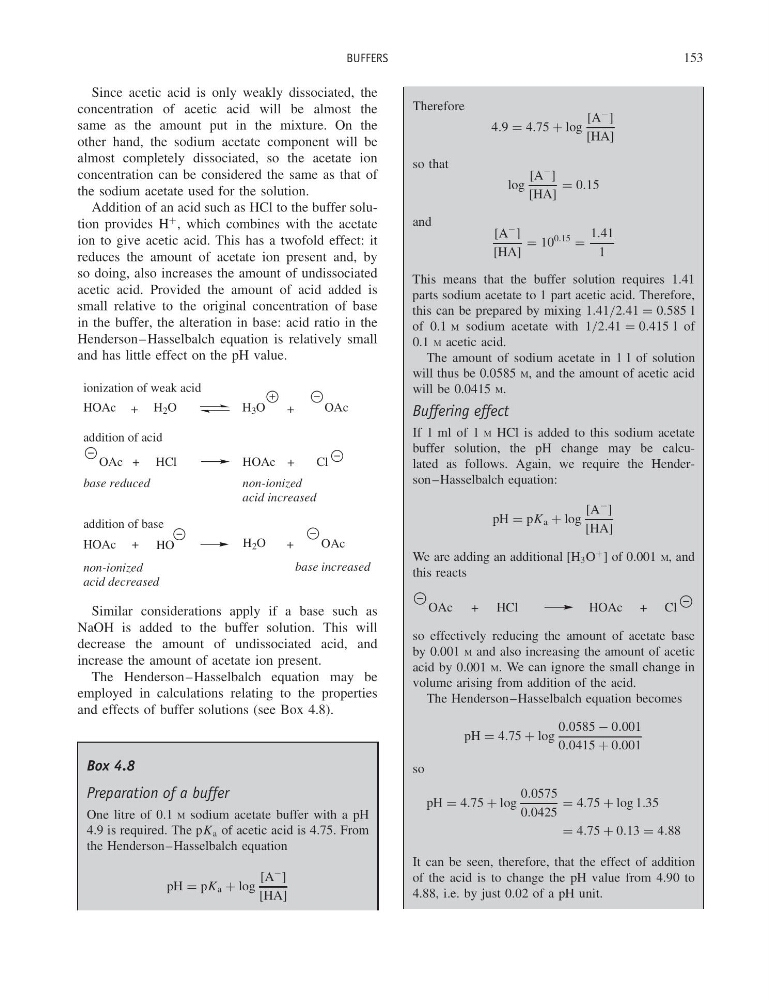
Addition of an acid such as HCl to the buffer solution provides H
+ , which combines with the acetate
ion to give acetic acid. This has a twofold effect: it
reduces the amount of acetate ion present and, by
so doing, also increases the amount of undissociated
acetic acid. Provided the amount of acid added is
small relative to the original concentration of base
in the buffer, the alteration in base: acid ratio in the
Henderson–Hasselbalch equation is relatively small
and has little effect on the pH value.
HOAc
H 2 O
+
H 3 O
+
OAc
OAc + HCl
HOAc +
Cl
HOAc + HO
H 2 O
+
OAc
addition of acid
addition of base
base reduced
non-ionized
acid increased
non-ionized
acid decreased
base increased
ionization of weak acid
Similar considerations apply if a base such as
NaOH is added to the buffer solution. This will
decrease the amount of undissociated acid, and
increase the amount of acetate ion present.
The Henderson–Hasselbalch equation may be
employed in calculations relating to the properties
and effects of buffer solutions (see Box 4.8).
Box 4.8
Preparation of a buffer
One litre of 0.1 M sodium acetate buffer with a pH
4.9 is required. The pK a of acetic acid is 4.75. From
the Henderson–Hasselbalch equation
pH = pK a + log
[A
− ]
[HA]
Therefore
4.9 = 4.75 + log
[A
− ]
[HA]
so that
log
[A
− ]
[HA]
= 0.15
and
[A
− ]
[HA]
= 10
0.15 =
1.41
1
This means that the buffer solution requires 1.41
parts sodium acetate to 1 part acetic acid. Therefore,
this can be prepared by mixing 1.41/2.41 = 0.585 l
of 0.1 M sodium acetate with 1/2.41 = 0.415 l of
0.1 M acetic acid.
The amount of sodium acetate in 1 l of solution
will thus be 0.0585 M, and the amount of acetic acid
will be 0.0415 M.
Buffering effect
If 1 ml of 1 M HCl is added to this sodium acetate
buffer solution, the pH change may be calculated as follows. Again, we require the Henderson–Hasselbalch equation:
pH = pK a + log
[A
− ]
[HA]
We are adding an additional [H 3 O
+ ] of 0.001 M, and
this reacts
OAc + HCl
HOAc + Cl
so effectively reducing the amount of acetate base
by 0.001 M and also increasing the amount of acetic
acid by 0.001 M. We can ignore the small change in
volume arising from addition of the acid.
The Henderson–Hasselbalch equation becomes
pH = 4.75 + log
0.0585 − 0.001
0.0415 + 0.001
so
pH = 4.75 + log
0.0575
0.0425
= 4.75 + log 1.35
= 4.75 + 0.13 = 4.88
It can be seen, therefore, that the effect of addition
of the acid is to change the pH value from 4.90 to
4.88, i.e. by just 0.02 of a pH unit.
153
Since acetic acid is only weakly dissociated, the
concentration of acetic acid will be almost the
same as the amount put in the mixture. On the
other hand, the sodium acetate component will be
almost completely dissociated, so the acetate ion
concentration can be considered the same as that of
the sodium acetate used for the solution.
Addition of an acid such as HCl to the buffer solution provides H
+ , which combines with the acetate
ion to give acetic acid. This has a twofold effect: it
reduces the amount of acetate ion present and, by
so doing, also increases the amount of undissociated
acetic acid. Provided the amount of acid added is
small relative to the original concentration of base
in the buffer, the alteration in base: acid ratio in the
Henderson–Hasselbalch equation is relatively small
and has little effect on the pH value.
HOAc
H 2 O
+
H 3 O
+
OAc
OAc + HCl
HOAc +
Cl
HOAc + HO
H 2 O
+
OAc
addition of acid
addition of base
base reduced
non-ionized
acid increased
non-ionized
acid decreased
base increased
ionization of weak acid
Similar considerations apply if a base such as
NaOH is added to the buffer solution. This will
decrease the amount of undissociated acid, and
increase the amount of acetate ion present.
The Henderson–Hasselbalch equation may be
employed in calculations relating to the properties
and effects of buffer solutions (see Box 4.8).
Box 4.8
Preparation of a buffer
One litre of 0.1 M sodium acetate buffer with a pH
4.9 is required. The pK a of acetic acid is 4.75. From
the Henderson–Hasselbalch equation
pH = pK a + log
[A
− ]
[HA]
Therefore
4.9 = 4.75 + log
[A
− ]
[HA]
so that
log
[A
− ]
[HA]
= 0.15
and
[A
− ]
[HA]
= 10
0.15 =
1.41
1
This means that the buffer solution requires 1.41
parts sodium acetate to 1 part acetic acid. Therefore,
this can be prepared by mixing 1.41/2.41 = 0.585 l
of 0.1 M sodium acetate with 1/2.41 = 0.415 l of
0.1 M acetic acid.
The amount of sodium acetate in 1 l of solution
will thus be 0.0585 M, and the amount of acetic acid
will be 0.0415 M.
Buffering effect
If 1 ml of 1 M HCl is added to this sodium acetate
buffer solution, the pH change may be calculated as follows. Again, we require the Henderson–Hasselbalch equation:
pH = pK a + log
[A
− ]
[HA]
We are adding an additional [H 3 O
+ ] of 0.001 M, and
this reacts
OAc + HCl
HOAc + Cl
so effectively reducing the amount of acetate base
by 0.001 M and also increasing the amount of acetic
acid by 0.001 M. We can ignore the small change in
volume arising from addition of the acid.
The Henderson–Hasselbalch equation becomes
pH = 4.75 + log
0.0585 − 0.001
0.0415 + 0.001
so
pH = 4.75 + log
0.0575
0.0425
= 4.75 + log 1.35
= 4.75 + 0.13 = 4.88
It can be seen, therefore, that the effect of addition
of the acid is to change the pH value from 4.90 to
4.88, i.e. by just 0.02 of a pH unit.