

152
ACIDS AND BASES
Box 4.7 (continued)
Interestingly, the heterocyclic side-chain of histidine is partially ionized at pH 7.0. This follows from
log
[B]
[BH
+ ]
= pH − pK a = 7.0 − 6.00 = −1.0
and
[B]
[BH
+ ]
= 10
−1.0 = 10
which translates to approximately 9.1% ionization.
We shall see that this modest level of ionization is particularly relevant in some enzymic reactions where
histidine residues play an important role (see Section 13.4.1). Note, however, that when histidine is bound in a
protein structure, pK a values for the imidazole ring vary somewhat in the range 6–7 depending upon the protein,
thus affecting the level of ionization.
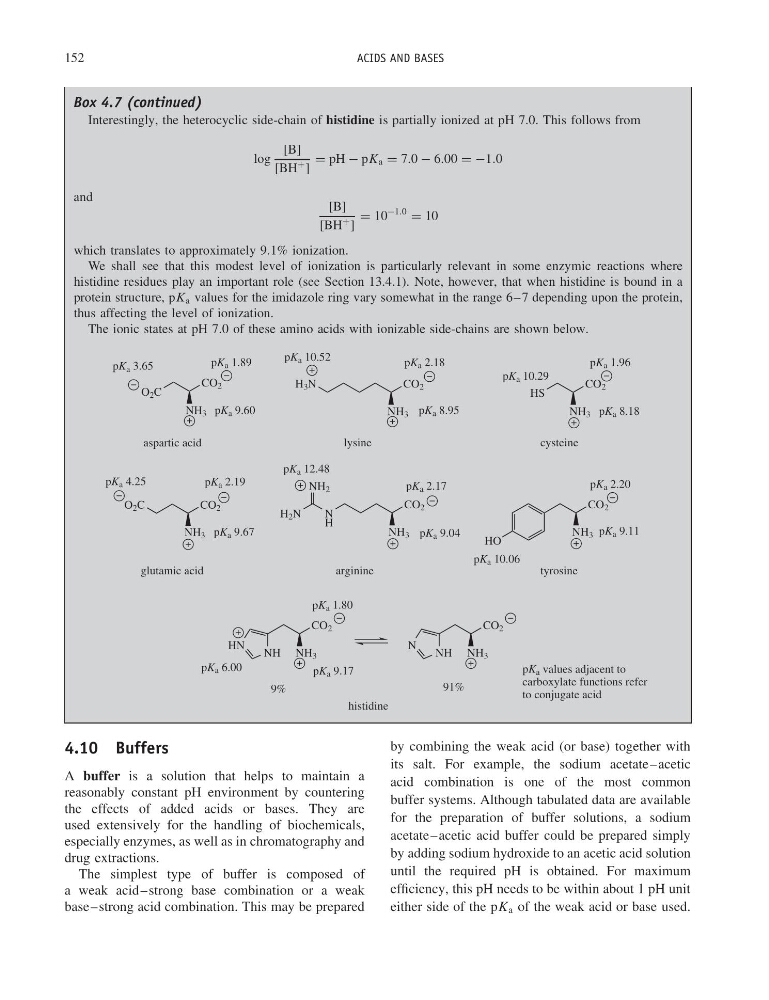
The ionic states at pH 7.0 of these amino acids with ionizable side-chains are shown below.
H 2 N
N
H
CO 2
NH 3
NH 2
O 2 C
CO 2
NH 3
O 2 C
CO 2
NH 3
CO 2
NH 3
HN
NH
HS
CO 2
NH 3
CO 2
NH 3
H 3 N
CO 2
NH 3
HO
aspartic acid
glutamic acid
pK a 3.65
pK a 4.25
lysine
arginine
cysteine
tyrosine
histidine
CO 2
NH 3
N
NH
9%
91%
pK a 1.89
pK a 9.60
pK a 2.19
pK a 9.67
pK a 10.52
pK a 2.18
pK a 8.95
pK a 10.29
pK a 1.96
pK a 8.18
pK a 12.48
pK a 2.17
pK a 9.04
pK a 10.06
pK a 2.20
pK a 9.11
pK a 6.00
pK a 1.80
pK a 9.17
pK a values adjacent to
carboxylate functions refer
to conjugate acid
4.10 Buffers
A buffer is a solution that helps to maintain a
reasonably constant pH environment by countering
the effects of added acids or bases. They are
used extensively for the handling of biochemicals,
especially enzymes, as well as in chromatography and
drug extractions.
The simplest type of buffer is composed of
a weak acid–strong base combination or a weak
base–strong acid combination. This may be prepared
by combining the weak acid (or base) together with
its salt. For example, the sodium acetate–acetic
acid combination is one of the most common
buffer systems. Although tabulated data are available
for the preparation of buffer solutions, a sodium
acetate–acetic acid buffer could be prepared simply
by adding sodium hydroxide to an acetic acid solution
until the required pH is obtained. For maximum
efficiency, this pH needs to be within about 1 pH unit
either side of the pK a of the weak acid or base used.
ACIDS AND BASES
Box 4.7 (continued)
Interestingly, the heterocyclic side-chain of histidine is partially ionized at pH 7.0. This follows from
log
[B]
[BH
+ ]
= pH − pK a = 7.0 − 6.00 = −1.0
and
[B]
[BH
+ ]
= 10
−1.0 = 10
which translates to approximately 9.1% ionization.
We shall see that this modest level of ionization is particularly relevant in some enzymic reactions where
histidine residues play an important role (see Section 13.4.1). Note, however, that when histidine is bound in a
protein structure, pK a values for the imidazole ring vary somewhat in the range 6–7 depending upon the protein,
thus affecting the level of ionization.
The ionic states at pH 7.0 of these amino acids with ionizable side-chains are shown below.
H 2 N
N
H
CO 2
NH 3
NH 2
O 2 C
CO 2
NH 3
O 2 C
CO 2
NH 3
CO 2
NH 3
HN
NH
HS
CO 2
NH 3
CO 2
NH 3
H 3 N
CO 2
NH 3
HO
aspartic acid
glutamic acid
pK a 3.65
pK a 4.25
lysine
arginine
cysteine
tyrosine
histidine
CO 2
NH 3
N
NH
9%
91%
pK a 1.89
pK a 9.60
pK a 2.19
pK a 9.67
pK a 10.52
pK a 2.18
pK a 8.95
pK a 10.29
pK a 1.96
pK a 8.18
pK a 12.48
pK a 2.17
pK a 9.04
pK a 10.06
pK a 2.20
pK a 9.11
pK a 6.00
pK a 1.80
pK a 9.17
pK a values adjacent to
carboxylate functions refer
to conjugate acid
4.10 Buffers
A buffer is a solution that helps to maintain a
reasonably constant pH environment by countering
the effects of added acids or bases. They are
used extensively for the handling of biochemicals,
especially enzymes, as well as in chromatography and
drug extractions.
The simplest type of buffer is composed of
a weak acid–strong base combination or a weak
base–strong acid combination. This may be prepared
by combining the weak acid (or base) together with
its salt. For example, the sodium acetate–acetic
acid combination is one of the most common
buffer systems. Although tabulated data are available
for the preparation of buffer solutions, a sodium
acetate–acetic acid buffer could be prepared simply
by adding sodium hydroxide to an acetic acid solution
until the required pH is obtained. For maximum
efficiency, this pH needs to be within about 1 pH unit
either side of the pK a of the weak acid or base used.