

164
ACIDS AND BASES
4.11.4 pK a and drug absorption
Cell membranes are structures containing lipids and
proteins as their main components. Many drug
molecules are weak acids or bases and can, therefore,
exist as ionized species, depending upon their pK a
values and the pH of the environment. One of the
more important concepts relating to drug absorption
is that ionized species have very low lipid solubility,
and are unable to permeate through membranes.
Only the non-ionized drug is usually able to cross
membranes. A range of pK a values covered by some
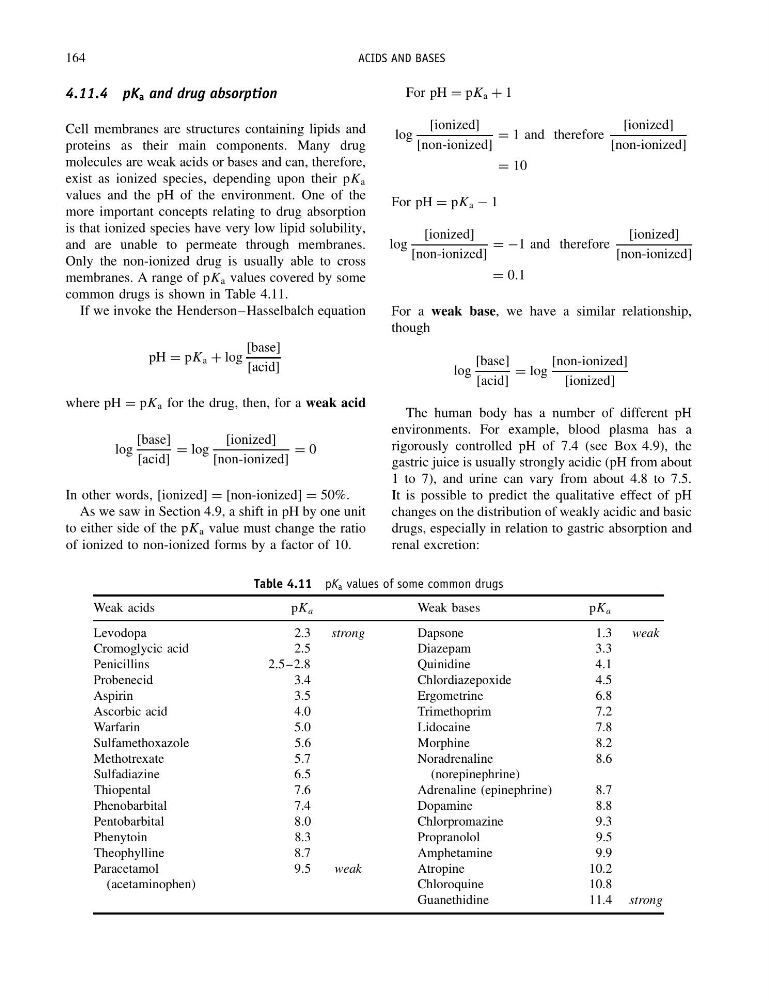
common drugs is shown in Table 4.11.
If we invoke the Henderson–Hasselbalch equation
pH = pK a + log
[base]
[acid]
where pH = pK a for the drug, then, for a weak acid
log
[base]
[acid]
= log
[ionized]
[non-ionized]
= 0
In other words, [ionized] = [non-ionized] = 50%.
As we saw in Section 4.9, a shift in pH by one unit
to either side of the pK a value must change the ratio
of ionized to non-ionized forms by a factor of 10.
For pH = pK a + 1
log
[ionized]
[non-ionized]
= 1 and therefore
[ionized]
[non-ionized]
= 10
For pH = pK a − 1
log
[ionized]
[non-ionized]
= −1 and therefore
[ionized]
[non-ionized]
= 0.1
For a weak base, we have a similar relationship,
though
log
[base]
[acid]
= log
[non-ionized]
[ionized]
The human body has a number of different pH
environments. For example, blood plasma has a
rigorously controlled pH of 7.4 (see Box 4.9), the
gastric juice is usually strongly acidic (pH from about
1 to 7), and urine can vary from about 4.8 to 7.5.
It is possible to predict the qualitative effect of pH
changes on the distribution of weakly acidic and basic
drugs, especially in relation to gastric absorption and
renal excretion:
Table 4.11 pK a values of some common drugs
Weak acids
pK a
Weak bases
pK a
Levodopa
2.3
strong
Dapsone
1.3
weak
Cromoglycic acid
2.5
Diazepam
3.3
Penicillins
2.5–2.8
Quinidine
4.1
Probenecid
3.4
Chlordiazepoxide
4.5
Aspirin
3.5
Ergometrine
6.8
Ascorbic acid
4.0
Trimethoprim
7.2
Warfarin
5.0
Lidocaine
7.8
Sulfamethoxazole
5.6
Morphine
8.2
Methotrexate
5.7
Noradrenaline
8.6
Sulfadiazine
6.5
(norepinephrine)
Thiopental
7.6
Adrenaline (epinephrine)
8.7
Phenobarbital
7.4
Dopamine
8.8
Pentobarbital
8.0
Chlorpromazine
9.3
Phenytoin
8.3
Propranolol
9.5
Theophylline
8.7
Amphetamine
9.9
Paracetamol
9.5
weak
Atropine
10.2
(acetaminophen)
Chloroquine
10.8
Guanethidine
11.4 strong
ACIDS AND BASES
4.11.4 pK a and drug absorption
Cell membranes are structures containing lipids and
proteins as their main components. Many drug
molecules are weak acids or bases and can, therefore,
exist as ionized species, depending upon their pK a
values and the pH of the environment. One of the
more important concepts relating to drug absorption
is that ionized species have very low lipid solubility,
and are unable to permeate through membranes.
Only the non-ionized drug is usually able to cross
membranes. A range of pK a values covered by some
common drugs is shown in Table 4.11.
If we invoke the Henderson–Hasselbalch equation
pH = pK a + log
[base]
[acid]
where pH = pK a for the drug, then, for a weak acid
log
[base]
[acid]
= log
[ionized]
[non-ionized]
= 0
In other words, [ionized] = [non-ionized] = 50%.
As we saw in Section 4.9, a shift in pH by one unit
to either side of the pK a value must change the ratio
of ionized to non-ionized forms by a factor of 10.
For pH = pK a + 1
log
[ionized]
[non-ionized]
= 1 and therefore
[ionized]
[non-ionized]
= 10
For pH = pK a − 1
log
[ionized]
[non-ionized]
= −1 and therefore
[ionized]
[non-ionized]
= 0.1
For a weak base, we have a similar relationship,
though
log
[base]
[acid]
= log
[non-ionized]
[ionized]
The human body has a number of different pH
environments. For example, blood plasma has a
rigorously controlled pH of 7.4 (see Box 4.9), the
gastric juice is usually strongly acidic (pH from about
1 to 7), and urine can vary from about 4.8 to 7.5.
It is possible to predict the qualitative effect of pH
changes on the distribution of weakly acidic and basic
drugs, especially in relation to gastric absorption and
renal excretion:
Table 4.11 pK a values of some common drugs
Weak acids
pK a
Weak bases
pK a
Levodopa
2.3
strong
Dapsone
1.3
weak
Cromoglycic acid
2.5
Diazepam
3.3
Penicillins
2.5–2.8
Quinidine
4.1
Probenecid
3.4
Chlordiazepoxide
4.5
Aspirin
3.5
Ergometrine
6.8
Ascorbic acid
4.0
Trimethoprim
7.2
Warfarin
5.0
Lidocaine
7.8
Sulfamethoxazole
5.6
Morphine
8.2
Methotrexate
5.7
Noradrenaline
8.6
Sulfadiazine
6.5
(norepinephrine)
Thiopental
7.6
Adrenaline (epinephrine)
8.7
Phenobarbital
7.4
Dopamine
8.8
Pentobarbital
8.0
Chlorpromazine
9.3
Phenytoin
8.3
Propranolol
9.5
Theophylline
8.7
Amphetamine
9.9
Paracetamol
9.5
weak
Atropine
10.2
(acetaminophen)
Chloroquine
10.8
Guanethidine
11.4 strong