

POLYFUNCTIONAL ACIDS AND BASES
145
the conjugate base. Again, this effect diminishes
rapidly as the chain length increases, as anticipated
for an inductive effect. Of course, ionization of a
carboxylic acid group to a carboxylate anion reverses
the inductive effect, in that the carboxylate will be
electron donating, and will destabilize the dianion.
This is reflected in the pK a2 values for malonic,
succinic and glutaric acids all being larger than the
pK a for acetic acid. Oxalic acid appears anomalous
in this respect, and this appears to be a result of the
high charge density associated with the dianion and
subsequent solvation effects.
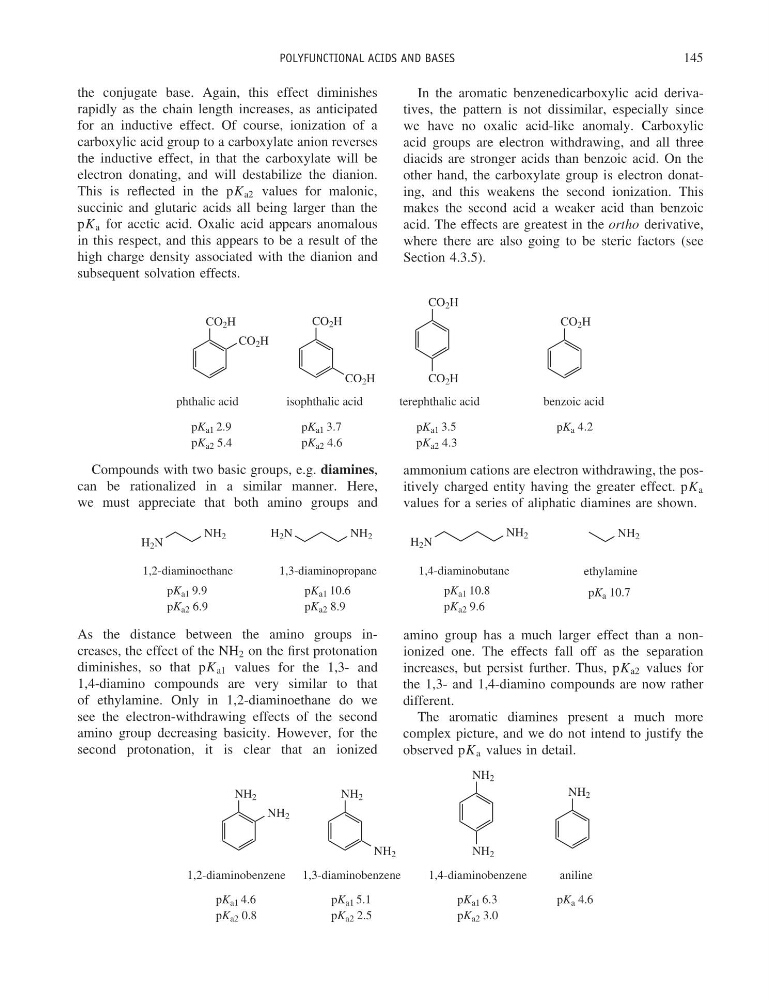
In the aromatic benzenedicarboxylic acid derivatives, the pattern is not dissimilar, especially since
we have no oxalic acid-like anomaly. Carboxylic
acid groups are electron withdrawing, and all three
diacids are stronger acids than benzoic acid. On the
other hand, the carboxylate group is electron donating, and this weakens the second ionization. This
makes the second acid a weaker acid than benzoic
acid. The effects are greatest in the ortho derivative,
where there are also going to be steric factors (see
Section 4.3.5).
CO 2 H
CO 2 H
CO 2 H
CO 2 H
CO 2 H
CO 2 H
pK a1 2.9
pK a2 5.4
pK a1 3.7
pK a2 4.6
pK a1 3.5
pK a2 4.3
phthalic acid
isophthalic acid
terephthalic acid
CO 2 H
benzoic acid
pK a 4.2
Compounds with two basic groups, e.g. diamines,
can be rationalized in a similar manner. Here,
we must appreciate that both amino groups and
ammonium cations are electron withdrawing, the positively charged entity having the greater effect. pK a
values for a series of aliphatic diamines are shown.
H 2 N
NH 2
1,2-diaminoethane
H 2 N
NH 2
1,3-diaminopropane
pK a1 9.9
pK a2 6.9
pK a1 10.6
pK a2 8.9
pK a 10.7
H 2 N
1,4-diaminobutane
pK a1 10.8
pK a2 9.6
NH 2
NH 2
ethylamine
As the distance between the amino groups increases, the effect of the NH 2 on the first protonation
diminishes, so that pK a1 values for the 1,3- and
1,4-diamino compounds are very similar to that
of ethylamine. Only in 1,2-diaminoethane do we
see the electron-withdrawing effects of the second
amino group decreasing basicity. However, for the
second protonation, it is clear that an ionized
amino group has a much larger effect than a nonionized one. The effects fall off as the separation
increases, but persist further. Thus, pK a2 values for
the 1,3- and 1,4-diamino compounds are now rather
different.
The aromatic diamines present a much more
complex picture, and we do not intend to justify the
observed pK a values in detail.
NH 2
NH 2
NH 2
NH 2
NH 2
NH 2
pK a1 4.6
pK a2 0.8
pK a1 5.1
pK a2 2.5
pK a1 6.3
pK a2 3.0
1,2-diaminobenzene 1,3-diaminobenzene
1,4-diaminobenzene
NH 2
aniline
pK a 4.6
145
the conjugate base. Again, this effect diminishes
rapidly as the chain length increases, as anticipated
for an inductive effect. Of course, ionization of a
carboxylic acid group to a carboxylate anion reverses
the inductive effect, in that the carboxylate will be
electron donating, and will destabilize the dianion.
This is reflected in the pK a2 values for malonic,
succinic and glutaric acids all being larger than the
pK a for acetic acid. Oxalic acid appears anomalous
in this respect, and this appears to be a result of the
high charge density associated with the dianion and
subsequent solvation effects.
In the aromatic benzenedicarboxylic acid derivatives, the pattern is not dissimilar, especially since
we have no oxalic acid-like anomaly. Carboxylic
acid groups are electron withdrawing, and all three
diacids are stronger acids than benzoic acid. On the
other hand, the carboxylate group is electron donating, and this weakens the second ionization. This
makes the second acid a weaker acid than benzoic
acid. The effects are greatest in the ortho derivative,
where there are also going to be steric factors (see
Section 4.3.5).
CO 2 H
CO 2 H
CO 2 H
CO 2 H
CO 2 H
CO 2 H
pK a1 2.9
pK a2 5.4
pK a1 3.7
pK a2 4.6
pK a1 3.5
pK a2 4.3
phthalic acid
isophthalic acid
terephthalic acid
CO 2 H
benzoic acid
pK a 4.2
Compounds with two basic groups, e.g. diamines,
can be rationalized in a similar manner. Here,
we must appreciate that both amino groups and
ammonium cations are electron withdrawing, the positively charged entity having the greater effect. pK a
values for a series of aliphatic diamines are shown.
H 2 N
NH 2
1,2-diaminoethane
H 2 N
NH 2
1,3-diaminopropane
pK a1 9.9
pK a2 6.9
pK a1 10.6
pK a2 8.9
pK a 10.7
H 2 N
1,4-diaminobutane
pK a1 10.8
pK a2 9.6
NH 2
NH 2
ethylamine
As the distance between the amino groups increases, the effect of the NH 2 on the first protonation
diminishes, so that pK a1 values for the 1,3- and
1,4-diamino compounds are very similar to that
of ethylamine. Only in 1,2-diaminoethane do we
see the electron-withdrawing effects of the second
amino group decreasing basicity. However, for the
second protonation, it is clear that an ionized
amino group has a much larger effect than a nonionized one. The effects fall off as the separation
increases, but persist further. Thus, pK a2 values for
the 1,3- and 1,4-diamino compounds are now rather
different.
The aromatic diamines present a much more
complex picture, and we do not intend to justify the
observed pK a values in detail.
NH 2
NH 2
NH 2
NH 2
NH 2
NH 2
pK a1 4.6
pK a2 0.8
pK a1 5.1
pK a2 2.5
pK a1 6.3
pK a2 3.0
1,2-diaminobenzene 1,3-diaminobenzene
1,4-diaminobenzene
NH 2
aniline
pK a 4.6