

144
ACIDS AND BASES
pair to make up the aromatic sextet, but the other has
a free lone pair that is available for protonation. As
with pyridine, this lone pair is in an sp
2 orbital, but
the increased basicity of imidazole compared with
pyridine is a result of additional resonance in the
conjugate acid.
N
N
imidazole
pK a 7.0
N
N
H
H
H
N
N H
H
imidazolium
cation
The basicity of some other heterocyclic systems will
be considered in Chapter 11.
4.7 Polyfunctional acids and bases
We have so far considered acids and bases with
a single ionizable group, and have rationalized the
measured pK a values in relation to structural features
in the molecule. This additional structural feature
could well have its own acidic or basic properties,
and we thus expect that such a compound will be
characterized by more than one pK a value.
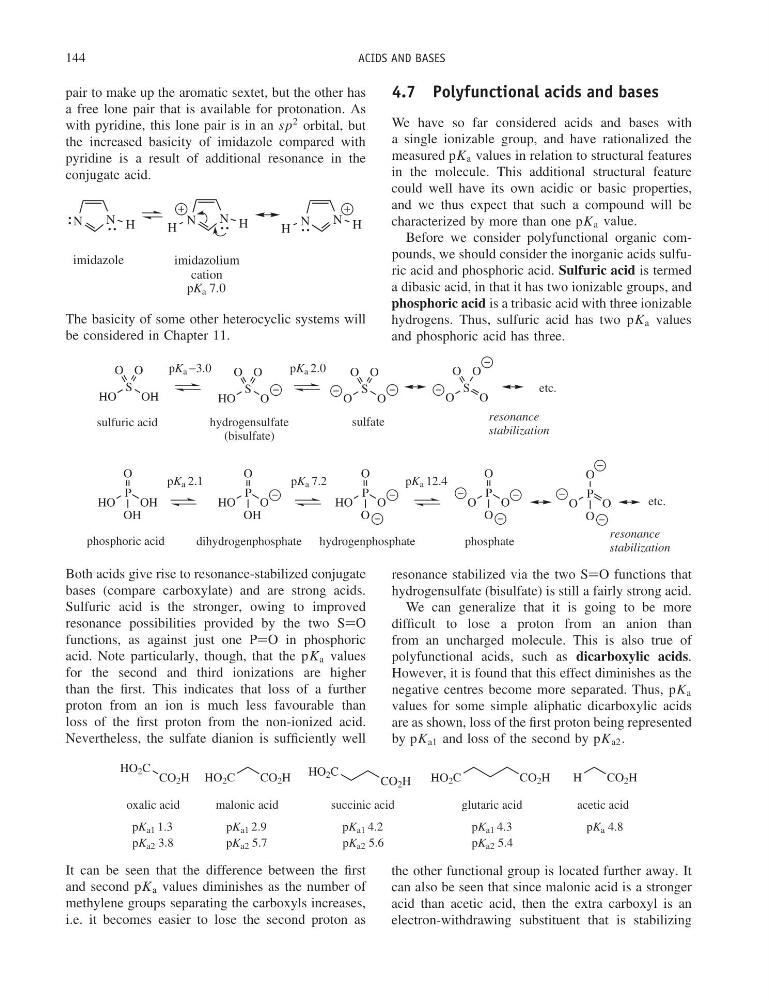
Before we consider polyfunctional organic compounds, we should consider the inorganic acids sulfuric acid and phosphoric acid. Sulfuric acid is termed
a dibasic acid, in that it has two ionizable groups, and
phosphoric acid is a tribasic acid with three ionizable
hydrogens. Thus, sulfuric acid has two pK a values
and phosphoric acid has three.
sulfuric acid
S
HO
OH
O
O
S
HO
O
O
O
S
O
O
O
O
hydrogensulfate
(bisulfate)
sulfate
pK a −3.0
pK a 2.0
phosphoric acid
O
P
HO
OH
OH
pK a 2.1
O
P
HO
O
OH
pK a 7.2
O
P
HO
O
O
pK a 12.4
O
P
O
O
O
dihydrogenphosphate hydrogenphosphate
phosphate
S
O
O
O
O
etc.
etc.
O
P
O
O
O
resonance
stabilization
resonance
stabilization
Both acids give rise to resonance-stabilized conjugate
bases (compare carboxylate) and are strong acids.
Sulfuric acid is the stronger, owing to improved
resonance possibilities provided by the two S=O
functions, as against just one P=O in phosphoric
acid. Note particularly, though, that the pK a values
for the second and third ionizations are higher
than the first. This indicates that loss of a further
proton from an ion is much less favourable than
loss of the first proton from the non-ionized acid.
Nevertheless, the sulfate dianion is sufficiently well
resonance stabilized via the two S=O functions that
hydrogensulfate (bisulfate) is still a fairly strong acid.
We can generalize that it is going to be more
difficult to lose a proton from an anion than
from an uncharged molecule. This is also true of
polyfunctional acids, such as dicarboxylic acids.
However, it is found that this effect diminishes as the
negative centres become more separated. Thus, pK a
values for some simple aliphatic dicarboxylic acids
are as shown, loss of the first proton being represented
by pK a1 and loss of the second by pK a2 .
HO 2 C
CO 2 H
oxalic acid
malonic acid
HO 2 C
CO 2 H
succinic acid
HO 2 C
CO 2 H
glutaric acid
pK a1 1.3
pK a2 3.8
pK a1 2.9
pK a2 5.7
pK a1 4.2
pK a2 5.6
pK a1 4.3
pK a2 5.4
H
CO 2 H
acetic acid
pK a 4.8
HO 2 C
CO 2 H
It can be seen that the difference between the first
and second pK a values diminishes as the number of
methylene groups separating the carboxyls increases,
i.e. it becomes easier to lose the second proton as
the other functional group is located further away. It
can also be seen that since malonic acid is a stronger
acid than acetic acid, then the extra carboxyl is an
electron-withdrawing substituent that is stabilizing
ACIDS AND BASES
pair to make up the aromatic sextet, but the other has
a free lone pair that is available for protonation. As
with pyridine, this lone pair is in an sp
2 orbital, but
the increased basicity of imidazole compared with
pyridine is a result of additional resonance in the
conjugate acid.
N
N
imidazole
pK a 7.0
N
N
H
H
H
N
N H
H
imidazolium
cation
The basicity of some other heterocyclic systems will
be considered in Chapter 11.
4.7 Polyfunctional acids and bases
We have so far considered acids and bases with
a single ionizable group, and have rationalized the
measured pK a values in relation to structural features
in the molecule. This additional structural feature
could well have its own acidic or basic properties,
and we thus expect that such a compound will be
characterized by more than one pK a value.
Before we consider polyfunctional organic compounds, we should consider the inorganic acids sulfuric acid and phosphoric acid. Sulfuric acid is termed
a dibasic acid, in that it has two ionizable groups, and
phosphoric acid is a tribasic acid with three ionizable
hydrogens. Thus, sulfuric acid has two pK a values
and phosphoric acid has three.
sulfuric acid
S
HO
OH
O
O
S
HO
O
O
O
S
O
O
O
O
hydrogensulfate
(bisulfate)
sulfate
pK a −3.0
pK a 2.0
phosphoric acid
O
P
HO
OH
OH
pK a 2.1
O
P
HO
O
OH
pK a 7.2
O
P
HO
O
O
pK a 12.4
O
P
O
O
O
dihydrogenphosphate hydrogenphosphate
phosphate
S
O
O
O
O
etc.
etc.
O
P
O
O
O
resonance
stabilization
resonance
stabilization
Both acids give rise to resonance-stabilized conjugate
bases (compare carboxylate) and are strong acids.
Sulfuric acid is the stronger, owing to improved
resonance possibilities provided by the two S=O
functions, as against just one P=O in phosphoric
acid. Note particularly, though, that the pK a values
for the second and third ionizations are higher
than the first. This indicates that loss of a further
proton from an ion is much less favourable than
loss of the first proton from the non-ionized acid.
Nevertheless, the sulfate dianion is sufficiently well
resonance stabilized via the two S=O functions that
hydrogensulfate (bisulfate) is still a fairly strong acid.
We can generalize that it is going to be more
difficult to lose a proton from an anion than
from an uncharged molecule. This is also true of
polyfunctional acids, such as dicarboxylic acids.
However, it is found that this effect diminishes as the
negative centres become more separated. Thus, pK a
values for some simple aliphatic dicarboxylic acids
are as shown, loss of the first proton being represented
by pK a1 and loss of the second by pK a2 .
HO 2 C
CO 2 H
oxalic acid
malonic acid
HO 2 C
CO 2 H
succinic acid
HO 2 C
CO 2 H
glutaric acid
pK a1 1.3
pK a2 3.8
pK a1 2.9
pK a2 5.7
pK a1 4.2
pK a2 5.6
pK a1 4.3
pK a2 5.4
H
CO 2 H
acetic acid
pK a 4.8
HO 2 C
CO 2 H
It can be seen that the difference between the first
and second pK a values diminishes as the number of
methylene groups separating the carboxyls increases,
i.e. it becomes easier to lose the second proton as
the other functional group is located further away. It
can also be seen that since malonic acid is a stronger
acid than acetic acid, then the extra carboxyl is an
electron-withdrawing substituent that is stabilizing