

BASICITY OF NITROGEN HETEROCYCLES
143
4.6 Basicity of nitrogen heterocycles
Our discussions of the basicity of organic nitrogen
compounds have concentrated predominantly on
simple amines in which the nitrogen atom under
consideration is part of an acyclic molecule. Many
biologically important compounds, and especially
drug molecules, are based upon systems in which
nitrogen is part of a heterocycle. We shall consider the
properties of heterocyclic compounds in more detail
in Chapter 11; here, we mainly want to show how
our rationalizations of basicity can be extended to a
few commonly encountered nitrogen heterocycles.
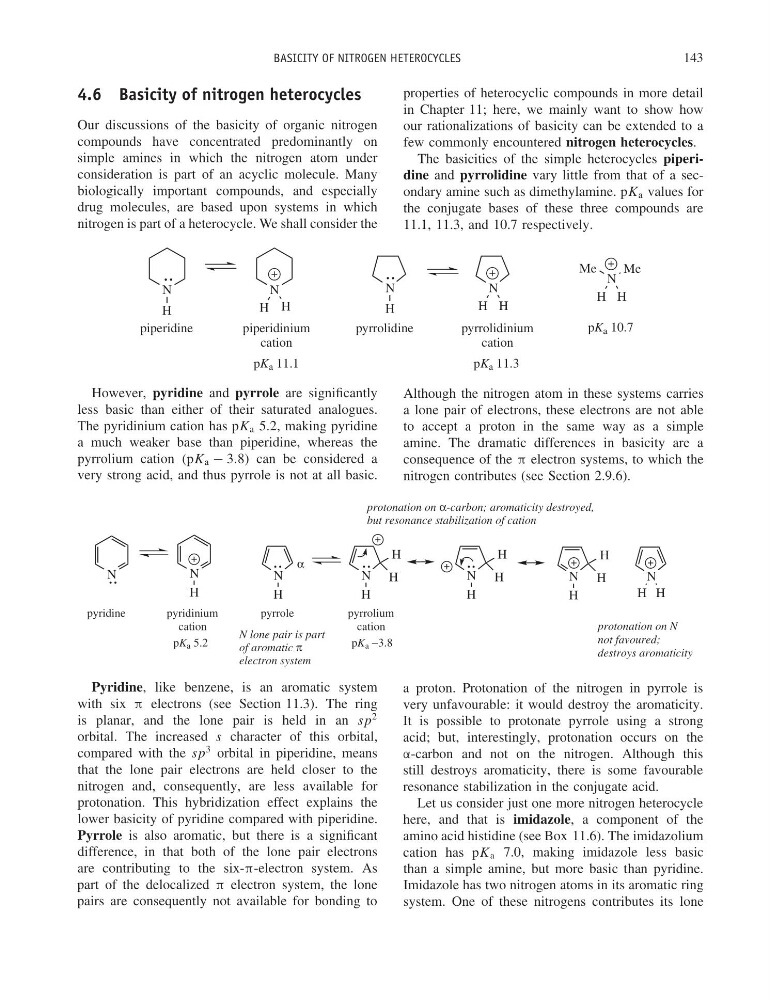
The basicities of the simple heterocycles piperidine and pyrrolidine vary little from that of a secondary amine such as dimethylamine. pK a values for
the conjugate bases of these three compounds are
11.1, 11.3, and 10.7 respectively.
N
N
piperidine
pK a 11.1
H
H
H
pK a 10.7
N
Me
Me
H
H
N
H
N
H H
pyrrolidine
pK a 11.3
piperidinium
cation
pyrrolidinium
cation
However, pyridine and pyrrole are significantly
less basic than either of their saturated analogues.
The pyridinium cation has pK a 5.2, making pyridine
a much weaker base than piperidine, whereas the
pyrrolium cation (pK a − 3.8) can be considered a
very strong acid, and thus pyrrole is not at all basic.
Although the nitrogen atom in these systems carries
a lone pair of electrons, these electrons are not able
to accept a proton in the same way as a simple
amine. The dramatic differences in basicity are a
consequence of the π electron systems, to which the
nitrogen contributes (see Section 2.9.6).
N
N
pyridine
pK a 5.2
N
H
N
H H
pyrrole
pK a −3.8
H
N
H
H
H
α
N
H
H
H
N
H
H
H
protonation on N
not favoured;
destroys aromaticity
protonation on α-carbon; aromaticity destroyed,
but resonance stabilization of cation
N lone pair is part
of aromatic π
electron system
pyridinium
cation
pyrrolium
cation
Pyridine, like benzene, is an aromatic system
with six π electrons (see Section 11.3). The ring
is planar, and the lone pair is held in an sp
2
orbital. The increased s character of this orbital,
compared with the sp
3 orbital in piperidine, means
that the lone pair electrons are held closer to the
nitrogen and, consequently, are less available for
protonation. This hybridization effect explains the
lower basicity of pyridine compared with piperidine.
Pyrrole is also aromatic, but there is a significant
difference, in that both of the lone pair electrons
are contributing to the six-π-electron system. As
part of the delocalized π electron system, the lone
pairs are consequently not available for bonding to
a proton. Protonation of the nitrogen in pyrrole is
very unfavourable: it would destroy the aromaticity.
It is possible to protonate pyrrole using a strong
acid; but, interestingly, protonation occurs on the
α-carbon and not on the nitrogen. Although this
still destroys aromaticity, there is some favourable
resonance stabilization in the conjugate acid.
Let us consider just one more nitrogen heterocycle
here, and that is imidazole, a component of the
amino acid histidine (see Box 11.6). The imidazolium
cation has pK a 7.0, making imidazole less basic
than a simple amine, but more basic than pyridine.
Imidazole has two nitrogen atoms in its aromatic ring
system. One of these nitrogens contributes its lone
143
4.6 Basicity of nitrogen heterocycles
Our discussions of the basicity of organic nitrogen
compounds have concentrated predominantly on
simple amines in which the nitrogen atom under
consideration is part of an acyclic molecule. Many
biologically important compounds, and especially
drug molecules, are based upon systems in which
nitrogen is part of a heterocycle. We shall consider the
properties of heterocyclic compounds in more detail
in Chapter 11; here, we mainly want to show how
our rationalizations of basicity can be extended to a
few commonly encountered nitrogen heterocycles.
The basicities of the simple heterocycles piperidine and pyrrolidine vary little from that of a secondary amine such as dimethylamine. pK a values for
the conjugate bases of these three compounds are
11.1, 11.3, and 10.7 respectively.
N
N
piperidine
pK a 11.1
H
H
H
pK a 10.7
N
Me
Me
H
H
N
H
N
H H
pyrrolidine
pK a 11.3
piperidinium
cation
pyrrolidinium
cation
However, pyridine and pyrrole are significantly
less basic than either of their saturated analogues.
The pyridinium cation has pK a 5.2, making pyridine
a much weaker base than piperidine, whereas the
pyrrolium cation (pK a − 3.8) can be considered a
very strong acid, and thus pyrrole is not at all basic.
Although the nitrogen atom in these systems carries
a lone pair of electrons, these electrons are not able
to accept a proton in the same way as a simple
amine. The dramatic differences in basicity are a
consequence of the π electron systems, to which the
nitrogen contributes (see Section 2.9.6).
N
N
pyridine
pK a 5.2
N
H
N
H H
pyrrole
pK a −3.8
H
N
H
H
H
α
N
H
H
H
N
H
H
H
protonation on N
not favoured;
destroys aromaticity
protonation on α-carbon; aromaticity destroyed,
but resonance stabilization of cation
N lone pair is part
of aromatic π
electron system
pyridinium
cation
pyrrolium
cation
Pyridine, like benzene, is an aromatic system
with six π electrons (see Section 11.3). The ring
is planar, and the lone pair is held in an sp
2
orbital. The increased s character of this orbital,
compared with the sp
3 orbital in piperidine, means
that the lone pair electrons are held closer to the
nitrogen and, consequently, are less available for
protonation. This hybridization effect explains the
lower basicity of pyridine compared with piperidine.
Pyrrole is also aromatic, but there is a significant
difference, in that both of the lone pair electrons
are contributing to the six-π-electron system. As
part of the delocalized π electron system, the lone
pairs are consequently not available for bonding to
a proton. Protonation of the nitrogen in pyrrole is
very unfavourable: it would destroy the aromaticity.
It is possible to protonate pyrrole using a strong
acid; but, interestingly, protonation occurs on the
α-carbon and not on the nitrogen. Although this
still destroys aromaticity, there is some favourable
resonance stabilization in the conjugate acid.
Let us consider just one more nitrogen heterocycle
here, and that is imidazole, a component of the
amino acid histidine (see Box 11.6). The imidazolium
cation has pK a 7.0, making imidazole less basic
than a simple amine, but more basic than pyridine.
Imidazole has two nitrogen atoms in its aromatic ring
system. One of these nitrogens contributes its lone