

142
ACIDS AND BASES
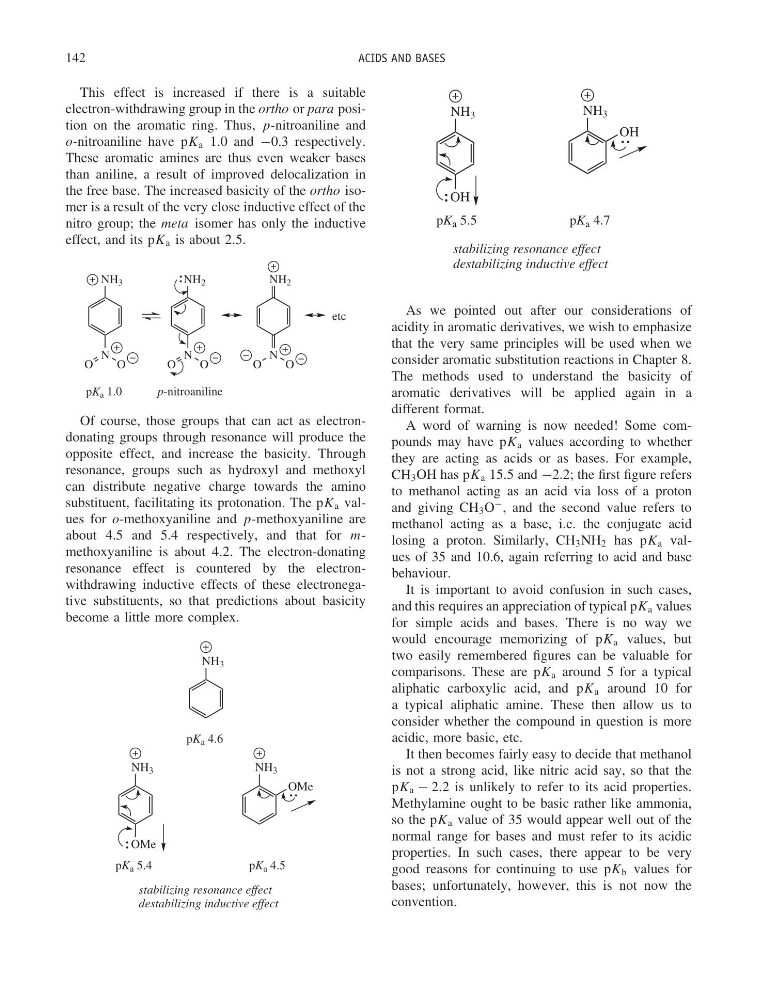
This effect is increased if there is a suitable
electron-withdrawing group in the ortho or para position on the aromatic ring. Thus, p-nitroaniline and
o-nitroaniline have pK a 1.0 and −0.3 respectively.
These aromatic amines are thus even weaker bases
than aniline, a result of improved delocalization in
the free base. The increased basicity of the ortho isomer is a result of the very close inductive effect of the
nitro group; the meta isomer has only the inductive
effect, and its pK a is about 2.5.
NH 2
NH 2
N
O
O
N
O
O
etc
pK a 1.0
NH 3
N
O
O
p-nitroaniline
Of course, those groups that can act as electrondonating groups through resonance will produce the
opposite effect, and increase the basicity. Through
resonance, groups such as hydroxyl and methoxyl
can distribute negative charge towards the amino
substituent, facilitating its protonation. The pK a values for o-methoxyaniline and p-methoxyaniline are
about 4.5 and 5.4 respectively, and that for mmethoxyaniline is about 4.2. The electron-donating
resonance effect is countered by the electronwithdrawing inductive effects of these electronegative substituents, so that predictions about basicity
become a little more complex.
NH 3
OMe
pK a 5.4
NH 3
pK a 4.5
OMe
NH 3
pK a 4.6
stabilizing resonance effect
destabilizing inductive effect
NH 3
OH
pK a 5.5
NH 3
OH
pK a 4.7
stabilizing resonance effect
destabilizing inductive effect
As we pointed out after our considerations of
acidity in aromatic derivatives, we wish to emphasize
that the very same principles will be used when we
consider aromatic substitution reactions in Chapter 8.
The methods used to understand the basicity of
aromatic derivatives will be applied again in a
different format.
A word of warning is now needed! Some compounds may have pK a values according to whether
they are acting as acids or as bases. For example,
CH 3 OH has pK a 15.5 and −2.2; the first figure refers
to methanol acting as an acid via loss of a proton
and giving CH 3 O
− , and the second value refers to
methanol acting as a base, i.e. the conjugate acid
losing a proton. Similarly, CH 3 NH 2 has pK a values of 35 and 10.6, again referring to acid and base
behaviour.
It is important to avoid confusion in such cases,
and this requires an appreciation of typical pK a values
for simple acids and bases. There is no way we
would encourage memorizing of pK a values, but
two easily remembered figures can be valuable for
comparisons. These are pK a around 5 for a typical
aliphatic carboxylic acid, and pK a around 10 for
a typical aliphatic amine. These then allow us to
consider whether the compound in question is more
acidic, more basic, etc.
It then becomes fairly easy to decide that methanol
is not a strong acid, like nitric acid say, so that the
pK a − 2.2 is unlikely to refer to its acid properties.
Methylamine ought to be basic rather like ammonia,
so the pK a value of 35 would appear well out of the
normal range for bases and must refer to its acidic
properties. In such cases, there appear to be very
good reasons for continuing to use pK b values for
bases; unfortunately, however, this is not now the
convention.
ACIDS AND BASES
This effect is increased if there is a suitable
electron-withdrawing group in the ortho or para position on the aromatic ring. Thus, p-nitroaniline and
o-nitroaniline have pK a 1.0 and −0.3 respectively.
These aromatic amines are thus even weaker bases
than aniline, a result of improved delocalization in
the free base. The increased basicity of the ortho isomer is a result of the very close inductive effect of the
nitro group; the meta isomer has only the inductive
effect, and its pK a is about 2.5.
NH 2
NH 2
N
O
O
N
O
O
etc
pK a 1.0
NH 3
N
O
O
p-nitroaniline
Of course, those groups that can act as electrondonating groups through resonance will produce the
opposite effect, and increase the basicity. Through
resonance, groups such as hydroxyl and methoxyl
can distribute negative charge towards the amino
substituent, facilitating its protonation. The pK a values for o-methoxyaniline and p-methoxyaniline are
about 4.5 and 5.4 respectively, and that for mmethoxyaniline is about 4.2. The electron-donating
resonance effect is countered by the electronwithdrawing inductive effects of these electronegative substituents, so that predictions about basicity
become a little more complex.
NH 3
OMe
pK a 5.4
NH 3
pK a 4.5
OMe
NH 3
pK a 4.6
stabilizing resonance effect
destabilizing inductive effect
NH 3
OH
pK a 5.5
NH 3
OH
pK a 4.7
stabilizing resonance effect
destabilizing inductive effect
As we pointed out after our considerations of
acidity in aromatic derivatives, we wish to emphasize
that the very same principles will be used when we
consider aromatic substitution reactions in Chapter 8.
The methods used to understand the basicity of
aromatic derivatives will be applied again in a
different format.
A word of warning is now needed! Some compounds may have pK a values according to whether
they are acting as acids or as bases. For example,
CH 3 OH has pK a 15.5 and −2.2; the first figure refers
to methanol acting as an acid via loss of a proton
and giving CH 3 O
− , and the second value refers to
methanol acting as a base, i.e. the conjugate acid
losing a proton. Similarly, CH 3 NH 2 has pK a values of 35 and 10.6, again referring to acid and base
behaviour.
It is important to avoid confusion in such cases,
and this requires an appreciation of typical pK a values
for simple acids and bases. There is no way we
would encourage memorizing of pK a values, but
two easily remembered figures can be valuable for
comparisons. These are pK a around 5 for a typical
aliphatic carboxylic acid, and pK a around 10 for
a typical aliphatic amine. These then allow us to
consider whether the compound in question is more
acidic, more basic, etc.
It then becomes fairly easy to decide that methanol
is not a strong acid, like nitric acid say, so that the
pK a − 2.2 is unlikely to refer to its acid properties.
Methylamine ought to be basic rather like ammonia,
so the pK a value of 35 would appear well out of the
normal range for bases and must refer to its acidic
properties. In such cases, there appear to be very
good reasons for continuing to use pK b values for
bases; unfortunately, however, this is not now the
convention.