

ELECTRONIC AND STRUCTURAL FEATURES THAT INFLUENCE BASICITY
141
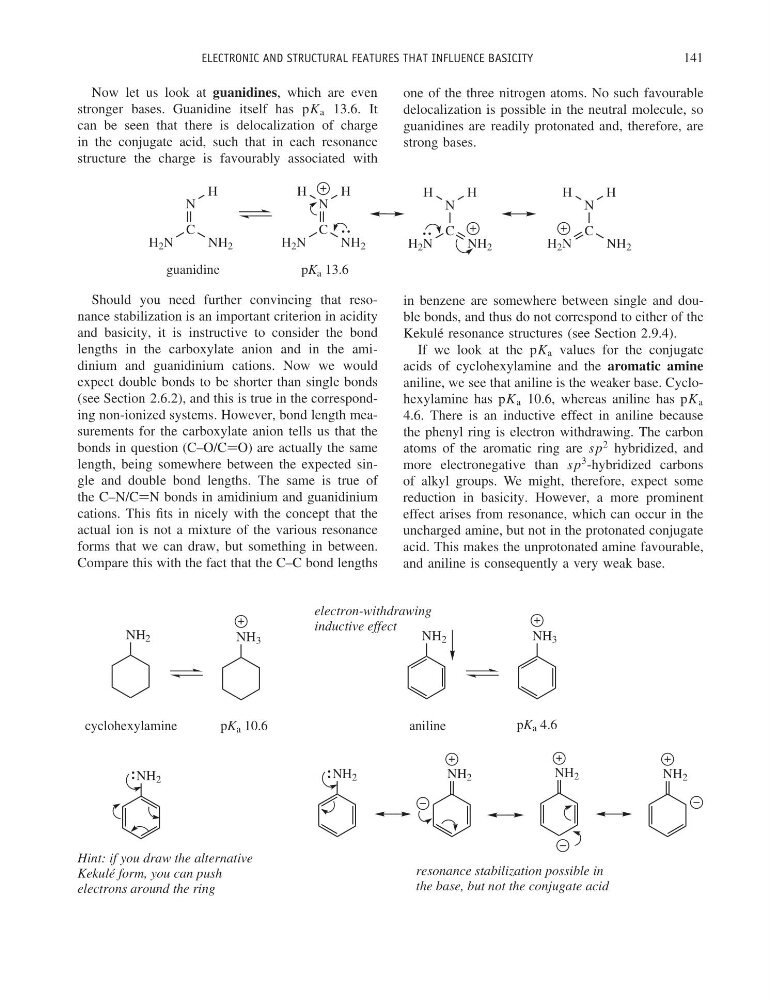
Now let us look at guanidines, which are even
stronger bases. Guanidine itself has pK a 13.6. It
can be seen that there is delocalization of charge
in the conjugate acid, such that in each resonance
structure the charge is favourably associated with
one of the three nitrogen atoms. No such favourable
delocalization is possible in the neutral molecule, so
guanidines are readily protonated and, therefore, are
strong bases.
N
C
H 2 N
NH 2
H
N
C
H 2 N
NH 2
H
H
pK a 13.6
N
C
H 2 N
NH 2
H
H
N
C
H 2 N
NH 2
H
H
guanidine
Should you need further convincing that resonance stabilization is an important criterion in acidity
and basicity, it is instructive to consider the bond
lengths in the carboxylate anion and in the amidinium and guanidinium cations. Now we would
expect double bonds to be shorter than single bonds
(see Section 2.6.2), and this is true in the corresponding non-ionized systems. However, bond length measurements for the carboxylate anion tells us that the
bonds in question (C–O/C=O) are actually the same
length, being somewhere between the expected single and double bond lengths. The same is true of
the C–N/C=N bonds in amidinium and guanidinium
cations. This fits in nicely with the concept that the
actual ion is not a mixture of the various resonance
forms that we can draw, but something in between.
Compare this with the fact that the C–C bond lengths
in benzene are somewhere between single and double bonds, and thus do not correspond to either of the
Kekul´ e resonance structures (see Section 2.9.4).
If we look at the pK a values for the conjugate
acids of cyclohexylamine and the aromatic amine
aniline, we see that aniline is the weaker base. Cyclohexylamine has pK a 10.6, whereas aniline has pK a
4.6. There is an inductive effect in aniline because
the phenyl ring is electron withdrawing. The carbon
atoms of the aromatic ring are sp
2 hybridized, and
more electronegative than sp
3 -hybridized carbons
of alkyl groups. We might, therefore, expect some
reduction in basicity. However, a more prominent
effect arises from resonance, which can occur in the
uncharged amine, but not in the protonated conjugate
acid. This makes the unprotonated amine favourable,
and aniline is consequently a very weak base.
NH 2
NH 3
cyclohexylamine
pK a 10.6
NH 2
NH 3
aniline
pK a 4.6
NH 2
NH 2
NH 2
NH 2
electron-withdrawing
inductive effect
resonance stabilization possible in
the base, but not the conjugate acid
NH 2
Hint: if you draw the alternative
Kekulé form, you can push
electrons around the ring
141
Now let us look at guanidines, which are even
stronger bases. Guanidine itself has pK a 13.6. It
can be seen that there is delocalization of charge
in the conjugate acid, such that in each resonance
structure the charge is favourably associated with
one of the three nitrogen atoms. No such favourable
delocalization is possible in the neutral molecule, so
guanidines are readily protonated and, therefore, are
strong bases.
N
C
H 2 N
NH 2
H
N
C
H 2 N
NH 2
H
H
pK a 13.6
N
C
H 2 N
NH 2
H
H
N
C
H 2 N
NH 2
H
H
guanidine
Should you need further convincing that resonance stabilization is an important criterion in acidity
and basicity, it is instructive to consider the bond
lengths in the carboxylate anion and in the amidinium and guanidinium cations. Now we would
expect double bonds to be shorter than single bonds
(see Section 2.6.2), and this is true in the corresponding non-ionized systems. However, bond length measurements for the carboxylate anion tells us that the
bonds in question (C–O/C=O) are actually the same
length, being somewhere between the expected single and double bond lengths. The same is true of
the C–N/C=N bonds in amidinium and guanidinium
cations. This fits in nicely with the concept that the
actual ion is not a mixture of the various resonance
forms that we can draw, but something in between.
Compare this with the fact that the C–C bond lengths
in benzene are somewhere between single and double bonds, and thus do not correspond to either of the
Kekul´ e resonance structures (see Section 2.9.4).
If we look at the pK a values for the conjugate
acids of cyclohexylamine and the aromatic amine
aniline, we see that aniline is the weaker base. Cyclohexylamine has pK a 10.6, whereas aniline has pK a
4.6. There is an inductive effect in aniline because
the phenyl ring is electron withdrawing. The carbon
atoms of the aromatic ring are sp
2 hybridized, and
more electronegative than sp
3 -hybridized carbons
of alkyl groups. We might, therefore, expect some
reduction in basicity. However, a more prominent
effect arises from resonance, which can occur in the
uncharged amine, but not in the protonated conjugate
acid. This makes the unprotonated amine favourable,
and aniline is consequently a very weak base.
NH 2
NH 3
cyclohexylamine
pK a 10.6
NH 2
NH 3
aniline
pK a 4.6
NH 2
NH 2
NH 2
NH 2
electron-withdrawing
inductive effect
resonance stabilization possible in
the base, but not the conjugate acid
NH 2
Hint: if you draw the alternative
Kekulé form, you can push
electrons around the ring