

146
ACIDS AND BASES
There are going to be a number of effects here,
with some that provide opposing influences. An
amino group has an electron-withdrawing inductive
effect, but has an electron-donating resonance effect
that tends to be greater in magnitude than the
inductive effect. A protonated amino group also
has an electron-withdrawing inductive effect that is
greater than that of an uncharged amino group. On
the other hand, it no longer supplies the electrondonating resonance effect. As with other disubstituted
benzenes, the ortho compound also experiences steric
effects that may reduce the benefits of resonance.
Both the meta and para diamines are stronger bases
than aniline, and protonation of the first amine in
all three compounds considerably inhibits the second
protonation.
4.8 pH
The acidity of an aqueous solution is normally
measured in terms of pH. pH is defined as
pH = − log 10 [H 3 O
+ ]
The lower the pH, the more acidic the solution; the
higher the pH, the more basic the solution. The pH
scale only applies to aqueous solutions, and is only
a measure of the acidity of the solution. It does not
indicate how strong the acid is (that is a function
of pK a ) and the pH of an acid will change as we
alter its concentration. For instance, dilution will
decrease the H 3 O
+ concentration, and thus the pH
will increase.
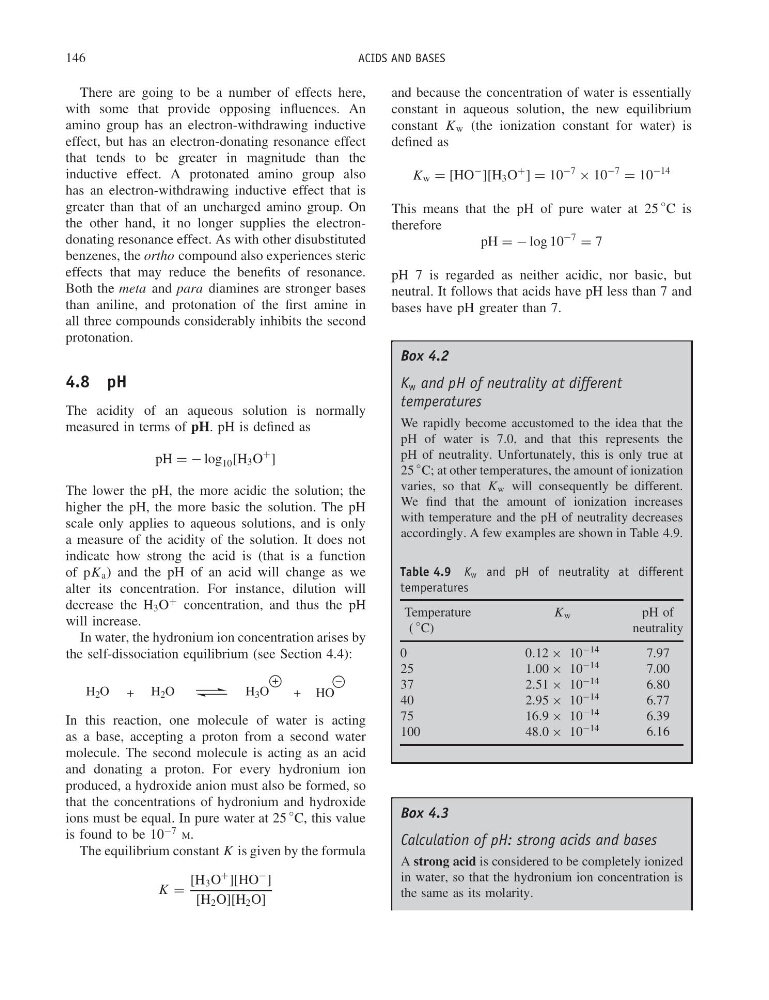
In water, the hydronium ion concentration arises by
the self-dissociation equilibrium (see Section 4.4):
H 2 O +
H 3 O
HO
H 2 O
+
In this reaction, one molecule of water is acting
as a base, accepting a proton from a second water
molecule. The second molecule is acting as an acid
and donating a proton. For every hydronium ion
produced, a hydroxide anion must also be formed, so
that the concentrations of hydronium and hydroxide
ions must be equal. In pure water at 25
◦ C, this value
is found to be 10
−7 M.
The equilibrium constant K is given by the formula
K =
[H 3 O
+ ][HO
− ]
[H 2 O][H 2 O]
and because the concentration of water is essentially
constant in aqueous solution, the new equilibrium
constant K w (the ionization constant for water) is
defined as
K w = [HO
− ][H 3 O
+ ] = 10
−7
× 10
−7
= 10
−14
This means that the pH of pure water at 25
◦ C is
therefore
pH = − log 10
−7
= 7
pH 7 is regarded as neither acidic, nor basic, but
neutral. It follows that acids have pH less than 7 and
bases have pH greater than 7.
Box 4.2
K w and pH of neutrality at different
temperatures
We rapidly become accustomed to the idea that the
pH of water is 7.0, and that this represents the
pH of neutrality. Unfortunately, this is only true at
25
◦ C; at other temperatures, the amount of ionization
varies, so that K w will consequently be different.
We find that the amount of ionization increases
with temperature and the pH of neutrality decreases
accordingly. A few examples are shown in Table 4.9.
Table 4.9 K w and pH of neutrality at different
temperatures
Temperature
(
◦ C)
K w
pH of
neutrality
0
0 .12 × 10
−14
7.97
25
1.00 × 10
−14
7.00
37
2.51 × 10
−14
6.80
40
2.95 × 10
−14
6.77
75
16.9 × 10
−14
6.39
100
48.0 × 10
−14
6.16
Box 4.3
Calculation of pH: strong acids and bases
A strong acid is considered to be completely ionized
in water, so that the hydronium ion concentration is
the same as its molarity.
ACIDS AND BASES
There are going to be a number of effects here,
with some that provide opposing influences. An
amino group has an electron-withdrawing inductive
effect, but has an electron-donating resonance effect
that tends to be greater in magnitude than the
inductive effect. A protonated amino group also
has an electron-withdrawing inductive effect that is
greater than that of an uncharged amino group. On
the other hand, it no longer supplies the electrondonating resonance effect. As with other disubstituted
benzenes, the ortho compound also experiences steric
effects that may reduce the benefits of resonance.
Both the meta and para diamines are stronger bases
than aniline, and protonation of the first amine in
all three compounds considerably inhibits the second
protonation.
4.8 pH
The acidity of an aqueous solution is normally
measured in terms of pH. pH is defined as
pH = − log 10 [H 3 O
+ ]
The lower the pH, the more acidic the solution; the
higher the pH, the more basic the solution. The pH
scale only applies to aqueous solutions, and is only
a measure of the acidity of the solution. It does not
indicate how strong the acid is (that is a function
of pK a ) and the pH of an acid will change as we
alter its concentration. For instance, dilution will
decrease the H 3 O
+ concentration, and thus the pH
will increase.
In water, the hydronium ion concentration arises by
the self-dissociation equilibrium (see Section 4.4):
H 2 O +
H 3 O
HO
H 2 O
+
In this reaction, one molecule of water is acting
as a base, accepting a proton from a second water
molecule. The second molecule is acting as an acid
and donating a proton. For every hydronium ion
produced, a hydroxide anion must also be formed, so
that the concentrations of hydronium and hydroxide
ions must be equal. In pure water at 25
◦ C, this value
is found to be 10
−7 M.
The equilibrium constant K is given by the formula
K =
[H 3 O
+ ][HO
− ]
[H 2 O][H 2 O]
and because the concentration of water is essentially
constant in aqueous solution, the new equilibrium
constant K w (the ionization constant for water) is
defined as
K w = [HO
− ][H 3 O
+ ] = 10
−7
× 10
−7
= 10
−14
This means that the pH of pure water at 25
◦ C is
therefore
pH = − log 10
−7
= 7
pH 7 is regarded as neither acidic, nor basic, but
neutral. It follows that acids have pH less than 7 and
bases have pH greater than 7.
Box 4.2
K w and pH of neutrality at different
temperatures
We rapidly become accustomed to the idea that the
pH of water is 7.0, and that this represents the
pH of neutrality. Unfortunately, this is only true at
25
◦ C; at other temperatures, the amount of ionization
varies, so that K w will consequently be different.
We find that the amount of ionization increases
with temperature and the pH of neutrality decreases
accordingly. A few examples are shown in Table 4.9.
Table 4.9 K w and pH of neutrality at different
temperatures
Temperature
(
◦ C)
K w
pH of
neutrality
0
0 .12 × 10
−14
7.97
25
1.00 × 10
−14
7.00
37
2.51 × 10
−14
6.80
40
2.95 × 10
−14
6.77
75
16.9 × 10
−14
6.39
100
48.0 × 10
−14
6.16
Box 4.3
Calculation of pH: strong acids and bases
A strong acid is considered to be completely ionized
in water, so that the hydronium ion concentration is
the same as its molarity.