

BASICITY
135
substitution reactions in Chapter 8, and this is why
we have purposely discussed the acidity of aromatic
derivatives in some detail.
4.4 Basicity
We have already defined a base as a substance that
will accept a proton by donating a pair of electrons.
Just as we have used pK a to measure the strength of
an acid, we need a system to measure the strength of
a base. Accordingly, a basicity scale based on pK b
was developed in a similar way to pK a .
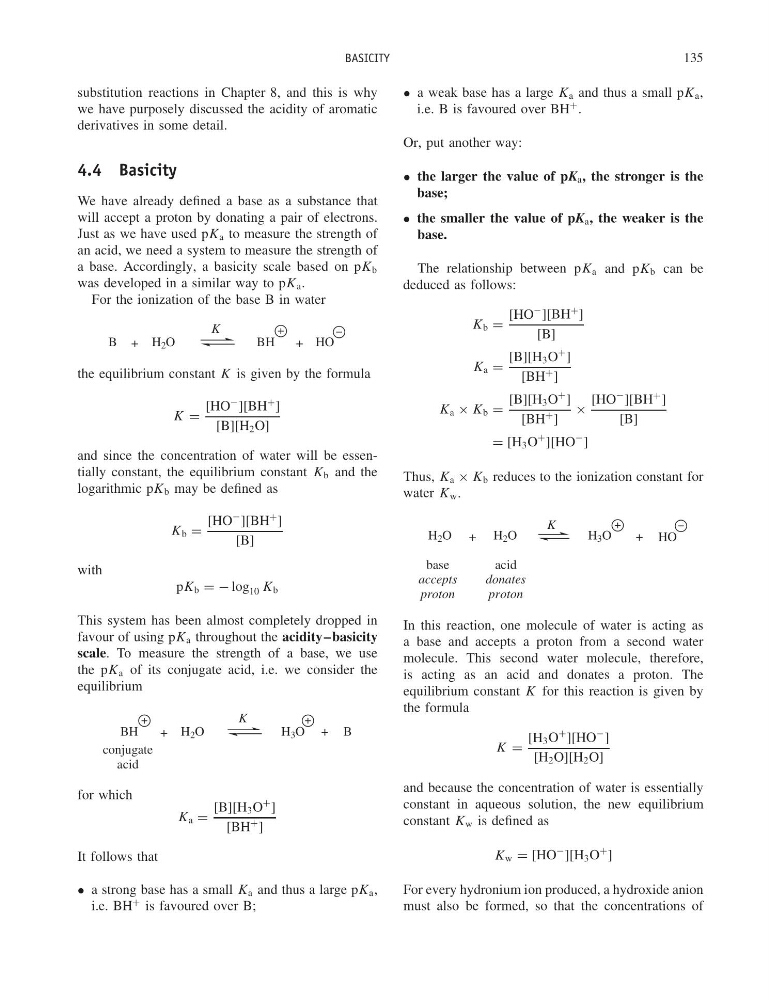
For the ionization of the base B in water
H 2 O
B +
HO
BH
+
K
the equilibrium constant K is given by the formula
K =
[HO
− ][BH
+ ]
[B][H 2 O]
and since the concentration of water will be essentially constant, the equilibrium constant K b and the
logarithmic pK b may be defined as
K b =
[HO
− ][BH
+ ]
[B]
with
pK b = − log 10 K b
This system has been almost completely dropped in
favour of using pK a throughout the acidity–basicity
scale. To measure the strength of a base, we use
the pK a of its conjugate acid, i.e. we consider the
equilibrium
BH
H 2 O
+
B
H 3 O +
conjugate
acid
K
for which
K a =
[B][H 3 O
+ ]
[BH
+ ]
It follows that
• a strong base has a small K a and thus a large pK a ,
i.e. BH
+ is favoured over B;
• a weak base has a large K a and thus a small pK a ,
i.e. B is favoured over BH
+ .
Or, put another way:
• the larger the value of pK a , the stronger is the
base;
• the smaller the value of pK a , the weaker is the
base.
The relationship between pK a and pK b can be
deduced as follows:
K b =
[HO
− ][BH
+ ]
[B]
K a =
[B][H 3 O
+ ]
[BH
+ ]
K a × K b =
[B][H 3 O
+ ]
[BH
+ ]
×
[HO
− ][BH
+ ]
[B]
= [H 3 O
+ ][HO
− ]
Thus, K a × K b reduces to the ionization constant for
water K w .
H 2 O +
H 3 O
HO
H 2 O
+
base
accepts
proton
acid
donates
proton
K
In this reaction, one molecule of water is acting as
a base and accepts a proton from a second water
molecule. This second water molecule, therefore,
is acting as an acid and donates a proton. The
equilibrium constant K for this reaction is given by
the formula
K =
[H 3 O
+ ][HO
− ]
[H 2 O][H 2 O]
and because the concentration of water is essentially
constant in aqueous solution, the new equilibrium
constant K w is defined as
K w = [HO
− ][H 3 O
+ ]
For every hydronium ion produced, a hydroxide anion
must also be formed, so that the concentrations of
135
substitution reactions in Chapter 8, and this is why
we have purposely discussed the acidity of aromatic
derivatives in some detail.
4.4 Basicity
We have already defined a base as a substance that
will accept a proton by donating a pair of electrons.
Just as we have used pK a to measure the strength of
an acid, we need a system to measure the strength of
a base. Accordingly, a basicity scale based on pK b
was developed in a similar way to pK a .
For the ionization of the base B in water
H 2 O
B +
HO
BH
+
K
the equilibrium constant K is given by the formula
K =
[HO
− ][BH
+ ]
[B][H 2 O]
and since the concentration of water will be essentially constant, the equilibrium constant K b and the
logarithmic pK b may be defined as
K b =
[HO
− ][BH
+ ]
[B]
with
pK b = − log 10 K b
This system has been almost completely dropped in
favour of using pK a throughout the acidity–basicity
scale. To measure the strength of a base, we use
the pK a of its conjugate acid, i.e. we consider the
equilibrium
BH
H 2 O
+
B
H 3 O +
conjugate
acid
K
for which
K a =
[B][H 3 O
+ ]
[BH
+ ]
It follows that
• a strong base has a small K a and thus a large pK a ,
i.e. BH
+ is favoured over B;
• a weak base has a large K a and thus a small pK a ,
i.e. B is favoured over BH
+ .
Or, put another way:
• the larger the value of pK a , the stronger is the
base;
• the smaller the value of pK a , the weaker is the
base.
The relationship between pK a and pK b can be
deduced as follows:
K b =
[HO
− ][BH
+ ]
[B]
K a =
[B][H 3 O
+ ]
[BH
+ ]
K a × K b =
[B][H 3 O
+ ]
[BH
+ ]
×
[HO
− ][BH
+ ]
[B]
= [H 3 O
+ ][HO
− ]
Thus, K a × K b reduces to the ionization constant for
water K w .
H 2 O +
H 3 O
HO
H 2 O
+
base
accepts
proton
acid
donates
proton
K
In this reaction, one molecule of water is acting as
a base and accepts a proton from a second water
molecule. This second water molecule, therefore,
is acting as an acid and donates a proton. The
equilibrium constant K for this reaction is given by
the formula
K =
[H 3 O
+ ][HO
− ]
[H 2 O][H 2 O]
and because the concentration of water is essentially
constant in aqueous solution, the new equilibrium
constant K w is defined as
K w = [HO
− ][H 3 O
+ ]
For every hydronium ion produced, a hydroxide anion
must also be formed, so that the concentrations of