

136
ACIDS AND BASES
hydronium and hydroxide ions must be equal. In pure
water at 25
◦ C, this value is found to be 10
−7 M.
K w = [HO
− ][H 3 O
+ ] = 10
−7
× 10
−7
= 10
−14
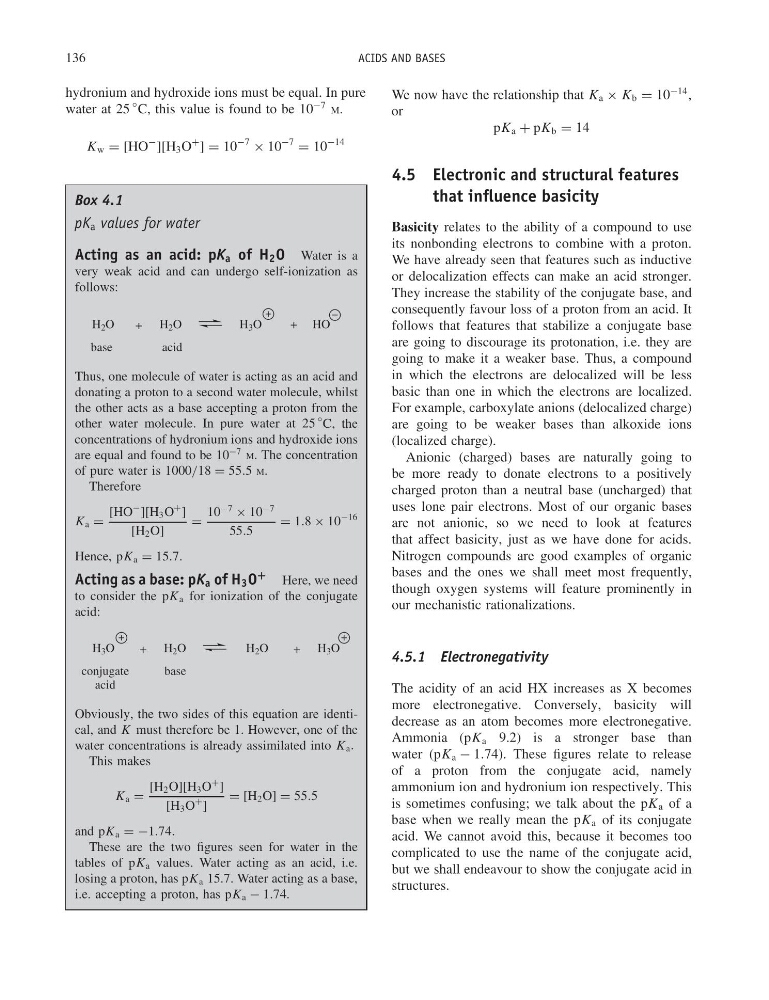
Box 4.1
pK a values for water
Acting as an acid: pK a of H 2 O Water is a
very weak acid and can undergo self-ionization as
follows:
H 2 O
H 2 O
+
H 3 O
+ HO
base
acid
Thus, one molecule of water is acting as an acid and
donating a proton to a second water molecule, whilst
the other acts as a base accepting a proton from the
other water molecule. In pure water at 25
◦ C, the
concentrations of hydronium ions and hydroxide ions
are equal and found to be 10
−7 M. The concentration
of pure water is 1000/18 = 55.5 M.
Therefore
K a =
[HO
− ][H 3 O
+ ]
[H 2 O]
=
10
−7
× 10
−7
55.5
= 1.8 × 10
−16
Hence, pK a = 15.7.
Acting as a base: pK a of H 3 O
+ Here, we need
to consider the pK a for ionization of the conjugate
acid:
H 2 O
+
H 3 O
conjugate
acid
base
H 3 O
+
H 2 O
Obviously, the two sides of this equation are identical, and K must therefore be 1. However, one of the
water concentrations is already assimilated into K a .
This makes
K a =
[H 2 O][H 3 O
+ ]
[H 3 O
+ ]
= [H 2 O] = 55.5
and pK a = −1.74.
These are the two figures seen for water in the
tables of pK a values. Water acting as an acid, i.e.
losing a proton, has pK a 15.7. Water acting as a base,
i.e. accepting a proton, has pK a − 1.74.
We now have the relationship that K a × K b = 10
−14 ,
or
pK a + pK b = 14
4.5 Electronic and structural features
that influence basicity
Basicity relates to the ability of a compound to use
its nonbonding electrons to combine with a proton.
We have already seen that features such as inductive
or delocalization effects can make an acid stronger.
They increase the stability of the conjugate base, and
consequently favour loss of a proton from an acid. It
follows that features that stabilize a conjugate base
are going to discourage its protonation, i.e. they are
going to make it a weaker base. Thus, a compound
in which the electrons are delocalized will be less
basic than one in which the electrons are localized.
For example, carboxylate anions (delocalized charge)
are going to be weaker bases than alkoxide ions
(localized charge).
Anionic (charged) bases are naturally going to
be more ready to donate electrons to a positively
charged proton than a neutral base (uncharged) that
uses lone pair electrons. Most of our organic bases
are not anionic, so we need to look at features
that affect basicity, just as we have done for acids.
Nitrogen compounds are good examples of organic
bases and the ones we shall meet most frequently,
though oxygen systems will feature prominently in
our mechanistic rationalizations.
4.5.1 Electronegativity
The acidity of an acid HX increases as X becomes
more electronegative. Conversely, basicity will
decrease as an atom becomes more electronegative.
Ammonia (pK a 9.2) is a stronger base than
water (pK a − 1.74). These figures relate to release
of a proton from the conjugate acid, namely
ammonium ion and hydronium ion respectively. This
is sometimes confusing; we talk about the pK a of a
base when we really mean the pK a of its conjugate
acid. We cannot avoid this, because it becomes too
complicated to use the name of the conjugate acid,
but we shall endeavour to show the conjugate acid in
structures.
ACIDS AND BASES
hydronium and hydroxide ions must be equal. In pure
water at 25
◦ C, this value is found to be 10
−7 M.
K w = [HO
− ][H 3 O
+ ] = 10
−7
× 10
−7
= 10
−14
Box 4.1
pK a values for water
Acting as an acid: pK a of H 2 O Water is a
very weak acid and can undergo self-ionization as
follows:
H 2 O
H 2 O
+
H 3 O
+ HO
base
acid
Thus, one molecule of water is acting as an acid and
donating a proton to a second water molecule, whilst
the other acts as a base accepting a proton from the
other water molecule. In pure water at 25
◦ C, the
concentrations of hydronium ions and hydroxide ions
are equal and found to be 10
−7 M. The concentration
of pure water is 1000/18 = 55.5 M.
Therefore
K a =
[HO
− ][H 3 O
+ ]
[H 2 O]
=
10
−7
× 10
−7
55.5
= 1.8 × 10
−16
Hence, pK a = 15.7.
Acting as a base: pK a of H 3 O
+ Here, we need
to consider the pK a for ionization of the conjugate
acid:
H 2 O
+
H 3 O
conjugate
acid
base
H 3 O
+
H 2 O
Obviously, the two sides of this equation are identical, and K must therefore be 1. However, one of the
water concentrations is already assimilated into K a .
This makes
K a =
[H 2 O][H 3 O
+ ]
[H 3 O
+ ]
= [H 2 O] = 55.5
and pK a = −1.74.
These are the two figures seen for water in the
tables of pK a values. Water acting as an acid, i.e.
losing a proton, has pK a 15.7. Water acting as a base,
i.e. accepting a proton, has pK a − 1.74.
We now have the relationship that K a × K b = 10
−14 ,
or
pK a + pK b = 14
4.5 Electronic and structural features
that influence basicity
Basicity relates to the ability of a compound to use
its nonbonding electrons to combine with a proton.
We have already seen that features such as inductive
or delocalization effects can make an acid stronger.
They increase the stability of the conjugate base, and
consequently favour loss of a proton from an acid. It
follows that features that stabilize a conjugate base
are going to discourage its protonation, i.e. they are
going to make it a weaker base. Thus, a compound
in which the electrons are delocalized will be less
basic than one in which the electrons are localized.
For example, carboxylate anions (delocalized charge)
are going to be weaker bases than alkoxide ions
(localized charge).
Anionic (charged) bases are naturally going to
be more ready to donate electrons to a positively
charged proton than a neutral base (uncharged) that
uses lone pair electrons. Most of our organic bases
are not anionic, so we need to look at features
that affect basicity, just as we have done for acids.
Nitrogen compounds are good examples of organic
bases and the ones we shall meet most frequently,
though oxygen systems will feature prominently in
our mechanistic rationalizations.
4.5.1 Electronegativity
The acidity of an acid HX increases as X becomes
more electronegative. Conversely, basicity will
decrease as an atom becomes more electronegative.
Ammonia (pK a 9.2) is a stronger base than
water (pK a − 1.74). These figures relate to release
of a proton from the conjugate acid, namely
ammonium ion and hydronium ion respectively. This
is sometimes confusing; we talk about the pK a of a
base when we really mean the pK a of its conjugate
acid. We cannot avoid this, because it becomes too
complicated to use the name of the conjugate acid,
but we shall endeavour to show the conjugate acid in
structures.