

134
ACIDS AND BASES
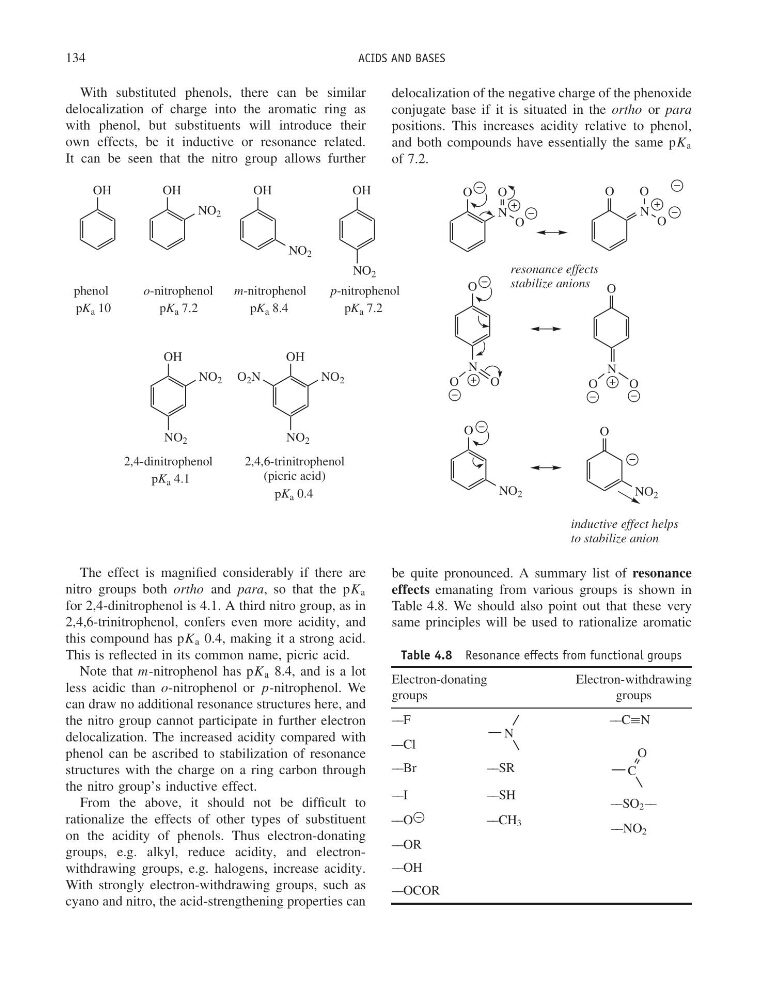
With substituted phenols, there can be similar
delocalization of charge into the aromatic ring as
with phenol, but substituents will introduce their
own effects, be it inductive or resonance related.
It can be seen that the nitro group allows further
delocalization of the negative charge of the phenoxide
conjugate base if it is situated in the ortho or para
positions. This increases acidity relative to phenol,
and both compounds have essentially the same pK a
of 7.2.
OH
phenol
pK a 10
OH
o-nitrophenol
pK a 7.2
NO 2
OH
m-nitrophenol
pK a 8.4
NO 2
OH
p-nitrophenol
pK a 7.2
NO 2
O
N
O
O
O
N
O
O
OH
2,4-dinitrophenol
pK a 4.1
NO 2
OH
2,4,6-trinitrophenol
(picric acid)
pK a 0.4
NO 2
NO 2
NO 2
O 2 N
O
NO 2
O
NO 2
inductive effect helps
to stabilize anion
O
O
N
N
O
O
O
O
resonance effects
stabilize anions
The effect is magnified considerably if there are
nitro groups both ortho and para, so that the pK a
for 2,4-dinitrophenol is 4.1. A third nitro group, as in
2,4,6-trinitrophenol, confers even more acidity, and
this compound has pK a 0.4, making it a strong acid.
This is reflected in its common name, picric acid.
Note that m-nitrophenol has pK a 8.4, and is a lot
less acidic than o-nitrophenol or p-nitrophenol. We
can draw no additional resonance structures here, and
the nitro group cannot participate in further electron
delocalization. The increased acidity compared with
phenol can be ascribed to stabilization of resonance
structures with the charge on a ring carbon through
the nitro group’s inductive effect.
From the above, it should not be difficult to
rationalize the effects of other types of substituent
on the acidity of phenols. Thus electron-donating
groups, e.g. alkyl, reduce acidity, and electronwithdrawing groups, e.g. halogens, increase acidity.
With strongly electron-withdrawing groups, such as
cyano and nitro, the acid-strengthening properties can
be quite pronounced. A summary list of resonance
effects emanating from various groups is shown in
Table 4.8. We should also point out that these very
same principles will be used to rationalize aromatic
Table 4.8 Resonance effects from functional groups
Electron-donating
groups
Electron-withdrawing
groups
––F
N
––C≡N
––Cl
C
O
––Br
––SR
––I
––SH
––SO 2 ––
––O
––CH 3
––NO 2
––OR
––OH
––OCOR
ACIDS AND BASES
With substituted phenols, there can be similar
delocalization of charge into the aromatic ring as
with phenol, but substituents will introduce their
own effects, be it inductive or resonance related.
It can be seen that the nitro group allows further
delocalization of the negative charge of the phenoxide
conjugate base if it is situated in the ortho or para
positions. This increases acidity relative to phenol,
and both compounds have essentially the same pK a
of 7.2.
OH
phenol
pK a 10
OH
o-nitrophenol
pK a 7.2
NO 2
OH
m-nitrophenol
pK a 8.4
NO 2
OH
p-nitrophenol
pK a 7.2
NO 2
O
N
O
O
O
N
O
O
OH
2,4-dinitrophenol
pK a 4.1
NO 2
OH
2,4,6-trinitrophenol
(picric acid)
pK a 0.4
NO 2
NO 2
NO 2
O 2 N
O
NO 2
O
NO 2
inductive effect helps
to stabilize anion
O
O
N
N
O
O
O
O
resonance effects
stabilize anions
The effect is magnified considerably if there are
nitro groups both ortho and para, so that the pK a
for 2,4-dinitrophenol is 4.1. A third nitro group, as in
2,4,6-trinitrophenol, confers even more acidity, and
this compound has pK a 0.4, making it a strong acid.
This is reflected in its common name, picric acid.
Note that m-nitrophenol has pK a 8.4, and is a lot
less acidic than o-nitrophenol or p-nitrophenol. We
can draw no additional resonance structures here, and
the nitro group cannot participate in further electron
delocalization. The increased acidity compared with
phenol can be ascribed to stabilization of resonance
structures with the charge on a ring carbon through
the nitro group’s inductive effect.
From the above, it should not be difficult to
rationalize the effects of other types of substituent
on the acidity of phenols. Thus electron-donating
groups, e.g. alkyl, reduce acidity, and electronwithdrawing groups, e.g. halogens, increase acidity.
With strongly electron-withdrawing groups, such as
cyano and nitro, the acid-strengthening properties can
be quite pronounced. A summary list of resonance
effects emanating from various groups is shown in
Table 4.8. We should also point out that these very
same principles will be used to rationalize aromatic
Table 4.8 Resonance effects from functional groups
Electron-donating
groups
Electron-withdrawing
groups
––F
N
––C≡N
––Cl
C
O
––Br
––SR
––I
––SH
––SO 2 ––
––O
––CH 3
––NO 2
––OR
––OH
––OCOR