

ELECTRONIC AND STRUCTURAL FEATURES THAT INFLUENCE ACIDITY
133
and its contribution predominates (but see below for
chlorine).
The relatively high acidity of ortho-hydroxybenzoic acid (salicylic acid), compared with the
other derivatives just considered, is ascribed to
intramolecular hydrogen bonding, which is not
possible in the other compounds, even with orthomethoxybenzoic acid.
O
O
O
H
favourable H-bonding
stabilizes anion
O
HO
O
H
H-bonding in
non-ionized acid
Hydrogen bonding involves a favourable sixmembered ring and helps to stabilize the conjugate
base. Although some hydrogen bonding occurs in the
non-ionized acid, the effect is much stronger in the
carboxylate anion.
It should be noted that the electron-donating
resonance effects just considered are the result of lone
pair electrons feeding in to the π electron system.
Potentially, any substituent with a lone pair might do
the same, yet we did not invoke such a mechanism
with chlorine substituents above. As the size of the
atom increases, lone pair electrons will be located in
orbitals of higher level, e.g. 3p rather than 2p as in
carbon. Consequently, the ability to overlap the lone
pair orbital with the π electron system of the aromatic
ring will diminish, a simple consequence of how
far from the atom the electrons are mostly located.
Chlorine thus produces a low resonance effect but a
high inductive effect, and the latter predominates.
Cl
O
OH
CO 2 H
Cl
weak
resonance effect
strong
inductive effect
HO
O
OH
CO 2 H
OH
strong
resonance effect
weak inductive
effect
>
>
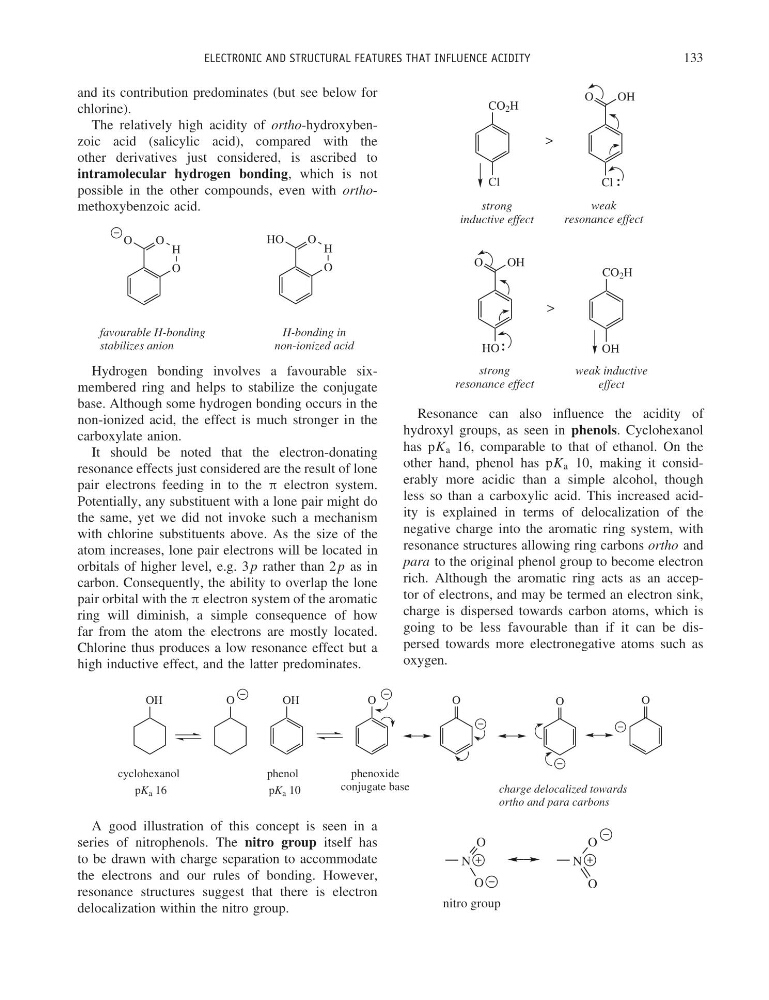
Resonance can also influence the acidity of
hydroxyl groups, as seen in phenols. Cyclohexanol
has pK a 16, comparable to that of ethanol. On the
other hand, phenol has pK a 10, making it considerably more acidic than a simple alcohol, though
less so than a carboxylic acid. This increased acidity is explained in terms of delocalization of the
negative charge into the aromatic ring system, with
resonance structures allowing ring carbons ortho and
para to the original phenol group to become electron
rich. Although the aromatic ring acts as an acceptor of electrons, and may be termed an electron sink,
charge is dispersed towards carbon atoms, which is
going to be less favourable than if it can be dispersed towards more electronegative atoms such as
oxygen.
OH
O
cyclohexanol
pK a 16
OH
O
O
O
O
phenol
pK a 10
phenoxide
conjugate base
charge delocalized towards
ortho and para carbons
A good illustration of this concept is seen in a
series of nitrophenols. The nitro group itself has
to be drawn with charge separation to accommodate
the electrons and our rules of bonding. However,
resonance structures suggest that there is electron
delocalization within the nitro group.
N
O
O
N
O
O
nitro group
133
and its contribution predominates (but see below for
chlorine).
The relatively high acidity of ortho-hydroxybenzoic acid (salicylic acid), compared with the
other derivatives just considered, is ascribed to
intramolecular hydrogen bonding, which is not
possible in the other compounds, even with orthomethoxybenzoic acid.
O
O
O
H
favourable H-bonding
stabilizes anion
O
HO
O
H
H-bonding in
non-ionized acid
Hydrogen bonding involves a favourable sixmembered ring and helps to stabilize the conjugate
base. Although some hydrogen bonding occurs in the
non-ionized acid, the effect is much stronger in the
carboxylate anion.
It should be noted that the electron-donating
resonance effects just considered are the result of lone
pair electrons feeding in to the π electron system.
Potentially, any substituent with a lone pair might do
the same, yet we did not invoke such a mechanism
with chlorine substituents above. As the size of the
atom increases, lone pair electrons will be located in
orbitals of higher level, e.g. 3p rather than 2p as in
carbon. Consequently, the ability to overlap the lone
pair orbital with the π electron system of the aromatic
ring will diminish, a simple consequence of how
far from the atom the electrons are mostly located.
Chlorine thus produces a low resonance effect but a
high inductive effect, and the latter predominates.
Cl
O
OH
CO 2 H
Cl
weak
resonance effect
strong
inductive effect
HO
O
OH
CO 2 H
OH
strong
resonance effect
weak inductive
effect
>
>
Resonance can also influence the acidity of
hydroxyl groups, as seen in phenols. Cyclohexanol
has pK a 16, comparable to that of ethanol. On the
other hand, phenol has pK a 10, making it considerably more acidic than a simple alcohol, though
less so than a carboxylic acid. This increased acidity is explained in terms of delocalization of the
negative charge into the aromatic ring system, with
resonance structures allowing ring carbons ortho and
para to the original phenol group to become electron
rich. Although the aromatic ring acts as an acceptor of electrons, and may be termed an electron sink,
charge is dispersed towards carbon atoms, which is
going to be less favourable than if it can be dispersed towards more electronegative atoms such as
oxygen.
OH
O
cyclohexanol
pK a 16
OH
O
O
O
O
phenol
pK a 10
phenoxide
conjugate base
charge delocalized towards
ortho and para carbons
A good illustration of this concept is seen in a
series of nitrophenols. The nitro group itself has
to be drawn with charge separation to accommodate
the electrons and our rules of bonding. However,
resonance structures suggest that there is electron
delocalization within the nitro group.
N
O
O
N
O
O
nitro group