

132
ACIDS AND BASES
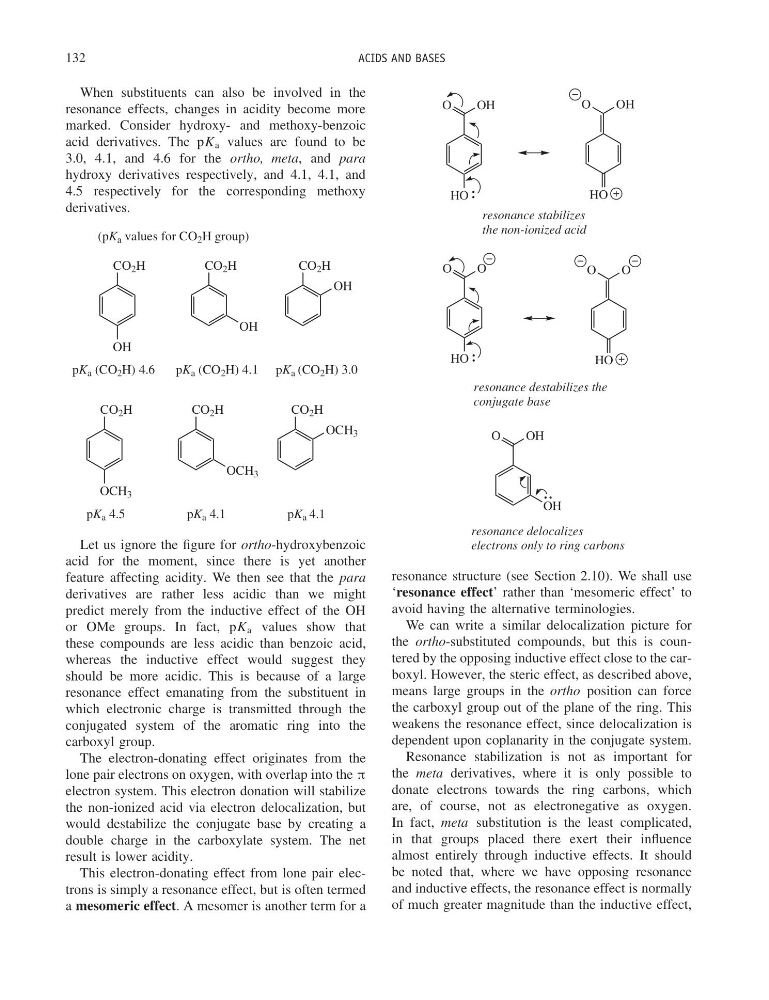
When substituents can also be involved in the
resonance effects, changes in acidity become more
marked. Consider hydroxy- and methoxy-benzoic
acid derivatives. The pK a values are found to be
3.0, 4.1, and 4.6 for the ortho, meta, and para
hydroxy derivatives respectively, and 4.1, 4.1, and
4.5 respectively for the corresponding methoxy
derivatives.
CO 2 H
CO 2 H
CO 2 H
OCH 3
OCH 3
OCH 3
CO 2 H
CO 2 H
CO 2 H
OH
OH
OH
pK a 4.5
pK a 4.1
pK a 4.1
pK a (CO 2 H) 4.6
pK a (CO 2 H) 4.1 pK a (CO 2 H) 3.0
(pK a values for CO 2 H group)
Let us ignore the figure for ortho-hydroxybenzoic
acid for the moment, since there is yet another
feature affecting acidity. We then see that the para
derivatives are rather less acidic than we might
predict merely from the inductive effect of the OH
or OMe groups. In fact, pK a values show that
these compounds are less acidic than benzoic acid,
whereas the inductive effect would suggest they
should be more acidic. This is because of a large
resonance effect emanating from the substituent in
which electronic charge is transmitted through the
conjugated system of the aromatic ring into the
carboxyl group.
The electron-donating effect originates from the
lone pair electrons on oxygen, with overlap into the π
electron system. This electron donation will stabilize
the non-ionized acid via electron delocalization, but
would destabilize the conjugate base by creating a
double charge in the carboxylate system. The net
result is lower acidity.
This electron-donating effect from lone pair electrons is simply a resonance effect, but is often termed
a mesomeric effect. A mesomer is another term for a
HO
O
OH
HO
O
OH
resonance stabilizes
the non-ionized acid
HO
O
O
HO
O
O
resonance destabilizes the
conjugate base
OH
O
OH
resonance delocalizes
electrons only to ring carbons
resonance structure (see Section 2.10). We shall use
‘resonance effect’ rather than ‘mesomeric effect’ to
avoid having the alternative terminologies.
We can write a similar delocalization picture for
the ortho-substituted compounds, but this is countered by the opposing inductive effect close to the carboxyl. However, the steric effect, as described above,
means large groups in the ortho position can force
the carboxyl group out of the plane of the ring. This
weakens the resonance effect, since delocalization is
dependent upon coplanarity in the conjugate system.
Resonance stabilization is not as important for
the meta derivatives, where it is only possible to
donate electrons towards the ring carbons, which
are, of course, not as electronegative as oxygen.
In fact, meta substitution is the least complicated,
in that groups placed there exert their influence
almost entirely through inductive effects. It should
be noted that, where we have opposing resonance
and inductive effects, the resonance effect is normally
of much greater magnitude than the inductive effect,
ACIDS AND BASES
When substituents can also be involved in the
resonance effects, changes in acidity become more
marked. Consider hydroxy- and methoxy-benzoic
acid derivatives. The pK a values are found to be
3.0, 4.1, and 4.6 for the ortho, meta, and para
hydroxy derivatives respectively, and 4.1, 4.1, and
4.5 respectively for the corresponding methoxy
derivatives.
CO 2 H
CO 2 H
CO 2 H
OCH 3
OCH 3
OCH 3
CO 2 H
CO 2 H
CO 2 H
OH
OH
OH
pK a 4.5
pK a 4.1
pK a 4.1
pK a (CO 2 H) 4.6
pK a (CO 2 H) 4.1 pK a (CO 2 H) 3.0
(pK a values for CO 2 H group)
Let us ignore the figure for ortho-hydroxybenzoic
acid for the moment, since there is yet another
feature affecting acidity. We then see that the para
derivatives are rather less acidic than we might
predict merely from the inductive effect of the OH
or OMe groups. In fact, pK a values show that
these compounds are less acidic than benzoic acid,
whereas the inductive effect would suggest they
should be more acidic. This is because of a large
resonance effect emanating from the substituent in
which electronic charge is transmitted through the
conjugated system of the aromatic ring into the
carboxyl group.
The electron-donating effect originates from the
lone pair electrons on oxygen, with overlap into the π
electron system. This electron donation will stabilize
the non-ionized acid via electron delocalization, but
would destabilize the conjugate base by creating a
double charge in the carboxylate system. The net
result is lower acidity.
This electron-donating effect from lone pair electrons is simply a resonance effect, but is often termed
a mesomeric effect. A mesomer is another term for a
HO
O
OH
HO
O
OH
resonance stabilizes
the non-ionized acid
HO
O
O
HO
O
O
resonance destabilizes the
conjugate base
OH
O
OH
resonance delocalizes
electrons only to ring carbons
resonance structure (see Section 2.10). We shall use
‘resonance effect’ rather than ‘mesomeric effect’ to
avoid having the alternative terminologies.
We can write a similar delocalization picture for
the ortho-substituted compounds, but this is countered by the opposing inductive effect close to the carboxyl. However, the steric effect, as described above,
means large groups in the ortho position can force
the carboxyl group out of the plane of the ring. This
weakens the resonance effect, since delocalization is
dependent upon coplanarity in the conjugate system.
Resonance stabilization is not as important for
the meta derivatives, where it is only possible to
donate electrons towards the ring carbons, which
are, of course, not as electronegative as oxygen.
In fact, meta substitution is the least complicated,
in that groups placed there exert their influence
almost entirely through inductive effects. It should
be noted that, where we have opposing resonance
and inductive effects, the resonance effect is normally
of much greater magnitude than the inductive effect,