

ELECTRONIC AND STRUCTURAL FEATURES THAT INFLUENCE ACIDITY
131
O
OH
O
OH
O
OH
resonance favours non-ionized benzoic acid
O
O
resonance unfavourable
in anion
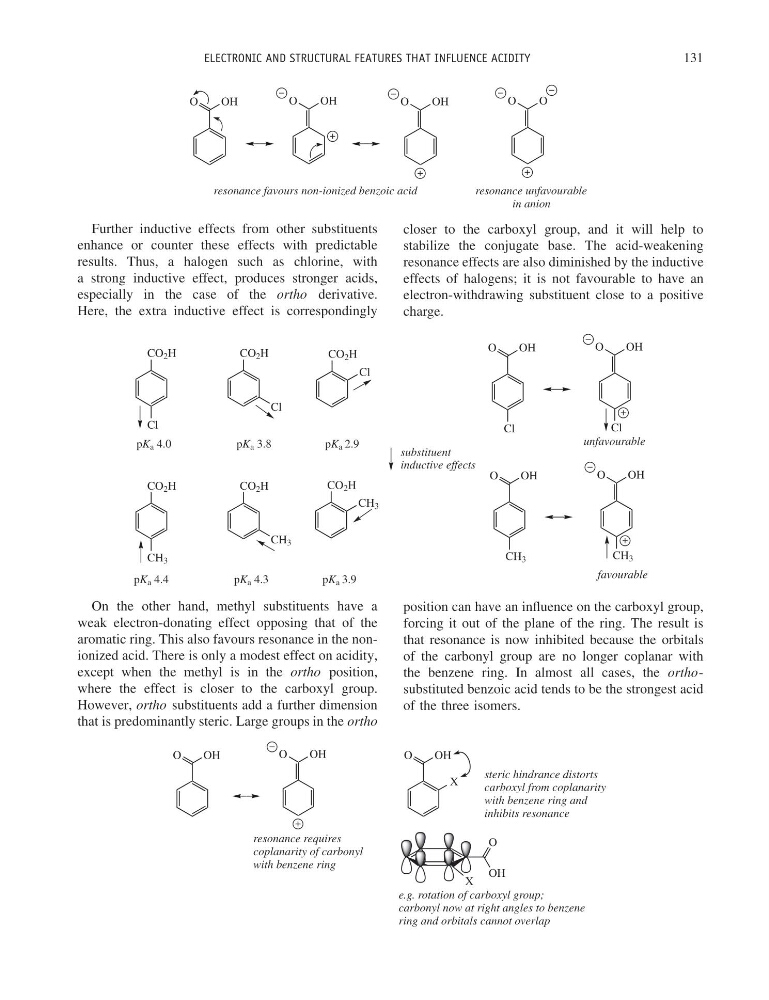
Further inductive effects from other substituents
enhance or counter these effects with predictable
results. Thus, a halogen such as chlorine, with
a strong inductive effect, produces stronger acids,
especially in the case of the ortho derivative.
Here, the extra inductive effect is correspondingly
closer to the carboxyl group, and it will help to
stabilize the conjugate base. The acid-weakening
resonance effects are also diminished by the inductive
effects of halogens; it is not favourable to have an
electron-withdrawing substituent close to a positive
charge.
CO 2 H
CO 2 H
CO 2 H
Cl
Cl
Cl
pK a 4.0
pK a 3.8
pK a 2.9
substituent
inductive effects
O
OH
O
OH
Cl
Cl
unfavourable
CO 2 H
CO 2 H
CO 2 H
CH 3
CH 3
CH 3
pK a 4.4
pK a 4.3
pK a 3.9
O
OH
O
OH
CH 3
CH 3
favourable
On the other hand, methyl substituents have a
weak electron-donating effect opposing that of the
aromatic ring. This also favours resonance in the nonionized acid. There is only a modest effect on acidity,
except when the methyl is in the ortho position,
where the effect is closer to the carboxyl group.
However, ortho substituents add a further dimension
that is predominantly steric. Large groups in the ortho
position can have an influence on the carboxyl group,
forcing it out of the plane of the ring. The result is
that resonance is now inhibited because the orbitals
of the carbonyl group are no longer coplanar with
the benzene ring. In almost all cases, the orthosubstituted benzoic acid tends to be the strongest acid
of the three isomers.
O
OH
O
OH
resonance requires
coplanarity of carbonyl
with benzene ring
O
OH
X
steric hindrance distorts
carboxyl from coplanarity
with benzene ring and
inhibits resonance
X
O
OH
e.g. rotation of carboxyl group;
carbonyl now at right angles to benzene
ring and orbitals cannot overlap
131
O
OH
O
OH
O
OH
resonance favours non-ionized benzoic acid
O
O
resonance unfavourable
in anion
Further inductive effects from other substituents
enhance or counter these effects with predictable
results. Thus, a halogen such as chlorine, with
a strong inductive effect, produces stronger acids,
especially in the case of the ortho derivative.
Here, the extra inductive effect is correspondingly
closer to the carboxyl group, and it will help to
stabilize the conjugate base. The acid-weakening
resonance effects are also diminished by the inductive
effects of halogens; it is not favourable to have an
electron-withdrawing substituent close to a positive
charge.
CO 2 H
CO 2 H
CO 2 H
Cl
Cl
Cl
pK a 4.0
pK a 3.8
pK a 2.9
substituent
inductive effects
O
OH
O
OH
Cl
Cl
unfavourable
CO 2 H
CO 2 H
CO 2 H
CH 3
CH 3
CH 3
pK a 4.4
pK a 4.3
pK a 3.9
O
OH
O
OH
CH 3
CH 3
favourable
On the other hand, methyl substituents have a
weak electron-donating effect opposing that of the
aromatic ring. This also favours resonance in the nonionized acid. There is only a modest effect on acidity,
except when the methyl is in the ortho position,
where the effect is closer to the carboxyl group.
However, ortho substituents add a further dimension
that is predominantly steric. Large groups in the ortho
position can have an influence on the carboxyl group,
forcing it out of the plane of the ring. The result is
that resonance is now inhibited because the orbitals
of the carbonyl group are no longer coplanar with
the benzene ring. In almost all cases, the orthosubstituted benzoic acid tends to be the strongest acid
of the three isomers.
O
OH
O
OH
resonance requires
coplanarity of carbonyl
with benzene ring
O
OH
X
steric hindrance distorts
carboxyl from coplanarity
with benzene ring and
inhibits resonance
X
O
OH
e.g. rotation of carboxyl group;
carbonyl now at right angles to benzene
ring and orbitals cannot overlap