

130
ACIDS AND BASES
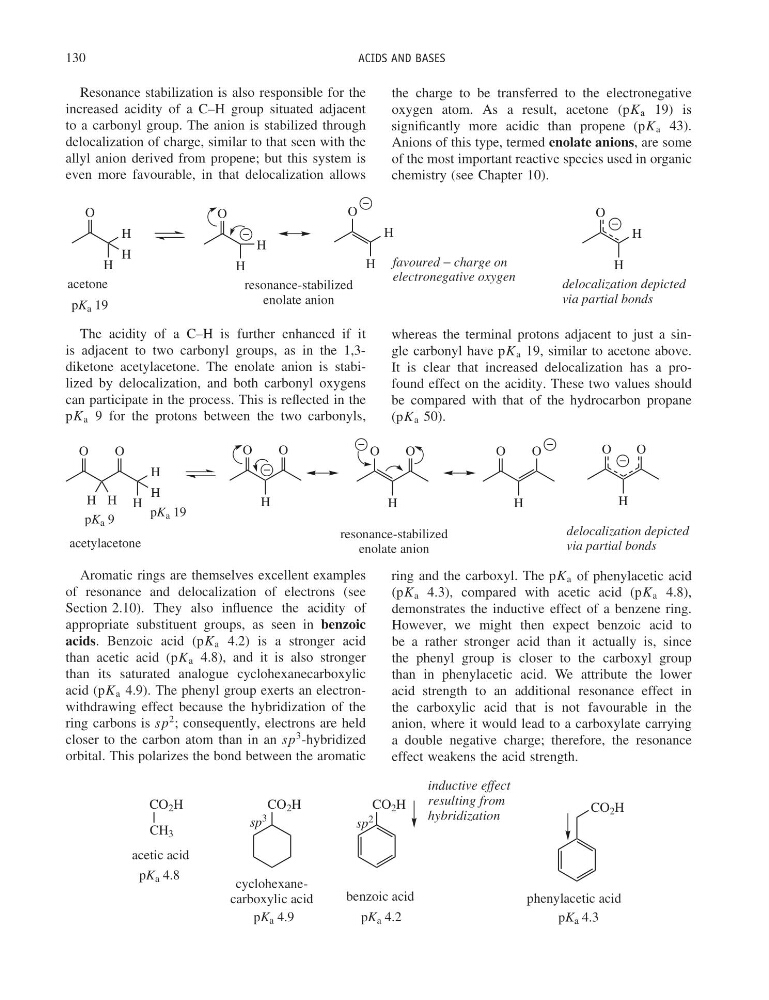
Resonance stabilization is also responsible for the
increased acidity of a C–H group situated adjacent
to a carbonyl group. The anion is stabilized through
delocalization of charge, similar to that seen with the
allyl anion derived from propene; but this system is
even more favourable, in that delocalization allows
the charge to be transferred to the electronegative
oxygen atom. As a result, acetone (pK a 19) is
significantly more acidic than propene (pK a 43).
Anions of this type, termed enolate anions, are some
of the most important reactive species used in organic
chemistry (see Chapter 10).
O
H
H
H
O
H
O
H
H
O
H
H
resonance-stabilized
enolate anion
favoured − charge on
electronegative oxygen
acetone
pK a 19
H
delocalization depicted
via partial bonds
The acidity of a C–H is further enhanced if it
is adjacent to two carbonyl groups, as in the 1,3diketone acetylacetone. The enolate anion is stabilized by delocalization, and both carbonyl oxygens
can participate in the process. This is reflected in the
pK a 9 for the protons between the two carbonyls,
whereas the terminal protons adjacent to just a single carbonyl have pK a 19, similar to acetone above.
It is clear that increased delocalization has a profound effect on the acidity. These two values should
be compared with that of the hydrocarbon propane
(pK a 50).
O
O
H
H
acetylacetone
pK a 19
H
H
H
pK a 9
O
O
O
O
O
O
O
O
H
resonance-stabilized
enolate anion
delocalization depicted
via partial bonds
H
H
H
Aromatic rings are themselves excellent examples
of resonance and delocalization of electrons (see
Section 2.10). They also influence the acidity of
appropriate substituent groups, as seen in benzoic
acids. Benzoic acid (pK a 4.2) is a stronger acid
than acetic acid (pK a 4.8), and it is also stronger
than its saturated analogue cyclohexanecarboxylic
acid (pK a 4.9). The phenyl group exerts an electronwithdrawing effect because the hybridization of the
ring carbons is sp
2 ; consequently, electrons are held
closer to the carbon atom than in an sp
3 -hybridized
orbital. This polarizes the bond between the aromatic
ring and the carboxyl. The pK a of phenylacetic acid
(pK a 4.3), compared with acetic acid (pK a 4.8),
demonstrates the inductive effect of a benzene ring.
However, we might then expect benzoic acid to
be a rather stronger acid than it actually is, since
the phenyl group is closer to the carboxyl group
than in phenylacetic acid. We attribute the lower
acid strength to an additional resonance effect in
the carboxylic acid that is not favourable in the
anion, where it would lead to a carboxylate carrying
a double negative charge; therefore, the resonance
effect weakens the acid strength.
CO 2 H
cyclohexanecarboxylic acid
pK a 4.9
CO 2 H
benzoic acid
pK a 4.2
sp 3
sp
2
inductive effect
resulting from
hybridization
CO 2 H
acetic acid
pK a 4.8
phenylacetic acid
pK a 4.3
CO 2 H
CH 3
ACIDS AND BASES
Resonance stabilization is also responsible for the
increased acidity of a C–H group situated adjacent
to a carbonyl group. The anion is stabilized through
delocalization of charge, similar to that seen with the
allyl anion derived from propene; but this system is
even more favourable, in that delocalization allows
the charge to be transferred to the electronegative
oxygen atom. As a result, acetone (pK a 19) is
significantly more acidic than propene (pK a 43).
Anions of this type, termed enolate anions, are some
of the most important reactive species used in organic
chemistry (see Chapter 10).
O
H
H
H
O
H
O
H
H
O
H
H
resonance-stabilized
enolate anion
favoured − charge on
electronegative oxygen
acetone
pK a 19
H
delocalization depicted
via partial bonds
The acidity of a C–H is further enhanced if it
is adjacent to two carbonyl groups, as in the 1,3diketone acetylacetone. The enolate anion is stabilized by delocalization, and both carbonyl oxygens
can participate in the process. This is reflected in the
pK a 9 for the protons between the two carbonyls,
whereas the terminal protons adjacent to just a single carbonyl have pK a 19, similar to acetone above.
It is clear that increased delocalization has a profound effect on the acidity. These two values should
be compared with that of the hydrocarbon propane
(pK a 50).
O
O
H
H
acetylacetone
pK a 19
H
H
H
pK a 9
O
O
O
O
O
O
O
O
H
resonance-stabilized
enolate anion
delocalization depicted
via partial bonds
H
H
H
Aromatic rings are themselves excellent examples
of resonance and delocalization of electrons (see
Section 2.10). They also influence the acidity of
appropriate substituent groups, as seen in benzoic
acids. Benzoic acid (pK a 4.2) is a stronger acid
than acetic acid (pK a 4.8), and it is also stronger
than its saturated analogue cyclohexanecarboxylic
acid (pK a 4.9). The phenyl group exerts an electronwithdrawing effect because the hybridization of the
ring carbons is sp
2 ; consequently, electrons are held
closer to the carbon atom than in an sp
3 -hybridized
orbital. This polarizes the bond between the aromatic
ring and the carboxyl. The pK a of phenylacetic acid
(pK a 4.3), compared with acetic acid (pK a 4.8),
demonstrates the inductive effect of a benzene ring.
However, we might then expect benzoic acid to
be a rather stronger acid than it actually is, since
the phenyl group is closer to the carboxyl group
than in phenylacetic acid. We attribute the lower
acid strength to an additional resonance effect in
the carboxylic acid that is not favourable in the
anion, where it would lead to a carboxylate carrying
a double negative charge; therefore, the resonance
effect weakens the acid strength.
CO 2 H
cyclohexanecarboxylic acid
pK a 4.9
CO 2 H
benzoic acid
pK a 4.2
sp 3
sp
2
inductive effect
resulting from
hybridization
CO 2 H
acetic acid
pK a 4.8
phenylacetic acid
pK a 4.3
CO 2 H
CH 3