

ELECTRONIC AND STRUCTURAL FEATURES THAT INFLUENCE ACIDITY
129
4.3.5 Resonance/delocalization effects
Delocalization of charge in the conjugate base anion
through resonance is a stabilizing factor and will
be reflected by an increase in acidity. Drawing
resonance structures allows us to rationalize that
the negative charge is not permanently localized on
a particular atom, but may be dispersed to other
areas of the structure. We should appreciate that a
better interpretation is that the electrons are contained
in a molecular orbital that spans several atoms.
However, drawing resonance structures provides a
simple and convenient way of predicting stability
through delocalization (see Section 2.10).
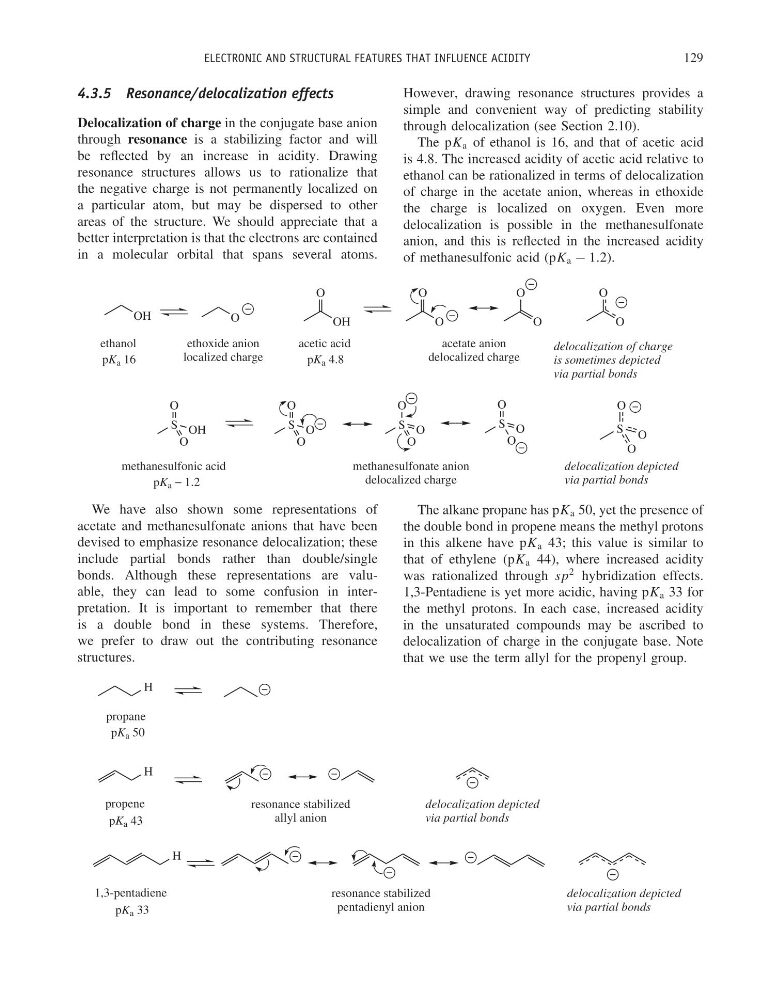
The pK a of ethanol is 16, and that of acetic acid
is 4.8. The increased acidity of acetic acid relative to
ethanol can be rationalized in terms of delocalization
of charge in the acetate anion, whereas in ethoxide
the charge is localized on oxygen. Even more
delocalization is possible in the methanesulfonate
anion, and this is reflected in the increased acidity
of methanesulfonic acid (pK a − 1.2).
OH
ethanol
pK a 16
O
O
OH
acetic acid
pK a 4.8
O
O
O
O
O
O
ethoxide anion
localized charge
acetate anion
delocalized charge
delocalization of charge
is sometimes depicted
via partial bonds
S OH
O
O
methanesulfonic acid
pK a − 1.2
S O
O
O
S O
O
O
S O
O
O
methanesulfonate anion
delocalized charge
S O
O
O
delocalization depicted
via partial bonds
We have also shown some representations of
acetate and methanesulfonate anions that have been
devised to emphasize resonance delocalization; these
include partial bonds rather than double/single
bonds. Although these representations are valuable, they can lead to some confusion in interpretation. It is important to remember that there
is a double bond in these systems. Therefore,
we prefer to draw out the contributing resonance
structures.
The alkane propane has pK a 50, yet the presence of
the double bond in propene means the methyl protons
in this alkene have pK a 43; this value is similar to
that of ethylene (pK a 44), where increased acidity
was rationalized through sp
2 hybridization effects.
1,3-Pentadiene is yet more acidic, having pK a 33 for
the methyl protons. In each case, increased acidity
in the unsaturated compounds may be ascribed to
delocalization of charge in the conjugate base. Note
that we use the term allyl for the propenyl group.
H
propene
pK a 43
H
propane
pK a 50
1,3-pentadiene
pK a 33
H
resonance stabilized
allyl anion
delocalization depicted
via partial bonds
delocalization depicted
via partial bonds
resonance stabilized
pentadienyl anion
129
4.3.5 Resonance/delocalization effects
Delocalization of charge in the conjugate base anion
through resonance is a stabilizing factor and will
be reflected by an increase in acidity. Drawing
resonance structures allows us to rationalize that
the negative charge is not permanently localized on
a particular atom, but may be dispersed to other
areas of the structure. We should appreciate that a
better interpretation is that the electrons are contained
in a molecular orbital that spans several atoms.
However, drawing resonance structures provides a
simple and convenient way of predicting stability
through delocalization (see Section 2.10).
The pK a of ethanol is 16, and that of acetic acid
is 4.8. The increased acidity of acetic acid relative to
ethanol can be rationalized in terms of delocalization
of charge in the acetate anion, whereas in ethoxide
the charge is localized on oxygen. Even more
delocalization is possible in the methanesulfonate
anion, and this is reflected in the increased acidity
of methanesulfonic acid (pK a − 1.2).
OH
ethanol
pK a 16
O
O
OH
acetic acid
pK a 4.8
O
O
O
O
O
O
ethoxide anion
localized charge
acetate anion
delocalized charge
delocalization of charge
is sometimes depicted
via partial bonds
S OH
O
O
methanesulfonic acid
pK a − 1.2
S O
O
O
S O
O
O
S O
O
O
methanesulfonate anion
delocalized charge
S O
O
O
delocalization depicted
via partial bonds
We have also shown some representations of
acetate and methanesulfonate anions that have been
devised to emphasize resonance delocalization; these
include partial bonds rather than double/single
bonds. Although these representations are valuable, they can lead to some confusion in interpretation. It is important to remember that there
is a double bond in these systems. Therefore,
we prefer to draw out the contributing resonance
structures.
The alkane propane has pK a 50, yet the presence of
the double bond in propene means the methyl protons
in this alkene have pK a 43; this value is similar to
that of ethylene (pK a 44), where increased acidity
was rationalized through sp
2 hybridization effects.
1,3-Pentadiene is yet more acidic, having pK a 33 for
the methyl protons. In each case, increased acidity
in the unsaturated compounds may be ascribed to
delocalization of charge in the conjugate base. Note
that we use the term allyl for the propenyl group.
H
propene
pK a 43
H
propane
pK a 50
1,3-pentadiene
pK a 33
H
resonance stabilized
allyl anion
delocalization depicted
via partial bonds
delocalization depicted
via partial bonds
resonance stabilized
pentadienyl anion