

128
ACIDS AND BASES
4.3.4 Hybridization effects
The acidity of a C–H bond is influenced by the
hybridization state of the carbon atom attached to the
acidic hydrogen. Dissociation of the acid generates
an anion whose lone pair of electrons is held in a
hybridized orbital. We can consider sp orbitals to
have more s character than sp
2 orbitals, and similarly
sp
2 orbitals to have more s character than sp
3 orbitals
(see Section 2.6.2). Since s orbitals are closer to
the nucleus than p orbitals, it follows that electrons
in an sp-hybridized orbital are held closer to the
nucleus than those in an sp
2 orbital; those in an
sp
2 orbital are similarly closer to the nucleus than
those in an sp
3 orbital. It is more favourable for the
electrons to be held close to the positively charged
nucleus, and thus an sp-hybridized anion is more
stable than an sp
2 -hydridized anion, which is more
stable than an sp
3 -hybridized anion. Thus, the acidity
of a C–H bond decreases as the s character of the
bond decreases.
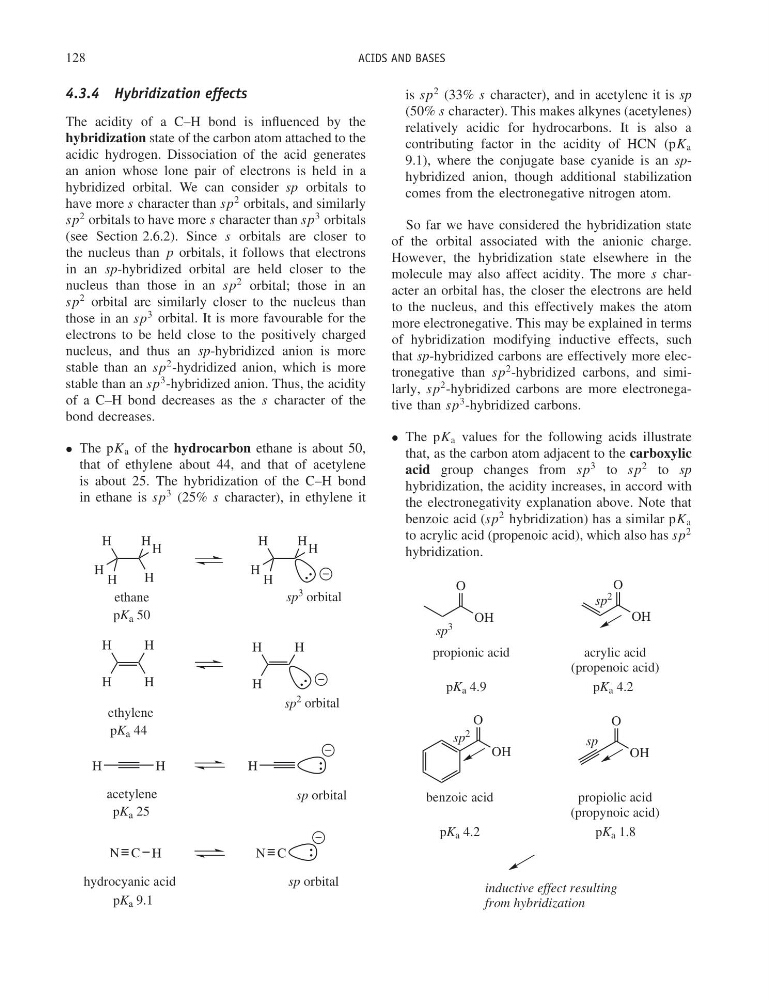
• The pK a of the hydrocarbon ethane is about 50,
that of ethylene about 44, and that of acetylene
is about 25. The hybridization of the C–H bond
in ethane is sp
3 (25% s character), in ethylene it
H
H
H
H
H
H
H
H
H
H
ethane
ethylene
pK a 44
pK a 50
H
H
H
H
H
H
H
H
sp 3 orbital
sp
2 orbital
H
H
acetylene
pK a 25
H
sp orbital
N C H
pK a 9.1
N C
sp orbital
hydrocyanic acid
is sp
2 (33% s character), and in acetylene it is sp
(50% s character). This makes alkynes (acetylenes)
relatively acidic for hydrocarbons. It is also a
contributing factor in the acidity of HCN (pK a
9.1), where the conjugate base cyanide is an sphybridized anion, though additional stabilization
comes from the electronegative nitrogen atom.
So far we have considered the hybridization state
of the orbital associated with the anionic charge.
However, the hybridization state elsewhere in the
molecule may also affect acidity. The more s character an orbital has, the closer the electrons are held
to the nucleus, and this effectively makes the atom
more electronegative. This may be explained in terms
of hybridization modifying inductive effects, such
that sp-hybridized carbons are effectively more electronegative than sp
2 -hybridized carbons, and similarly, sp
2 -hybridized carbons are more electronegative than sp
3 -hybridized carbons.
• The pK a values for the following acids illustrate
that, as the carbon atom adjacent to the carboxylic
acid group changes from sp
3 to sp
2 to sp
hybridization, the acidity increases, in accord with
the electronegativity explanation above. Note that
benzoic acid (sp
2 hybridization) has a similar pK a
to acrylic acid (propenoic acid), which also has sp
2
hybridization.
O
OH
O
OH
O
OH
O
OH
acrylic acid
(propenoic acid)
pK a 4.2
benzoic acid
pK a 4.2
propionic acid
pK a 4.9
propiolic acid
(propynoic acid)
pK a 1.8
sp
3
sp 2
sp 2
sp
inductive effect resulting
from hybridization
ACIDS AND BASES
4.3.4 Hybridization effects
The acidity of a C–H bond is influenced by the
hybridization state of the carbon atom attached to the
acidic hydrogen. Dissociation of the acid generates
an anion whose lone pair of electrons is held in a
hybridized orbital. We can consider sp orbitals to
have more s character than sp
2 orbitals, and similarly
sp
2 orbitals to have more s character than sp
3 orbitals
(see Section 2.6.2). Since s orbitals are closer to
the nucleus than p orbitals, it follows that electrons
in an sp-hybridized orbital are held closer to the
nucleus than those in an sp
2 orbital; those in an
sp
2 orbital are similarly closer to the nucleus than
those in an sp
3 orbital. It is more favourable for the
electrons to be held close to the positively charged
nucleus, and thus an sp-hybridized anion is more
stable than an sp
2 -hydridized anion, which is more
stable than an sp
3 -hybridized anion. Thus, the acidity
of a C–H bond decreases as the s character of the
bond decreases.
• The pK a of the hydrocarbon ethane is about 50,
that of ethylene about 44, and that of acetylene
is about 25. The hybridization of the C–H bond
in ethane is sp
3 (25% s character), in ethylene it
H
H
H
H
H
H
H
H
H
H
ethane
ethylene
pK a 44
pK a 50
H
H
H
H
H
H
H
H
sp 3 orbital
sp
2 orbital
H
H
acetylene
pK a 25
H
sp orbital
N C H
pK a 9.1
N C
sp orbital
hydrocyanic acid
is sp
2 (33% s character), and in acetylene it is sp
(50% s character). This makes alkynes (acetylenes)
relatively acidic for hydrocarbons. It is also a
contributing factor in the acidity of HCN (pK a
9.1), where the conjugate base cyanide is an sphybridized anion, though additional stabilization
comes from the electronegative nitrogen atom.
So far we have considered the hybridization state
of the orbital associated with the anionic charge.
However, the hybridization state elsewhere in the
molecule may also affect acidity. The more s character an orbital has, the closer the electrons are held
to the nucleus, and this effectively makes the atom
more electronegative. This may be explained in terms
of hybridization modifying inductive effects, such
that sp-hybridized carbons are effectively more electronegative than sp
2 -hybridized carbons, and similarly, sp
2 -hybridized carbons are more electronegative than sp
3 -hybridized carbons.
• The pK a values for the following acids illustrate
that, as the carbon atom adjacent to the carboxylic
acid group changes from sp
3 to sp
2 to sp
hybridization, the acidity increases, in accord with
the electronegativity explanation above. Note that
benzoic acid (sp
2 hybridization) has a similar pK a
to acrylic acid (propenoic acid), which also has sp
2
hybridization.
O
OH
O
OH
O
OH
O
OH
acrylic acid
(propenoic acid)
pK a 4.2
benzoic acid
pK a 4.2
propionic acid
pK a 4.9
propiolic acid
(propynoic acid)
pK a 1.8
sp
3
sp 2
sp 2
sp
inductive effect resulting
from hybridization