

ELECTRONIC AND STRUCTURAL FEATURES THAT INFLUENCE ACIDITY
127
substituent in question is located further away
from the site of negative charge, because it has
to be transmitted through more bonds. Thus, the
effect on the acidity in butanoic acid derivatives can be seen to diminish with distance. 2Chlorobutanoic acid (pK a 2.9) shows a significant
enhancement in acidity over butanoic acid (pK a
4.9), whereas 3-chlorobutanoic acid (pK a 4.1) and
4-chlorobutanoic acid (pK a 4.5) show rather more
modest changes.
• Other electron-withdrawing groups that increase
the acidity of acids include, listed in decreasing
order of their effect: –NO 2 , –N
+ R 3 , –CN, –CO 2 R,
–CO–, –OR and –OH. A more extensive list is
given in Table 4.7.
Electron-donating groups will have the opposite
effect, destabilizing the conjugate base by increasing
electron density, and thus produce weaker acids. The
most common electron-donating groups encountered
are going to be alkyl groups, though the effect
from alkyl groups is actually rather small. Indeed,
it is not immediately apparent why there should
be any inductive effect at all, since substitution of
hydrogen by alkyl should not lead to any bond
polarization. At this point, we should merely note
that alkyl groups have a weak electron-donating
effect – it may not be strictly an inductive effect (see
Section 6.2.1).
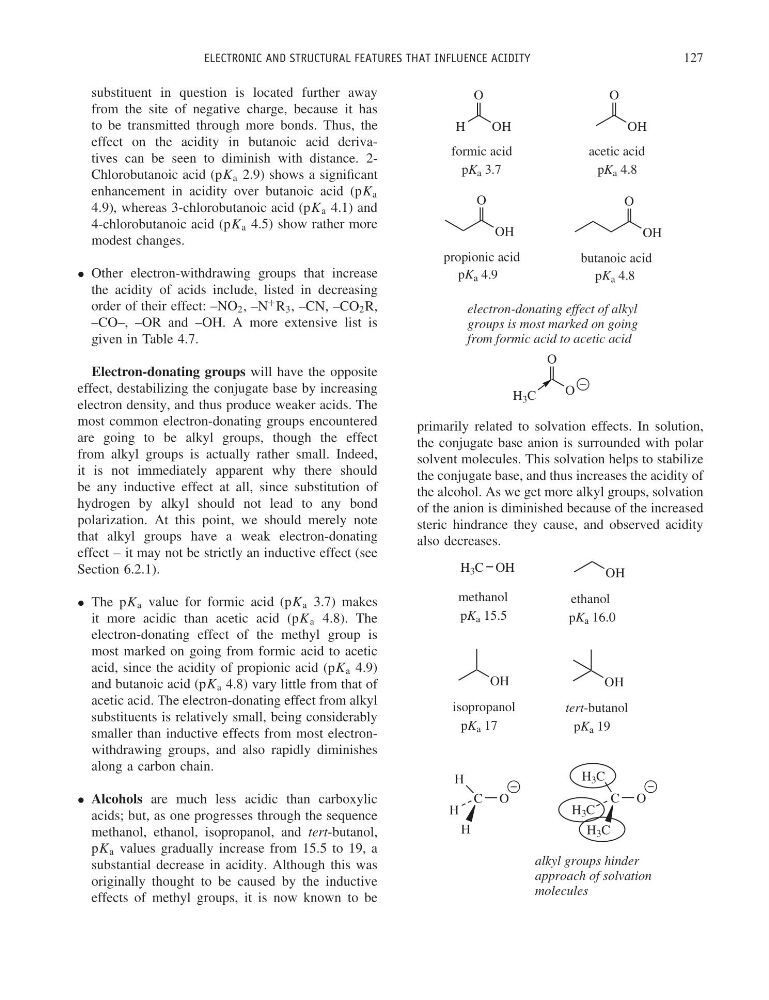
• The pK a value for formic acid (pK a 3.7) makes
it more acidic than acetic acid (pK a 4.8). The
electron-donating effect of the methyl group is
most marked on going from formic acid to acetic
acid, since the acidity of propionic acid (pK a 4.9)
and butanoic acid (pK a 4.8) vary little from that of
acetic acid. The electron-donating effect from alkyl
substituents is relatively small, being considerably
smaller than inductive effects from most electronwithdrawing groups, and also rapidly diminishes
along a carbon chain.
• Alcohols are much less acidic than carboxylic
acids; but, as one progresses through the sequence
methanol, ethanol, isopropanol, and tert-butanol,
pK a values gradually increase from 15.5 to 19, a
substantial decrease in acidity. Although this was
originally thought to be caused by the inductive
effects of methyl groups, it is now known to be
O
OH
acetic acid
pK a 4.8
O
OH
propionic acid
pK a 4.9
O
H
OH
formic acid
pK a 3.7
O
OH
butanoic acid
pK a 4.8
electron-donating effect of alkyl
groups is most marked on going
from formic acid to acetic acid
H 3 C
O
O
primarily related to solvation effects. In solution,
the conjugate base anion is surrounded with polar
solvent molecules. This solvation helps to stabilize
the conjugate base, and thus increases the acidity of
the alcohol. As we get more alkyl groups, solvation
of the anion is diminished because of the increased
steric hindrance they cause, and observed acidity
also decreases.
H 3 C OH
OH
OH
methanol
ethanol
isopropanol
pK a 15.5
pK a 16.0
pK a 17
OH
tert-butanol
pK a 19
H 3 C
C O
H 3 C
H 3 C
H
C O
H
H
alkyl groups hinder
approach of solvation
molecules
127
substituent in question is located further away
from the site of negative charge, because it has
to be transmitted through more bonds. Thus, the
effect on the acidity in butanoic acid derivatives can be seen to diminish with distance. 2Chlorobutanoic acid (pK a 2.9) shows a significant
enhancement in acidity over butanoic acid (pK a
4.9), whereas 3-chlorobutanoic acid (pK a 4.1) and
4-chlorobutanoic acid (pK a 4.5) show rather more
modest changes.
• Other electron-withdrawing groups that increase
the acidity of acids include, listed in decreasing
order of their effect: –NO 2 , –N
+ R 3 , –CN, –CO 2 R,
–CO–, –OR and –OH. A more extensive list is
given in Table 4.7.
Electron-donating groups will have the opposite
effect, destabilizing the conjugate base by increasing
electron density, and thus produce weaker acids. The
most common electron-donating groups encountered
are going to be alkyl groups, though the effect
from alkyl groups is actually rather small. Indeed,
it is not immediately apparent why there should
be any inductive effect at all, since substitution of
hydrogen by alkyl should not lead to any bond
polarization. At this point, we should merely note
that alkyl groups have a weak electron-donating
effect – it may not be strictly an inductive effect (see
Section 6.2.1).
• The pK a value for formic acid (pK a 3.7) makes
it more acidic than acetic acid (pK a 4.8). The
electron-donating effect of the methyl group is
most marked on going from formic acid to acetic
acid, since the acidity of propionic acid (pK a 4.9)
and butanoic acid (pK a 4.8) vary little from that of
acetic acid. The electron-donating effect from alkyl
substituents is relatively small, being considerably
smaller than inductive effects from most electronwithdrawing groups, and also rapidly diminishes
along a carbon chain.
• Alcohols are much less acidic than carboxylic
acids; but, as one progresses through the sequence
methanol, ethanol, isopropanol, and tert-butanol,
pK a values gradually increase from 15.5 to 19, a
substantial decrease in acidity. Although this was
originally thought to be caused by the inductive
effects of methyl groups, it is now known to be
O
OH
acetic acid
pK a 4.8
O
OH
propionic acid
pK a 4.9
O
H
OH
formic acid
pK a 3.7
O
OH
butanoic acid
pK a 4.8
electron-donating effect of alkyl
groups is most marked on going
from formic acid to acetic acid
H 3 C
O
O
primarily related to solvation effects. In solution,
the conjugate base anion is surrounded with polar
solvent molecules. This solvation helps to stabilize
the conjugate base, and thus increases the acidity of
the alcohol. As we get more alkyl groups, solvation
of the anion is diminished because of the increased
steric hindrance they cause, and observed acidity
also decreases.
H 3 C OH
OH
OH
methanol
ethanol
isopropanol
pK a 15.5
pK a 16.0
pK a 17
OH
tert-butanol
pK a 19
H 3 C
C O
H 3 C
H 3 C
H
C O
H
H
alkyl groups hinder
approach of solvation
molecules