

126
ACIDS AND BASES
• Increasing the number of halogen atoms increases
this effect, with a consequent increase in acidity.
Note that introduction of one chlorine atom
increases acidity by a factor of almost 100, and
trichloroacetic acid is a strong acid.
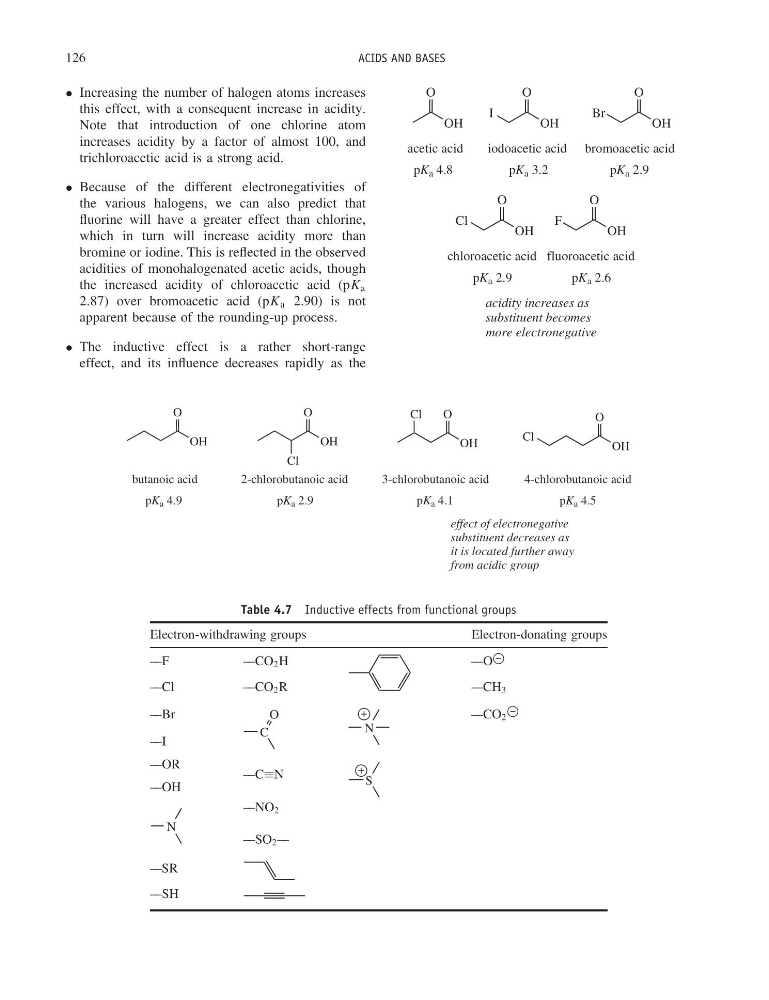
• Because of the different electronegativities of
the various halogens, we can also predict that
fluorine will have a greater effect than chlorine,
which in turn will increase acidity more than
bromine or iodine. This is reflected in the observed
acidities of monohalogenated acetic acids, though
the increased acidity of chloroacetic acid (pK a
2.87) over bromoacetic acid (pK a 2.90) is not
apparent because of the rounding-up process.
• The inductive effect is a rather short-range
effect, and its influence decreases rapidly as the
O
OH
acetic acid
O
OH
F
O
OH
Cl
O
OH
Br
fluoroacetic acid
chloroacetic acid
bromoacetic acid
pK a 4.8
pK a 2.6
pK a 2.9
pK a 2.9
O
OH
I
iodoacetic acid
pK a 3.2
acidity increases as
substituent becomes
more electronegative
O
OH
O
OH
Cl
butanoic acid
2-chlorobutanoic acid
pK a 4.9
pK a 2.9
O
OH
O
OH
Cl
Cl
3-chlorobutanoic acid
4-chlorobutanoic acid
pK a 4.1
pK a 4.5
effect of electronegative
substituent decreases as
it is located further away
from acidic group
Table 4.7 Inductive effects from functional groups
Electron-withdrawing groups
Electron-donating groups
––F
––CO 2 H
––O
––Cl
––CO 2 R
– – C H 3
––Br
––I
C
O
N
––CO 2
––OR
––OH
––C≡N
S
––NO 2
N
––SO 2 ––
––SR
––SH
ACIDS AND BASES
• Increasing the number of halogen atoms increases
this effect, with a consequent increase in acidity.
Note that introduction of one chlorine atom
increases acidity by a factor of almost 100, and
trichloroacetic acid is a strong acid.
• Because of the different electronegativities of
the various halogens, we can also predict that
fluorine will have a greater effect than chlorine,
which in turn will increase acidity more than
bromine or iodine. This is reflected in the observed
acidities of monohalogenated acetic acids, though
the increased acidity of chloroacetic acid (pK a
2.87) over bromoacetic acid (pK a 2.90) is not
apparent because of the rounding-up process.
• The inductive effect is a rather short-range
effect, and its influence decreases rapidly as the
O
OH
acetic acid
O
OH
F
O
OH
Cl
O
OH
Br
fluoroacetic acid
chloroacetic acid
bromoacetic acid
pK a 4.8
pK a 2.6
pK a 2.9
pK a 2.9
O
OH
I
iodoacetic acid
pK a 3.2
acidity increases as
substituent becomes
more electronegative
O
OH
O
OH
Cl
butanoic acid
2-chlorobutanoic acid
pK a 4.9
pK a 2.9
O
OH
O
OH
Cl
Cl
3-chlorobutanoic acid
4-chlorobutanoic acid
pK a 4.1
pK a 4.5
effect of electronegative
substituent decreases as
it is located further away
from acidic group
Table 4.7 Inductive effects from functional groups
Electron-withdrawing groups
Electron-donating groups
––F
––CO 2 H
––O
––Cl
––CO 2 R
– – C H 3
––Br
––I
C
O
N
––CO 2
––OR
––OH
––C≡N
S
––NO 2
N
––SO 2 ––
––SR
––SH