

ELECTRONIC AND STRUCTURAL FEATURES THAT INFLUENCE ACIDITY
125
values can be used to predict whether a reagent is a
good or a poor nucleophile, whether it can function as
a good leaving group, and how easy it is to generate
anionic nucleophiles. We shall also find that pK a
values can tell us how much of a compound or a drug
is ionized under particular conditions and, therefore,
whether or not it can be produced in a soluble form.
It is now appropriate to consider some of the
electronic and structural features that influence pK a
so that we can rationalize and predict relative
acidities.
4.3 Electronic and structural features
that influence acidity
4.3.1 Electronegativity
The more electronegative an element is, the more it
helps to stabilize the negative charge of the conjugate
base. For example, the acidities of compounds of
second-row elements in the periodic table increase
as the atom to which hydrogen is attached becomes
more electronegative:
• pK a values for CH 4 , NH 3 , H 2 O and HF are
about 48, 38, 16 and 3, respectively, i.e. we
have increasing acidity left to right as the electronegativity of the atom attached to hydrogen
increases.
4.3.2 Bond energies
Within a single column of the periodic table, acidities
increase as one descends the column: pK a values for
HF, HCl, HBr, and HI are about 3, −7, −9, and
−10 respectively, i.e. we have increasing acidity on
descending the group.
This is the reverse of what might be expected
simply based on electronegativities, but relates to the
increasing size of the atom and the corresponding
improved ability to disperse the negative charge
over the atom. We are seeing a weakening in bond
strengths on descending the group.
Similarly, although sulfur is less electronegative than oxygen, thiols (RSH) are more acidic
than alcohols (ROH). For example, pK a values for
methanethiol and methanol are 10.5 and 16 respectively.
4.3.3 Inductive effects
Electron-donating and electron-withdrawing groups
influence acidity by respectively destabilizing or
stabilizing the conjugate base. This inductive effect,
a charge polarization transmitted through σ bonds
(see Section 2.7), causes a shift in electron density,
and its influence may easily be predicted.
X A
X A
electron-withdrawing
inductive effect
stabilizing
electron-donating
inductive effect
destabilizing
X A H
X A
H
Thus, electron-withdrawing groups increase
acidity:
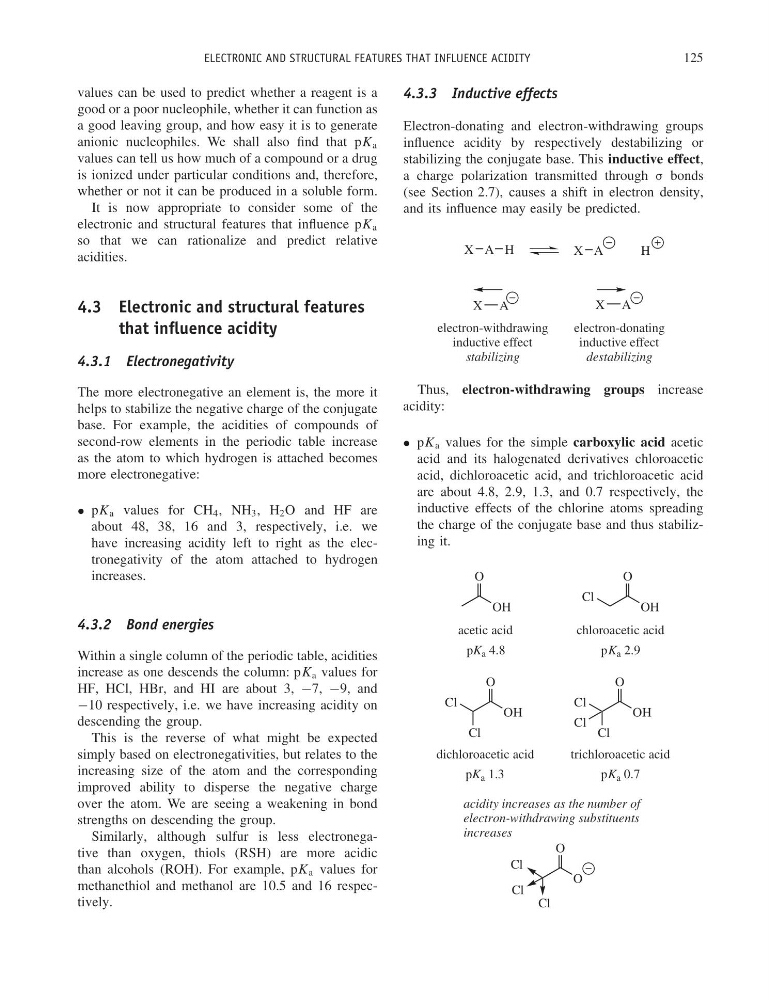
• pK a values for the simple carboxylic acid acetic
acid and its halogenated derivatives chloroacetic
acid, dichloroacetic acid, and trichloroacetic acid
are about 4.8, 2.9, 1.3, and 0.7 respectively, the
inductive effects of the chlorine atoms spreading
the charge of the conjugate base and thus stabilizing it.
O
OH
acetic acid
O
OH
Cl
O
OH
Cl
Cl
O
OH
Cl
Cl
Cl
chloroacetic acid
dichloroacetic acid
trichloroacetic acid
pK a 4.8
pK a 2.9
pK a 1.3
pK a 0.7
acidity increases as the number of
electron-withdrawing substituents
increases
Cl
Cl
Cl
O
O
125
values can be used to predict whether a reagent is a
good or a poor nucleophile, whether it can function as
a good leaving group, and how easy it is to generate
anionic nucleophiles. We shall also find that pK a
values can tell us how much of a compound or a drug
is ionized under particular conditions and, therefore,
whether or not it can be produced in a soluble form.
It is now appropriate to consider some of the
electronic and structural features that influence pK a
so that we can rationalize and predict relative
acidities.
4.3 Electronic and structural features
that influence acidity
4.3.1 Electronegativity
The more electronegative an element is, the more it
helps to stabilize the negative charge of the conjugate
base. For example, the acidities of compounds of
second-row elements in the periodic table increase
as the atom to which hydrogen is attached becomes
more electronegative:
• pK a values for CH 4 , NH 3 , H 2 O and HF are
about 48, 38, 16 and 3, respectively, i.e. we
have increasing acidity left to right as the electronegativity of the atom attached to hydrogen
increases.
4.3.2 Bond energies
Within a single column of the periodic table, acidities
increase as one descends the column: pK a values for
HF, HCl, HBr, and HI are about 3, −7, −9, and
−10 respectively, i.e. we have increasing acidity on
descending the group.
This is the reverse of what might be expected
simply based on electronegativities, but relates to the
increasing size of the atom and the corresponding
improved ability to disperse the negative charge
over the atom. We are seeing a weakening in bond
strengths on descending the group.
Similarly, although sulfur is less electronegative than oxygen, thiols (RSH) are more acidic
than alcohols (ROH). For example, pK a values for
methanethiol and methanol are 10.5 and 16 respectively.
4.3.3 Inductive effects
Electron-donating and electron-withdrawing groups
influence acidity by respectively destabilizing or
stabilizing the conjugate base. This inductive effect,
a charge polarization transmitted through σ bonds
(see Section 2.7), causes a shift in electron density,
and its influence may easily be predicted.
X A
X A
electron-withdrawing
inductive effect
stabilizing
electron-donating
inductive effect
destabilizing
X A H
X A
H
Thus, electron-withdrawing groups increase
acidity:
• pK a values for the simple carboxylic acid acetic
acid and its halogenated derivatives chloroacetic
acid, dichloroacetic acid, and trichloroacetic acid
are about 4.8, 2.9, 1.3, and 0.7 respectively, the
inductive effects of the chlorine atoms spreading
the charge of the conjugate base and thus stabilizing it.
O
OH
acetic acid
O
OH
Cl
O
OH
Cl
Cl
O
OH
Cl
Cl
Cl
chloroacetic acid
dichloroacetic acid
trichloroacetic acid
pK a 4.8
pK a 2.9
pK a 1.3
pK a 0.7
acidity increases as the number of
electron-withdrawing substituents
increases
Cl
Cl
Cl
O
O