

CONFIGURATIONAL ISOMERS
111
first ring. We can predict, therefore, that trans-decalone has a lower energy than cis-decalone. The isomerization
is brought about because the carbonyl group is adjacent (α) to the hydrogen at the ring fusion. This hydrogen is
relatively acidic and may be removed by base, generating the enolate anion (see Sections 4.3.5 and 10.1 for detail
of this reaction). The enolate anion must now be planar around the site of ring fusion and, by a reversal of the
process, may pick up a proton from either side of the double bond. However, instead of getting a 1 : 1 mixture of
the two possible isomers, this reaction very much favours the trans isomer because of its lower thermodynamic
energy. The equilibrium mixture contains principally trans-decalone.
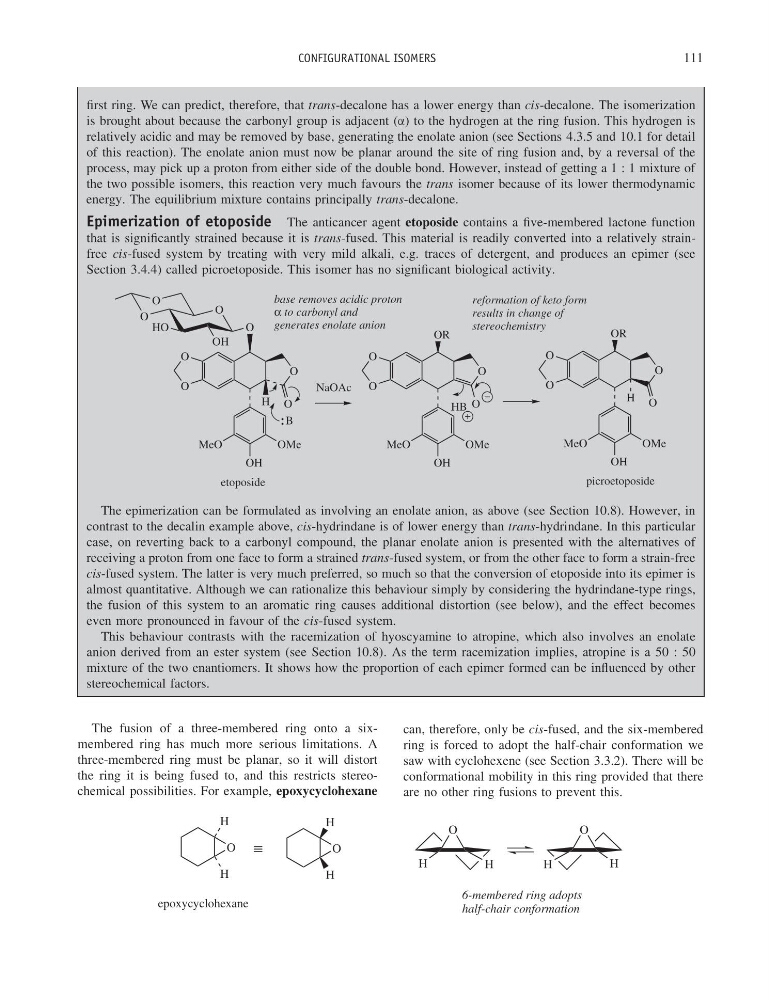
Epimerization of etoposide The anticancer agent etoposide contains a five-membered lactone function
that is significantly strained because it is trans-fused. This material is readily converted into a relatively strainfree cis-fused system by treating with very mild alkali, e.g. traces of detergent, and produces an epimer (see
Section 3.4.4) called picroetoposide. This isomer has no significant biological activity.
etoposide
OH
MeO
O
O
OMe
O
O
OH
MeO
O
O
OMe
O
O
OR
OH
MeO
O
O
OMe
O
O
OR
H
picroetoposide
H
base removes acidic proton
α to carbonyl and
generates enolate anion
reformation of keto form
results in change of
stereochemistry
O
O
O
O
OH
HO
HB
B
NaOAc
The epimerization can be formulated as involving an enolate anion, as above (see Section 10.8). However, in
contrast to the decalin example above, cis-hydrindane is of lower energy than trans-hydrindane. In this particular
case, on reverting back to a carbonyl compound, the planar enolate anion is presented with the alternatives of
receiving a proton from one face to form a strained trans-fused system, or from the other face to form a strain-free
cis-fused system. The latter is very much preferred, so much so that the conversion of etoposide into its epimer is
almost quantitative. Although we can rationalize this behaviour simply by considering the hydrindane-type rings,
the fusion of this system to an aromatic ring causes additional distortion (see below), and the effect becomes
even more pronounced in favour of the cis-fused system.
This behaviour contrasts with the racemization of hyoscyamine to atropine, which also involves an enolate
anion derived from an ester system (see Section 10.8). As the term racemization implies, atropine is a 50 : 50
mixture of the two enantiomers. It shows how the proportion of each epimer formed can be influenced by other
stereochemical factors.
The fusion of a three-membered ring onto a sixmembered ring has much more serious limitations. A
three-membered ring must be planar, so it will distort
the ring it is being fused to, and this restricts stereochemical possibilities. For example, epoxycyclohexane
can, therefore, only be cis-fused, and the six-membered
ring is forced to adopt the half-chair conformation we
saw with cyclohexene (see Section 3.3.2). There will be
conformational mobility in this ring provided that there
are no other ring fusions to prevent this.
O
H
H
O
H
H
6-membered ring adopts
half-chair conformation
O
H
H
≡
O
H
H
epoxycyclohexane
111
first ring. We can predict, therefore, that trans-decalone has a lower energy than cis-decalone. The isomerization
is brought about because the carbonyl group is adjacent (α) to the hydrogen at the ring fusion. This hydrogen is
relatively acidic and may be removed by base, generating the enolate anion (see Sections 4.3.5 and 10.1 for detail
of this reaction). The enolate anion must now be planar around the site of ring fusion and, by a reversal of the
process, may pick up a proton from either side of the double bond. However, instead of getting a 1 : 1 mixture of
the two possible isomers, this reaction very much favours the trans isomer because of its lower thermodynamic
energy. The equilibrium mixture contains principally trans-decalone.
Epimerization of etoposide The anticancer agent etoposide contains a five-membered lactone function
that is significantly strained because it is trans-fused. This material is readily converted into a relatively strainfree cis-fused system by treating with very mild alkali, e.g. traces of detergent, and produces an epimer (see
Section 3.4.4) called picroetoposide. This isomer has no significant biological activity.
etoposide
OH
MeO
O
O
OMe
O
O
OH
MeO
O
O
OMe
O
O
OR
OH
MeO
O
O
OMe
O
O
OR
H
picroetoposide
H
base removes acidic proton
α to carbonyl and
generates enolate anion
reformation of keto form
results in change of
stereochemistry
O
O
O
O
OH
HO
HB
B
NaOAc
The epimerization can be formulated as involving an enolate anion, as above (see Section 10.8). However, in
contrast to the decalin example above, cis-hydrindane is of lower energy than trans-hydrindane. In this particular
case, on reverting back to a carbonyl compound, the planar enolate anion is presented with the alternatives of
receiving a proton from one face to form a strained trans-fused system, or from the other face to form a strain-free
cis-fused system. The latter is very much preferred, so much so that the conversion of etoposide into its epimer is
almost quantitative. Although we can rationalize this behaviour simply by considering the hydrindane-type rings,
the fusion of this system to an aromatic ring causes additional distortion (see below), and the effect becomes
even more pronounced in favour of the cis-fused system.
This behaviour contrasts with the racemization of hyoscyamine to atropine, which also involves an enolate
anion derived from an ester system (see Section 10.8). As the term racemization implies, atropine is a 50 : 50
mixture of the two enantiomers. It shows how the proportion of each epimer formed can be influenced by other
stereochemical factors.
The fusion of a three-membered ring onto a sixmembered ring has much more serious limitations. A
three-membered ring must be planar, so it will distort
the ring it is being fused to, and this restricts stereochemical possibilities. For example, epoxycyclohexane
can, therefore, only be cis-fused, and the six-membered
ring is forced to adopt the half-chair conformation we
saw with cyclohexene (see Section 3.3.2). There will be
conformational mobility in this ring provided that there
are no other ring fusions to prevent this.
O
H
H
O
H
H
6-membered ring adopts
half-chair conformation
O
H
H
≡
O
H
H
epoxycyclohexane