

112
STEREOCHEMISTRY
Note that, in situations where a ring fusion produces
chiral centres, we can find the number of configurational
isomers possible is less than that predicted from the 2
n
guidelines. This may be the consequence of symmetry,
in that an isomer is the same as its mirror image, as we
have seen above. However, it can also be the result of
restrictions caused by the ring fusion, so that one centre
effectively defines the chirality of another, thus reducing
the number of combinations. In epoxycyclohexanes, no
trans-fused variants can exist.
O
H
H
two chiral centres, but only
two configurational isomers;
no trans isomers can exist
O
H
H
dimethyl substitution
removes symmetry
without adding a new
chiral centre
Note that a cyclohexane system will be forced
into a similar half-chair conformation by fusing a
planar aromatic ring onto a cyclohexane ring (a
tetrahydronaphthalene system).
tetrahydronaphthalene
cyclohexene ring adopts halfchair conformation
Box 3.19
Shapes of steroids
Steroids all contain a tetracyclic ring system comprised of three six-membered rings and one five-membered ring
fused together. Cholesterol is the best known of the steroids. It is an essential structural component of animal
cells, though the presence of excess cholesterol in the blood is definitely associated with the incidence of heart
disease and heart attacks.
Whilst cholesterol typifies the fundamental structure, further modifications to the side-chain and the ring system
help to create a wide range of biologically important natural products, e.g. sterols, steroidal saponins, cardioactive
glycosides, bile acids, corticosteroids, and mammalian sex hormones. Because of the profound biological activities
encountered, many natural steroids, together with a considerable number of synthetic and semi-synthetic steroidal
compounds, are routinely employed in medicine. The markedly different biological activities observed emanating
from compounds containing a common structural skeleton is, in part, ascribed to the functional groups attached
to the steroid nucleus and, in part, to the overall shape conferred on this nucleus by the stereochemistry of ring
fusions.
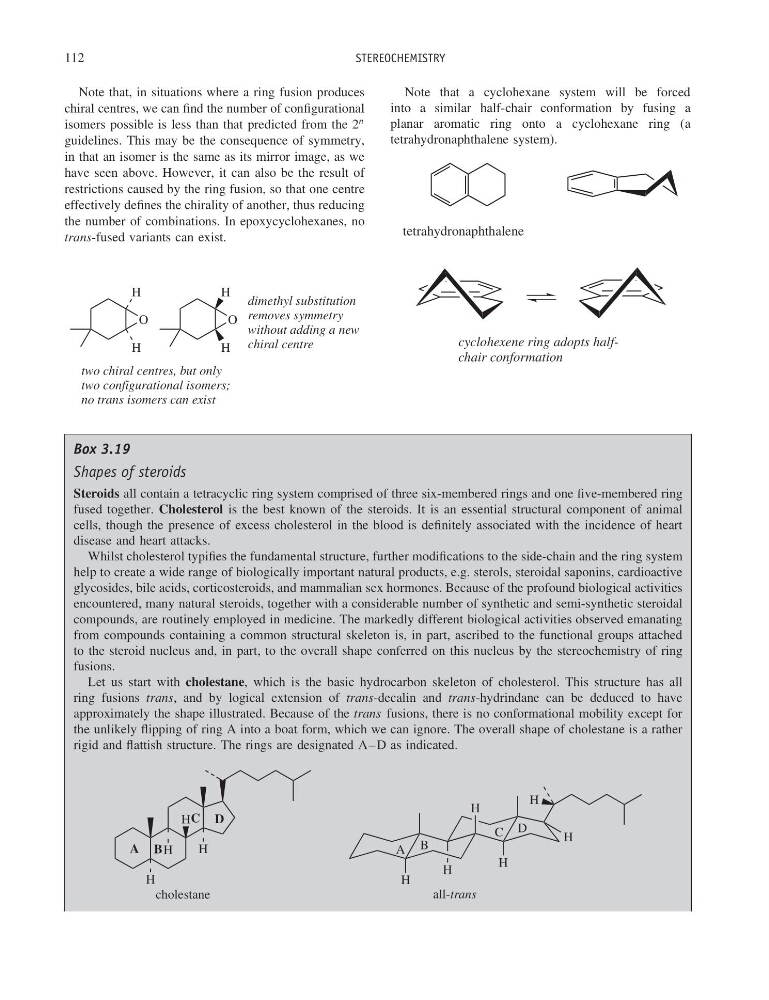
Let us start with cholestane, which is the basic hydrocarbon skeleton of cholesterol. This structure has all
ring fusions trans, and by logical extension of trans-decalin and trans-hydrindane can be deduced to have
approximately the shape illustrated. Because of the trans fusions, there is no conformational mobility except for
the unlikely flipping of ring A into a boat form, which we can ignore. The overall shape of cholestane is a rather
rigid and flattish structure. The rings are designated A–D as indicated.
H
H
H
H
all-trans
H
H
H
cholestane
H
H
H
A B
C D
A B
C D
STEREOCHEMISTRY
Note that, in situations where a ring fusion produces
chiral centres, we can find the number of configurational
isomers possible is less than that predicted from the 2
n
guidelines. This may be the consequence of symmetry,
in that an isomer is the same as its mirror image, as we
have seen above. However, it can also be the result of
restrictions caused by the ring fusion, so that one centre
effectively defines the chirality of another, thus reducing
the number of combinations. In epoxycyclohexanes, no
trans-fused variants can exist.
O
H
H
two chiral centres, but only
two configurational isomers;
no trans isomers can exist
O
H
H
dimethyl substitution
removes symmetry
without adding a new
chiral centre
Note that a cyclohexane system will be forced
into a similar half-chair conformation by fusing a
planar aromatic ring onto a cyclohexane ring (a
tetrahydronaphthalene system).
tetrahydronaphthalene
cyclohexene ring adopts halfchair conformation
Box 3.19
Shapes of steroids
Steroids all contain a tetracyclic ring system comprised of three six-membered rings and one five-membered ring
fused together. Cholesterol is the best known of the steroids. It is an essential structural component of animal
cells, though the presence of excess cholesterol in the blood is definitely associated with the incidence of heart
disease and heart attacks.
Whilst cholesterol typifies the fundamental structure, further modifications to the side-chain and the ring system
help to create a wide range of biologically important natural products, e.g. sterols, steroidal saponins, cardioactive
glycosides, bile acids, corticosteroids, and mammalian sex hormones. Because of the profound biological activities
encountered, many natural steroids, together with a considerable number of synthetic and semi-synthetic steroidal
compounds, are routinely employed in medicine. The markedly different biological activities observed emanating
from compounds containing a common structural skeleton is, in part, ascribed to the functional groups attached
to the steroid nucleus and, in part, to the overall shape conferred on this nucleus by the stereochemistry of ring
fusions.
Let us start with cholestane, which is the basic hydrocarbon skeleton of cholesterol. This structure has all
ring fusions trans, and by logical extension of trans-decalin and trans-hydrindane can be deduced to have
approximately the shape illustrated. Because of the trans fusions, there is no conformational mobility except for
the unlikely flipping of ring A into a boat form, which we can ignore. The overall shape of cholestane is a rather
rigid and flattish structure. The rings are designated A–D as indicated.
H
H
H
H
all-trans
H
H
H
cholestane
H
H
H
A B
C D
A B
C D