

110
STEREOCHEMISTRY
H
H
eq
eq
ax
eq
H
H
H
H
H
H
≡
ax
eq
eq
ax
rotate 60˚
trans-hydrindane
cis-hydrindane
H
H
H
H
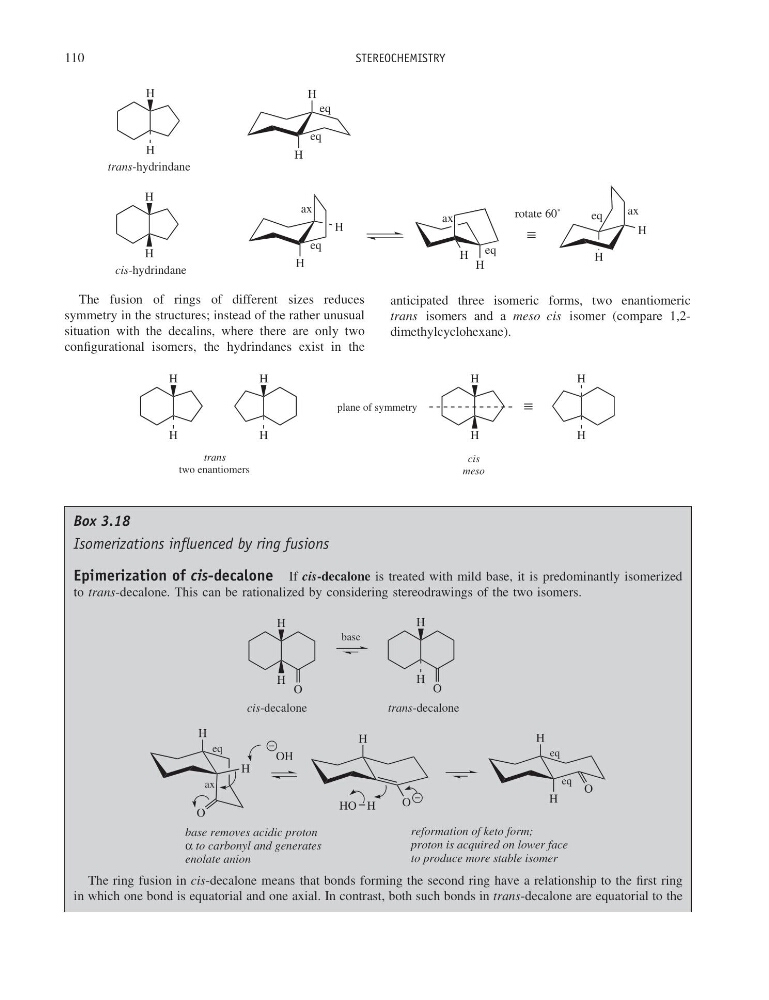
The fusion of rings of different sizes reduces
symmetry in the structures; instead of the rather unusual
situation with the decalins, where there are only two
configurational isomers, the hydrindanes exist in the
anticipated three isomeric forms, two enantiomeric
trans isomers and a meso cis isomer (compare 1,2dimethylcyclohexane).
H
H
H
H
trans
two enantiomers
H
H
H
H
≡
cis
meso
plane of symmetry
Box 3.18
Isomerizations influenced by ring fusions
Epimerization of cis-decalone If cis-decalone is treated with mild base, it is predominantly isomerized
to trans-decalone. This can be rationalized by considering stereodrawings of the two isomers.
O
H
H
O
H
H
base
H
H
O
H
O
H
OH
H
O
H
HO
eq
ax
eq
eq
cis-decalone
trans-decalone
base removes acidic proton
α to carbonyl and generates
enolate anion
reformation of keto form;
proton is acquired on lower face
to produce more stable isomer
The ring fusion in cis-decalone means that bonds forming the second ring have a relationship to the first ring
in which one bond is equatorial and one axial. In contrast, both such bonds in trans-decalone are equatorial to the
STEREOCHEMISTRY
H
H
eq
eq
ax
eq
H
H
H
H
H
H
≡
ax
eq
eq
ax
rotate 60˚
trans-hydrindane
cis-hydrindane
H
H
H
H
The fusion of rings of different sizes reduces
symmetry in the structures; instead of the rather unusual
situation with the decalins, where there are only two
configurational isomers, the hydrindanes exist in the
anticipated three isomeric forms, two enantiomeric
trans isomers and a meso cis isomer (compare 1,2dimethylcyclohexane).
H
H
H
H
trans
two enantiomers
H
H
H
H
≡
cis
meso
plane of symmetry
Box 3.18
Isomerizations influenced by ring fusions
Epimerization of cis-decalone If cis-decalone is treated with mild base, it is predominantly isomerized
to trans-decalone. This can be rationalized by considering stereodrawings of the two isomers.
O
H
H
O
H
H
base
H
H
O
H
O
H
OH
H
O
H
HO
eq
ax
eq
eq
cis-decalone
trans-decalone
base removes acidic proton
α to carbonyl and generates
enolate anion
reformation of keto form;
proton is acquired on lower face
to produce more stable isomer
The ring fusion in cis-decalone means that bonds forming the second ring have a relationship to the first ring
in which one bond is equatorial and one axial. In contrast, both such bonds in trans-decalone are equatorial to the