

CONFIGURATIONAL ISOMERS
107
bonds, the bonds starting the two rings must be arranged
perpendicular to each other. If there is appropriate
substitution on the rings, then this can lead to the spiro
centre becoming chiral (see Section 3.4.6).
Box 3.17
Natural spiro compounds
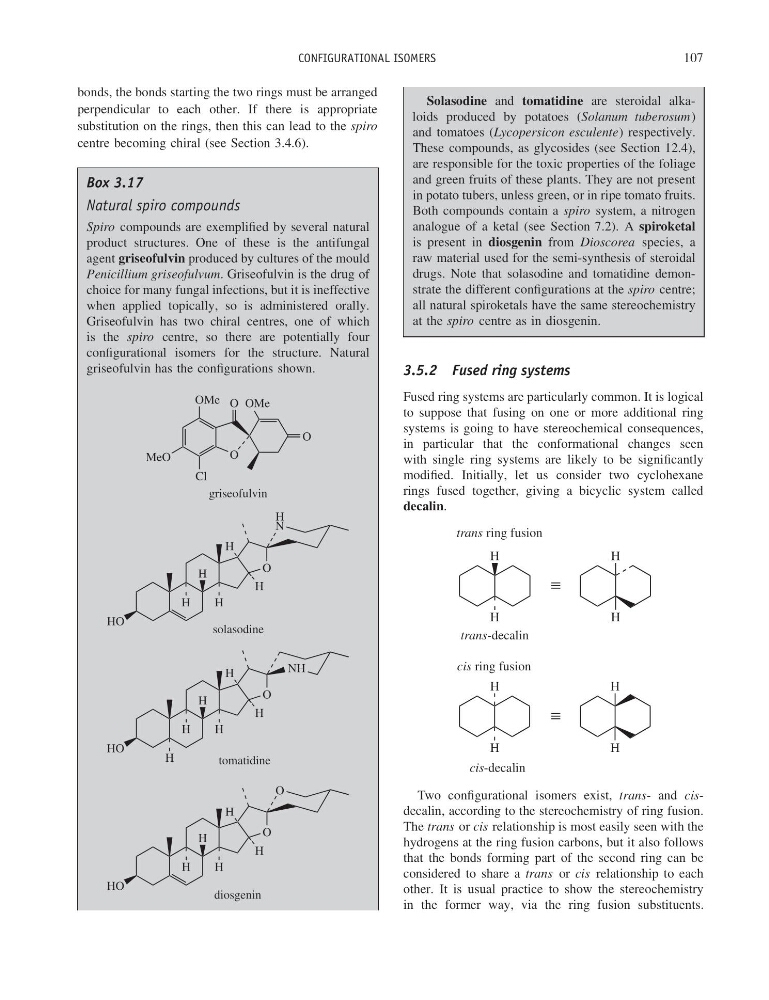
Spiro compounds are exemplified by several natural
product structures. One of these is the antifungal
agent griseofulvin produced by cultures of the mould
Penicillium griseofulvum. Griseofulvin is the drug of
choice for many fungal infections, but it is ineffective
when applied topically, so is administered orally.
Griseofulvin has two chiral centres, one of which
is the spiro centre, so there are potentially four
configurational isomers for the structure. Natural
griseofulvin has the configurations shown.
O
OMe
MeO
Cl
O
O OMe
griseofulvin
O
H
N
H
H
H
H
H
HO
solasodine
O
NH
H
H
H
H
H
HO
H
tomatidine
O
O
H
H
H
H
H
HO
diosgenin
Solasodine and tomatidine are steroidal alkaloids produced by potatoes (Solanum tuberosum)
and tomatoes (Lycopersicon esculente) respectively.
These compounds, as glycosides (see Section 12.4),
are responsible for the toxic properties of the foliage
and green fruits of these plants. They are not present
in potato tubers, unless green, or in ripe tomato fruits.
Both compounds contain a spiro system, a nitrogen
analogue of a ketal (see Section 7.2). A spiroketal
is present in diosgenin from Dioscorea species, a
raw material used for the semi-synthesis of steroidal
drugs. Note that solasodine and tomatidine demonstrate the different configurations at the spiro centre;
all natural spiroketals have the same stereochemistry
at the spiro centre as in diosgenin.
3.5.2 Fused ring systems
Fused ring systems are particularly common. It is logical
to suppose that fusing on one or more additional ring
systems is going to have stereochemical consequences,
in particular that the conformational changes seen
with single ring systems are likely to be significantly
modified. Initially, let us consider two cyclohexane
rings fused together, giving a bicyclic system called
decalin.
H
H
trans-decalin
H
H
≡
H
H
cis-decalin
H
H
≡
trans ring fusion
cis ring fusion
Two configurational isomers exist, trans- and cisdecalin, according to the stereochemistry of ring fusion.
The trans or cis relationship is most easily seen with the
hydrogens at the ring fusion carbons, but it also follows
that the bonds forming part of the second ring can be
considered to share a trans or cis relationship to each
other. It is usual practice to show the stereochemistry
in the former way, via the ring fusion substituents.
107
bonds, the bonds starting the two rings must be arranged
perpendicular to each other. If there is appropriate
substitution on the rings, then this can lead to the spiro
centre becoming chiral (see Section 3.4.6).
Box 3.17
Natural spiro compounds
Spiro compounds are exemplified by several natural
product structures. One of these is the antifungal
agent griseofulvin produced by cultures of the mould
Penicillium griseofulvum. Griseofulvin is the drug of
choice for many fungal infections, but it is ineffective
when applied topically, so is administered orally.
Griseofulvin has two chiral centres, one of which
is the spiro centre, so there are potentially four
configurational isomers for the structure. Natural
griseofulvin has the configurations shown.
O
OMe
MeO
Cl
O
O OMe
griseofulvin
O
H
N
H
H
H
H
H
HO
solasodine
O
NH
H
H
H
H
H
HO
H
tomatidine
O
O
H
H
H
H
H
HO
diosgenin
Solasodine and tomatidine are steroidal alkaloids produced by potatoes (Solanum tuberosum)
and tomatoes (Lycopersicon esculente) respectively.
These compounds, as glycosides (see Section 12.4),
are responsible for the toxic properties of the foliage
and green fruits of these plants. They are not present
in potato tubers, unless green, or in ripe tomato fruits.
Both compounds contain a spiro system, a nitrogen
analogue of a ketal (see Section 7.2). A spiroketal
is present in diosgenin from Dioscorea species, a
raw material used for the semi-synthesis of steroidal
drugs. Note that solasodine and tomatidine demonstrate the different configurations at the spiro centre;
all natural spiroketals have the same stereochemistry
at the spiro centre as in diosgenin.
3.5.2 Fused ring systems
Fused ring systems are particularly common. It is logical
to suppose that fusing on one or more additional ring
systems is going to have stereochemical consequences,
in particular that the conformational changes seen
with single ring systems are likely to be significantly
modified. Initially, let us consider two cyclohexane
rings fused together, giving a bicyclic system called
decalin.
H
H
trans-decalin
H
H
≡
H
H
cis-decalin
H
H
≡
trans ring fusion
cis ring fusion
Two configurational isomers exist, trans- and cisdecalin, according to the stereochemistry of ring fusion.
The trans or cis relationship is most easily seen with the
hydrogens at the ring fusion carbons, but it also follows
that the bonds forming part of the second ring can be
considered to share a trans or cis relationship to each
other. It is usual practice to show the stereochemistry
in the former way, via the ring fusion substituents.