

108
STEREOCHEMISTRY
The situation is in many ways analogous to transand cis-1,2-dimethylcyclohexane (see Section 3.3.2),
and these afford useful comparisons as we consider
conformational changes.
H
H
eq
eq
relate to
eq
eq
ax
ax
trans-decalin
H
H
cannot achieve
bonding within a
six-membered ring
ax
ax
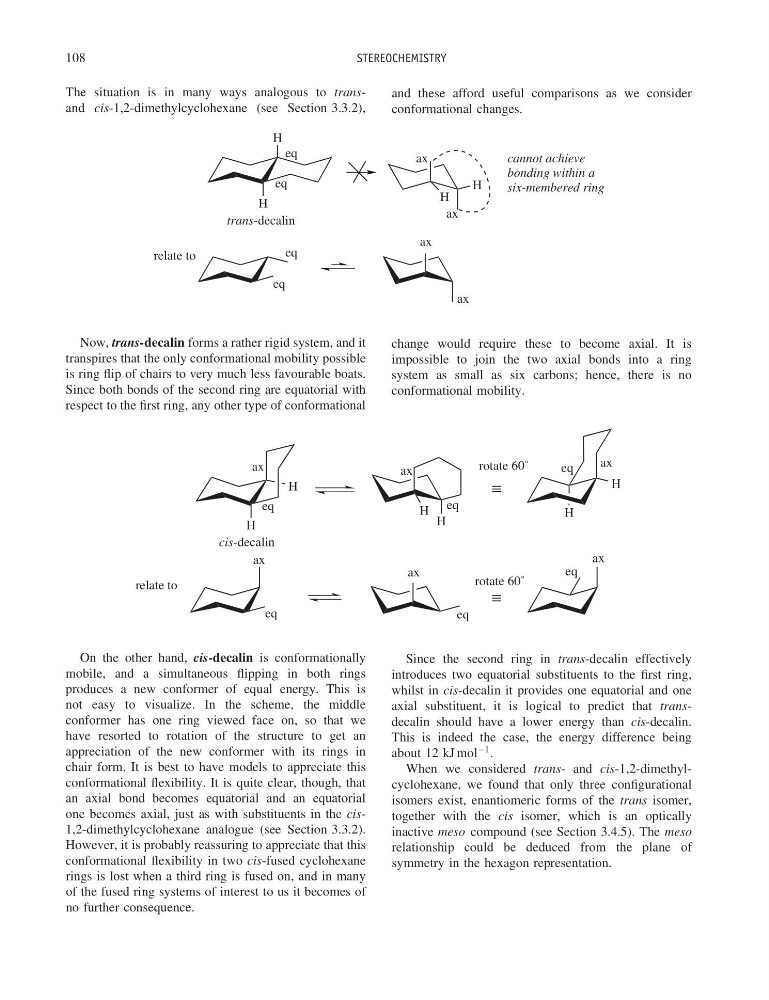
Now, trans-decalin forms a rather rigid system, and it
transpires that the only conformational mobility possible
is ring flip of chairs to very much less favourable boats.
Since both bonds of the second ring are equatorial with
respect to the first ring, any other type of conformational
change would require these to become axial. It is
impossible to join the two axial bonds into a ring
system as small as six carbons; hence, there is no
conformational mobility.
ax
eq
H
H
H
H
H
H
ax
eq
≡
≡
relate to
ax
eq
eq
ax
rotate 60˚
ax
eq
eq
ax
rotate 60˚
cis-decalin
On the other hand, cis-decalin is conformationally
mobile, and a simultaneous flipping in both rings
produces a new conformer of equal energy. This is
not easy to visualize. In the scheme, the middle
conformer has one ring viewed face on, so that we
have resorted to rotation of the structure to get an
appreciation of the new conformer with its rings in
chair form. It is best to have models to appreciate this
conformational flexibility. It is quite clear, though, that
an axial bond becomes equatorial and an equatorial
one becomes axial, just as with substituents in the cis1,2-dimethylcyclohexane analogue (see Section 3.3.2).
However, it is probably reassuring to appreciate that this
conformational flexibility in two cis-fused cyclohexane
rings is lost when a third ring is fused on, and in many
of the fused ring systems of interest to us it becomes of
no further consequence.
Since the second ring in trans-decalin effectively
introduces two equatorial substituents to the first ring,
whilst in cis-decalin it provides one equatorial and one
axial substituent, it is logical to predict that transdecalin should have a lower energy than cis-decalin.
This is indeed the case, the energy difference being
about 12 kJ mol
−1 .
When we considered trans- and cis-1,2-dimethylcyclohexane, we found that only three configurational
isomers exist, enantiomeric forms of the trans isomer,
together with the cis isomer, which is an optically
inactive meso compound (see Section 3.4.5). The meso
relationship could be deduced from the plane of
symmetry in the hexagon representation.
STEREOCHEMISTRY
The situation is in many ways analogous to transand cis-1,2-dimethylcyclohexane (see Section 3.3.2),
and these afford useful comparisons as we consider
conformational changes.
H
H
eq
eq
relate to
eq
eq
ax
ax
trans-decalin
H
H
cannot achieve
bonding within a
six-membered ring
ax
ax
Now, trans-decalin forms a rather rigid system, and it
transpires that the only conformational mobility possible
is ring flip of chairs to very much less favourable boats.
Since both bonds of the second ring are equatorial with
respect to the first ring, any other type of conformational
change would require these to become axial. It is
impossible to join the two axial bonds into a ring
system as small as six carbons; hence, there is no
conformational mobility.
ax
eq
H
H
H
H
H
H
ax
eq
≡
≡
relate to
ax
eq
eq
ax
rotate 60˚
ax
eq
eq
ax
rotate 60˚
cis-decalin
On the other hand, cis-decalin is conformationally
mobile, and a simultaneous flipping in both rings
produces a new conformer of equal energy. This is
not easy to visualize. In the scheme, the middle
conformer has one ring viewed face on, so that we
have resorted to rotation of the structure to get an
appreciation of the new conformer with its rings in
chair form. It is best to have models to appreciate this
conformational flexibility. It is quite clear, though, that
an axial bond becomes equatorial and an equatorial
one becomes axial, just as with substituents in the cis1,2-dimethylcyclohexane analogue (see Section 3.3.2).
However, it is probably reassuring to appreciate that this
conformational flexibility in two cis-fused cyclohexane
rings is lost when a third ring is fused on, and in many
of the fused ring systems of interest to us it becomes of
no further consequence.
Since the second ring in trans-decalin effectively
introduces two equatorial substituents to the first ring,
whilst in cis-decalin it provides one equatorial and one
axial substituent, it is logical to predict that transdecalin should have a lower energy than cis-decalin.
This is indeed the case, the energy difference being
about 12 kJ mol
−1 .
When we considered trans- and cis-1,2-dimethylcyclohexane, we found that only three configurational
isomers exist, enantiomeric forms of the trans isomer,
together with the cis isomer, which is an optically
inactive meso compound (see Section 3.4.5). The meso
relationship could be deduced from the plane of
symmetry in the hexagon representation.