

106
STEREOCHEMISTRY
The alternative chair conformation, should we draw it instead, would be less favoured than that shown because
of the increased number of axial substituents. The conformation of D-glucose is the easily remembered one, in
that all the substituents are equatorial.
A similar procedure is shown for D-(−)-ribose, which, although it is capable of forming a six-membered cyclic
form, is found to exist predominantly as a five-membered ring (see Section 12.2.2).
D and L amino acids
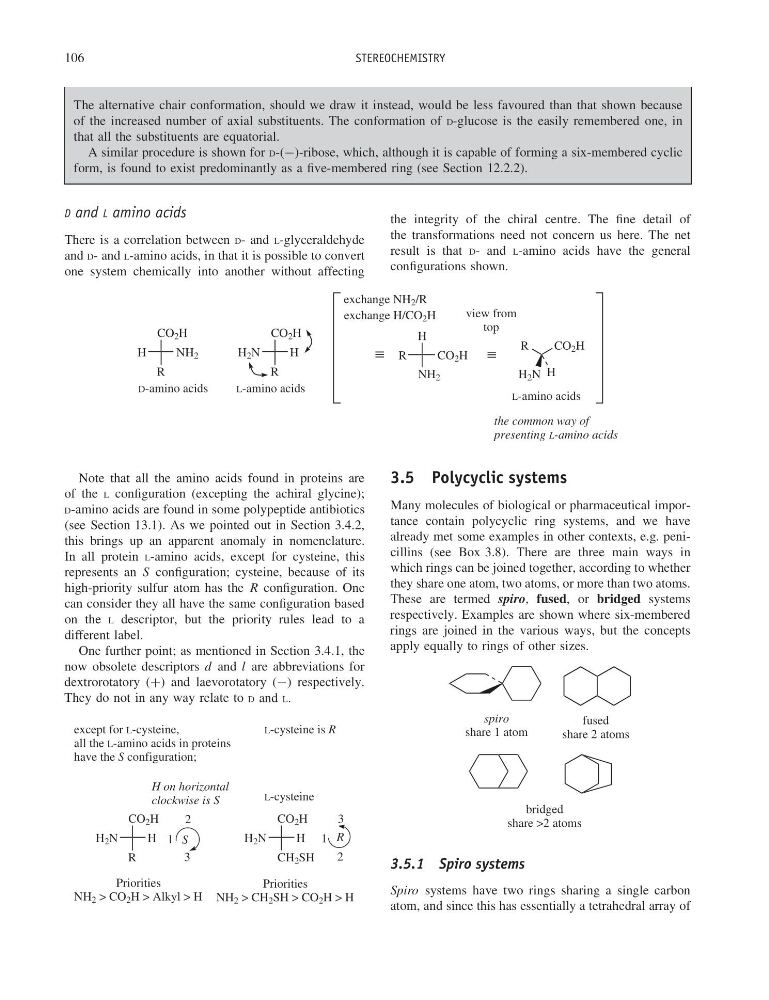
There is a correlation between D- and L-glyceraldehyde
and D- and L-amino acids, in that it is possible to convert
one system chemically into another without affecting
the integrity of the chiral centre. The fine detail of
the transformations need not concern us here. The net
result is that D- and L-amino acids have the general
configurations shown.
H
R
H 2 N
CO 2 H
NH 2
H
CO 2 H
R
L-amino acids
R
CO 2 H
H 2 N H
D-amino acids
R
H
CO 2 H
NH 2
exchange NH 2 /R
exchange H/CO 2 H
≡
≡
view from
top
L-amino acids
the common way of
presenting L-amino acids
Note that all the amino acids found in proteins are
of the L configuration (excepting the achiral glycine);
D-amino acids are found in some polypeptide antibiotics
(see Section 13.1). As we pointed out in Section 3.4.2,
this brings up an apparent anomaly in nomenclature.
In all protein L-amino acids, except for cysteine, this
represents an S configuration; cysteine, because of its
high-priority sulfur atom has the R configuration. One
can consider they all have the same configuration based
on the L descriptor, but the priority rules lead to a
different label.
One further point; as mentioned in Section 3.4.1, the
now obsolete descriptors d and l are abbreviations for
dextrorotatory (+) and laevorotatory (−) respectively.
They do not in any way relate to D and L.
H 2 N
CO 2 H
H
R
H 2 N
CO 2 H
H
CH 2 SH
except for L-cysteine,
all the L-amino acids in proteins
have the S configuration;
Priorities
NH 2 > CO 2 H > Alkyl > H
Priorities
NH 2 > CH 2 SH > CO 2 H > H
H on horizontal
clockwise is S
L-cysteine
1
2
3
1
2
3
S
R
L-cysteine is R
3.5 Polycyclic systems
Many molecules of biological or pharmaceutical importance contain polycyclic ring systems, and we have
already met some examples in other contexts, e.g. penicillins (see Box 3.8). There are three main ways in
which rings can be joined together, according to whether
they share one atom, two atoms, or more than two atoms.
These are termed spiro, fused, or bridged systems
respectively. Examples are shown where six-membered
rings are joined in the various ways, but the concepts
apply equally to rings of other sizes.
spiro
share 1 atom
fused
share 2 atoms
bridged
share >2 atoms
3.5.1 Spiro systems
Spiro systems have two rings sharing a single carbon
atom, and since this has essentially a tetrahedral array of
STEREOCHEMISTRY
The alternative chair conformation, should we draw it instead, would be less favoured than that shown because
of the increased number of axial substituents. The conformation of D-glucose is the easily remembered one, in
that all the substituents are equatorial.
A similar procedure is shown for D-(−)-ribose, which, although it is capable of forming a six-membered cyclic
form, is found to exist predominantly as a five-membered ring (see Section 12.2.2).
D and L amino acids
There is a correlation between D- and L-glyceraldehyde
and D- and L-amino acids, in that it is possible to convert
one system chemically into another without affecting
the integrity of the chiral centre. The fine detail of
the transformations need not concern us here. The net
result is that D- and L-amino acids have the general
configurations shown.
H
R
H 2 N
CO 2 H
NH 2
H
CO 2 H
R
L-amino acids
R
CO 2 H
H 2 N H
D-amino acids
R
H
CO 2 H
NH 2
exchange NH 2 /R
exchange H/CO 2 H
≡
≡
view from
top
L-amino acids
the common way of
presenting L-amino acids
Note that all the amino acids found in proteins are
of the L configuration (excepting the achiral glycine);
D-amino acids are found in some polypeptide antibiotics
(see Section 13.1). As we pointed out in Section 3.4.2,
this brings up an apparent anomaly in nomenclature.
In all protein L-amino acids, except for cysteine, this
represents an S configuration; cysteine, because of its
high-priority sulfur atom has the R configuration. One
can consider they all have the same configuration based
on the L descriptor, but the priority rules lead to a
different label.
One further point; as mentioned in Section 3.4.1, the
now obsolete descriptors d and l are abbreviations for
dextrorotatory (+) and laevorotatory (−) respectively.
They do not in any way relate to D and L.
H 2 N
CO 2 H
H
R
H 2 N
CO 2 H
H
CH 2 SH
except for L-cysteine,
all the L-amino acids in proteins
have the S configuration;
Priorities
NH 2 > CO 2 H > Alkyl > H
Priorities
NH 2 > CH 2 SH > CO 2 H > H
H on horizontal
clockwise is S
L-cysteine
1
2
3
1
2
3
S
R
L-cysteine is R
3.5 Polycyclic systems
Many molecules of biological or pharmaceutical importance contain polycyclic ring systems, and we have
already met some examples in other contexts, e.g. penicillins (see Box 3.8). There are three main ways in
which rings can be joined together, according to whether
they share one atom, two atoms, or more than two atoms.
These are termed spiro, fused, or bridged systems
respectively. Examples are shown where six-membered
rings are joined in the various ways, but the concepts
apply equally to rings of other sizes.
spiro
share 1 atom
fused
share 2 atoms
bridged
share >2 atoms
3.5.1 Spiro systems
Spiro systems have two rings sharing a single carbon
atom, and since this has essentially a tetrahedral array of