

CONFIGURATIONAL ISOMERS
105
HO
O
H
H
HO
H
H
OH
H
CH 2 OH
OH
1
2
4
5
6
3
the commonly used Haworth
representation follows directly
from the Fischer projection
H
CHO
OH
HO
H
H
OH
H
OH
CH 2 OH
D-(+)-glucose
2
4
3
6
5
1
H
CHO
OH
HO
H
H
OH
HOH 2 C
H
OH
rotate three groups; this brings the
5-hydroxyl onto the main chain which
will then form the ring system
≡
rotate
three
groups
≡
H
CHO
OH
HO
H
H
OH
HOH 2 C
H
OH
H
OH
OH
H
H
OH
HOH 2 C
H
HO
≡
H
O
H
formation of
hemiacetal
(see Section 7.2)
1
2
3
4
5
6
this conformational drawing is
much more informative than
the Haworth representation
'up' substituents shown in bold
'up' substituents
shown in bold
H
O
OH
OH
H
H
OH
H
OH
CH 2 OH
H
1
2
3
4
5
6
cyclic hemiacetal
form of D-(+)-glucose
turn
90º
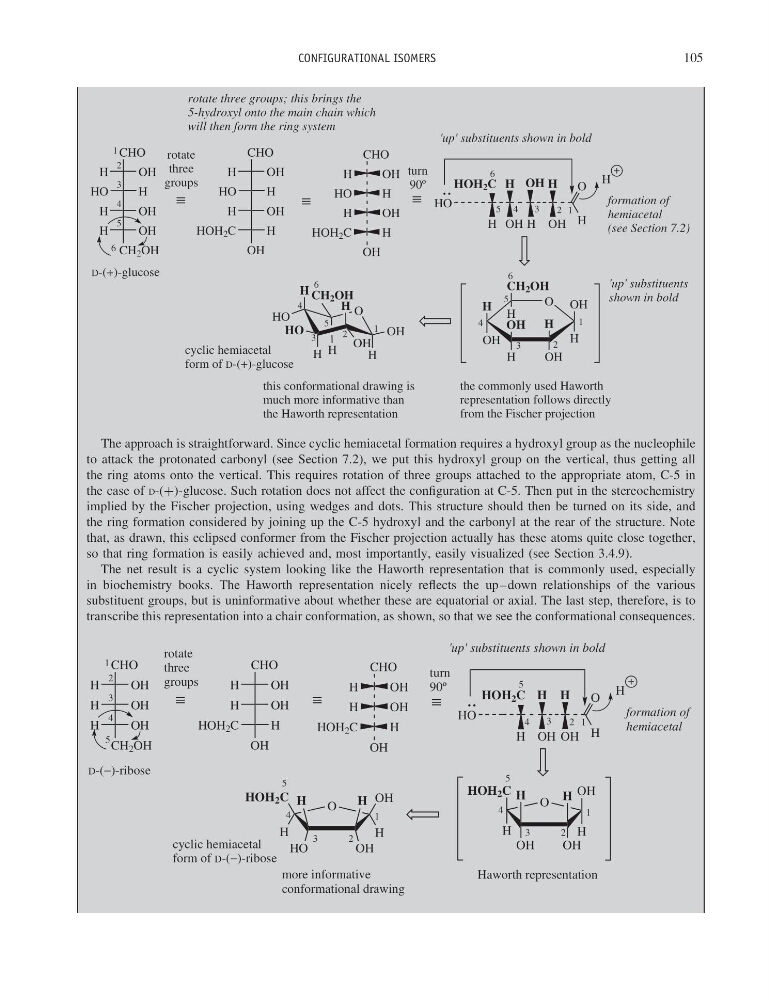
The approach is straightforward. Since cyclic hemiacetal formation requires a hydroxyl group as the nucleophile
to attack the protonated carbonyl (see Section 7.2), we put this hydroxyl group on the vertical, thus getting all
the ring atoms onto the vertical. This requires rotation of three groups attached to the appropriate atom, C-5 in
the case of D-(+)-glucose. Such rotation does not affect the configuration at C-5. Then put in the stereochemistry
implied by the Fischer projection, using wedges and dots. This structure should then be turned on its side, and
the ring formation considered by joining up the C-5 hydroxyl and the carbonyl at the rear of the structure. Note
that, as drawn, this eclipsed conformer from the Fischer projection actually has these atoms quite close together,
so that ring formation is easily achieved and, most importantly, easily visualized (see Section 3.4.9).
The net result is a cyclic system looking like the Haworth representation that is commonly used, especially
in biochemistry books. The Haworth representation nicely reflects the up–down relationships of the various
substituent groups, but is uninformative about whether these are equatorial or axial. The last step, therefore, is to
transcribe this representation into a chair conformation, as shown, so that we see the conformational consequences.
O
HOH 2 C
HO
OH
OH
H
CHO
OH
H
OH
CH 2 OH
H
OH
D-(−)-ribose
2
4
3
5
1
H
CHO
OH
H
OH
OH
HOH 2 C
H
≡
rotate
three
groups
≡
H
CHO
OH
H
OH
OH
HOH 2 C
H
H
OH
H
OH
HOH 2 C
H
HO
≡
H
O
H
formation of
hemiacetal
1
2
3
4
5
'up' substituents shown in bold
O
HOH 2 C
H
OH
H
H
OH
OH
H
cyclic hemiacetal
form of D-(−)-ribose
2
4
3
5
1
2
4
3
5
1
H
H
H
H
turn
90º
Haworth representation
more informative
conformational drawing
105
HO
O
H
H
HO
H
H
OH
H
CH 2 OH
OH
1
2
4
5
6
3
the commonly used Haworth
representation follows directly
from the Fischer projection
H
CHO
OH
HO
H
H
OH
H
OH
CH 2 OH
D-(+)-glucose
2
4
3
6
5
1
H
CHO
OH
HO
H
H
OH
HOH 2 C
H
OH
rotate three groups; this brings the
5-hydroxyl onto the main chain which
will then form the ring system
≡
rotate
three
groups
≡
H
CHO
OH
HO
H
H
OH
HOH 2 C
H
OH
H
OH
OH
H
H
OH
HOH 2 C
H
HO
≡
H
O
H
formation of
hemiacetal
(see Section 7.2)
1
2
3
4
5
6
this conformational drawing is
much more informative than
the Haworth representation
'up' substituents shown in bold
'up' substituents
shown in bold
H
O
OH
OH
H
H
OH
H
OH
CH 2 OH
H
1
2
3
4
5
6
cyclic hemiacetal
form of D-(+)-glucose
turn
90º
The approach is straightforward. Since cyclic hemiacetal formation requires a hydroxyl group as the nucleophile
to attack the protonated carbonyl (see Section 7.2), we put this hydroxyl group on the vertical, thus getting all
the ring atoms onto the vertical. This requires rotation of three groups attached to the appropriate atom, C-5 in
the case of D-(+)-glucose. Such rotation does not affect the configuration at C-5. Then put in the stereochemistry
implied by the Fischer projection, using wedges and dots. This structure should then be turned on its side, and
the ring formation considered by joining up the C-5 hydroxyl and the carbonyl at the rear of the structure. Note
that, as drawn, this eclipsed conformer from the Fischer projection actually has these atoms quite close together,
so that ring formation is easily achieved and, most importantly, easily visualized (see Section 3.4.9).
The net result is a cyclic system looking like the Haworth representation that is commonly used, especially
in biochemistry books. The Haworth representation nicely reflects the up–down relationships of the various
substituent groups, but is uninformative about whether these are equatorial or axial. The last step, therefore, is to
transcribe this representation into a chair conformation, as shown, so that we see the conformational consequences.
O
HOH 2 C
HO
OH
OH
H
CHO
OH
H
OH
CH 2 OH
H
OH
D-(−)-ribose
2
4
3
5
1
H
CHO
OH
H
OH
OH
HOH 2 C
H
≡
rotate
three
groups
≡
H
CHO
OH
H
OH
OH
HOH 2 C
H
H
OH
H
OH
HOH 2 C
H
HO
≡
H
O
H
formation of
hemiacetal
1
2
3
4
5
'up' substituents shown in bold
O
HOH 2 C
H
OH
H
H
OH
OH
H
cyclic hemiacetal
form of D-(−)-ribose
2
4
3
5
1
2
4
3
5
1
H
H
H
H
turn
90º
Haworth representation
more informative
conformational drawing