

104
STEREOCHEMISTRY
Box 3.15
Fischer projections of glucose and stereoisomers
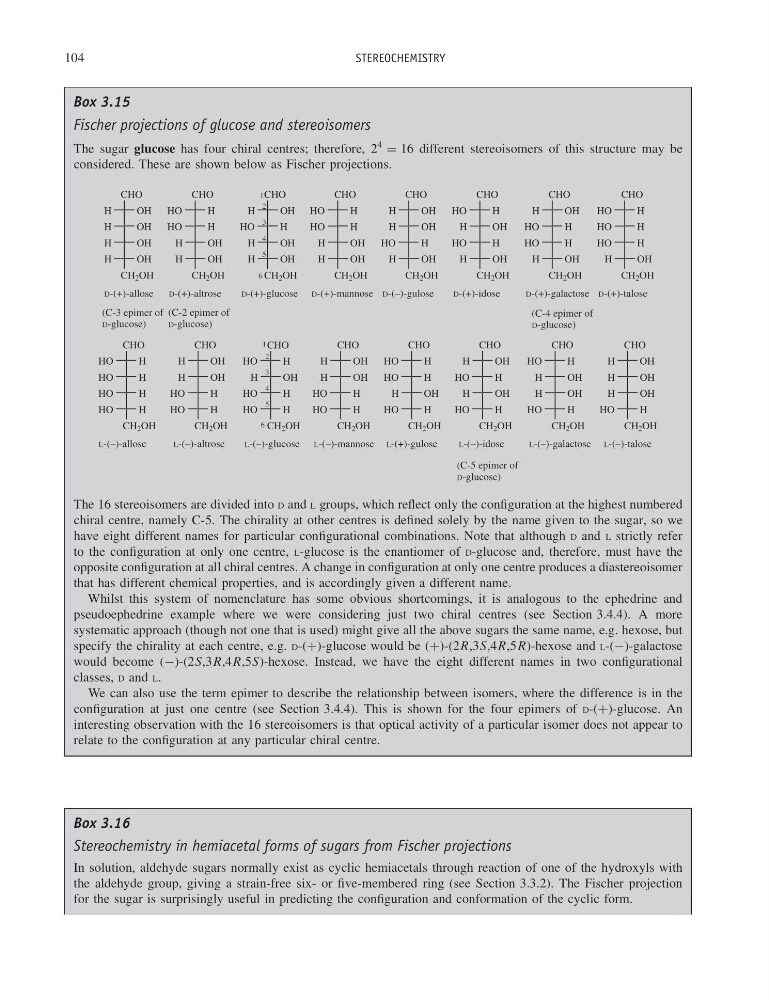
The sugar glucose has four chiral centres; therefore, 2
4
= 16 different stereoisomers of this structure may be
considered. These are shown below as Fischer projections.
H
CHO
OH
HO
H
H
OH
H
OH
CH 2 OH
D-(+)-glucose
2
4
3
6
5
1
HO
CHO
H
HO
H
H
OH
H
OH
CH 2 OH
D-(+)-altrose
H
CHO
OH
H
OH
H
OH
H
OH
CH 2 OH
D-(+)-allose
HO
CHO
H
HO
H
H
OH
H
OH
CH 2 OH
D-(+)-mannose
H
CHO
OH
HO
H
HO
H
H
OH
CH 2 OH
D-(+)-galactose
HO
CHO
H
H
OH
HO
H
H
OH
CH 2 OH
D-(+)-idose
H
CHO
OH
H
OH
HO
H
H
OH
CH 2 OH
D-(–)-gulose
HO
CHO
H
HO
H
HO
H
H
OH
CH 2 OH
D-(+)-talose
H
CHO
HO
OH
H
H
HO
H
HO
CH 2 OH
L-(–)-glucose
2
4
3
6
5
1
OH
CHO
H
OH
H
H
HO
H
HO
CH 2 OH
L-(–)-altrose
H
CHO
HO
H
HO
H
HO
H
HO
CH 2 OH
L-(–)-allose
OH
CHO
H
OH
H
H
HO
H
HO
CH 2 OH
L-(–)-mannose
H
CHO
HO
OH
H
OH
H
H
HO
CH 2 OH
L-(–)-galactose
OH
CHO
H
H
HO
OH
H
H
HO
CH 2 OH
L-(–)-idose
H
CHO
HO
H
HO
OH
H
H
HO
CH 2 OH
L-(+)-gulose
OH
CHO
H
OH
H
OH
H
H
HO
CH 2 OH
L-(–)-talose
(C-2 epimer of
D-glucose)
(C-3 epimer of
D-glucose)
(C-4 epimer of
D-glucose)
(C-5 epimer of
D-glucose)
The 16 stereoisomers are divided into D and L groups, which reflect only the configuration at the highest numbered
chiral centre, namely C-5. The chirality at other centres is defined solely by the name given to the sugar, so we
have eight different names for particular configurational combinations. Note that although D and L strictly refer
to the configuration at only one centre, L-glucose is the enantiomer of D-glucose and, therefore, must have the
opposite configuration at all chiral centres. A change in configuration at only one centre produces a diastereoisomer
that has different chemical properties, and is accordingly given a different name.
Whilst this system of nomenclature has some obvious shortcomings, it is analogous to the ephedrine and
pseudoephedrine example where we were considering just two chiral centres (see Section 3.4.4). A more
systematic approach (though not one that is used) might give all the above sugars the same name, e.g. hexose, but
specify the chirality at each centre, e.g. D-(+)-glucose would be (+)-(2R,3S,4R,5R)-hexose and L-(−)-galactose
would become (−)-(2S,3R,4R,5S)-hexose. Instead, we have the eight different names in two configurational
classes, D and L.
We can also use the term epimer to describe the relationship between isomers, where the difference is in the
configuration at just one centre (see Section 3.4.4). This is shown for the four epimers of D-(+)-glucose. An
interesting observation with the 16 stereoisomers is that optical activity of a particular isomer does not appear to
relate to the configuration at any particular chiral centre.
Box 3.16
Stereochemistry in hemiacetal forms of sugars from Fischer projections
In solution, aldehyde sugars normally exist as cyclic hemiacetals through reaction of one of the hydroxyls with
the aldehyde group, giving a strain-free six- or five-membered ring (see Section 3.3.2). The Fischer projection
for the sugar is surprisingly useful in predicting the configuration and conformation of the cyclic form.
STEREOCHEMISTRY
Box 3.15
Fischer projections of glucose and stereoisomers
The sugar glucose has four chiral centres; therefore, 2
4
= 16 different stereoisomers of this structure may be
considered. These are shown below as Fischer projections.
H
CHO
OH
HO
H
H
OH
H
OH
CH 2 OH
D-(+)-glucose
2
4
3
6
5
1
HO
CHO
H
HO
H
H
OH
H
OH
CH 2 OH
D-(+)-altrose
H
CHO
OH
H
OH
H
OH
H
OH
CH 2 OH
D-(+)-allose
HO
CHO
H
HO
H
H
OH
H
OH
CH 2 OH
D-(+)-mannose
H
CHO
OH
HO
H
HO
H
H
OH
CH 2 OH
D-(+)-galactose
HO
CHO
H
H
OH
HO
H
H
OH
CH 2 OH
D-(+)-idose
H
CHO
OH
H
OH
HO
H
H
OH
CH 2 OH
D-(–)-gulose
HO
CHO
H
HO
H
HO
H
H
OH
CH 2 OH
D-(+)-talose
H
CHO
HO
OH
H
H
HO
H
HO
CH 2 OH
L-(–)-glucose
2
4
3
6
5
1
OH
CHO
H
OH
H
H
HO
H
HO
CH 2 OH
L-(–)-altrose
H
CHO
HO
H
HO
H
HO
H
HO
CH 2 OH
L-(–)-allose
OH
CHO
H
OH
H
H
HO
H
HO
CH 2 OH
L-(–)-mannose
H
CHO
HO
OH
H
OH
H
H
HO
CH 2 OH
L-(–)-galactose
OH
CHO
H
H
HO
OH
H
H
HO
CH 2 OH
L-(–)-idose
H
CHO
HO
H
HO
OH
H
H
HO
CH 2 OH
L-(+)-gulose
OH
CHO
H
OH
H
OH
H
H
HO
CH 2 OH
L-(–)-talose
(C-2 epimer of
D-glucose)
(C-3 epimer of
D-glucose)
(C-4 epimer of
D-glucose)
(C-5 epimer of
D-glucose)
The 16 stereoisomers are divided into D and L groups, which reflect only the configuration at the highest numbered
chiral centre, namely C-5. The chirality at other centres is defined solely by the name given to the sugar, so we
have eight different names for particular configurational combinations. Note that although D and L strictly refer
to the configuration at only one centre, L-glucose is the enantiomer of D-glucose and, therefore, must have the
opposite configuration at all chiral centres. A change in configuration at only one centre produces a diastereoisomer
that has different chemical properties, and is accordingly given a different name.
Whilst this system of nomenclature has some obvious shortcomings, it is analogous to the ephedrine and
pseudoephedrine example where we were considering just two chiral centres (see Section 3.4.4). A more
systematic approach (though not one that is used) might give all the above sugars the same name, e.g. hexose, but
specify the chirality at each centre, e.g. D-(+)-glucose would be (+)-(2R,3S,4R,5R)-hexose and L-(−)-galactose
would become (−)-(2S,3R,4R,5S)-hexose. Instead, we have the eight different names in two configurational
classes, D and L.
We can also use the term epimer to describe the relationship between isomers, where the difference is in the
configuration at just one centre (see Section 3.4.4). This is shown for the four epimers of D-(+)-glucose. An
interesting observation with the 16 stereoisomers is that optical activity of a particular isomer does not appear to
relate to the configuration at any particular chiral centre.
Box 3.16
Stereochemistry in hemiacetal forms of sugars from Fischer projections
In solution, aldehyde sugars normally exist as cyclic hemiacetals through reaction of one of the hydroxyls with
the aldehyde group, giving a strain-free six- or five-membered ring (see Section 3.3.2). The Fischer projection
for the sugar is surprisingly useful in predicting the configuration and conformation of the cyclic form.