

CONFIGURATIONAL ISOMERS
103
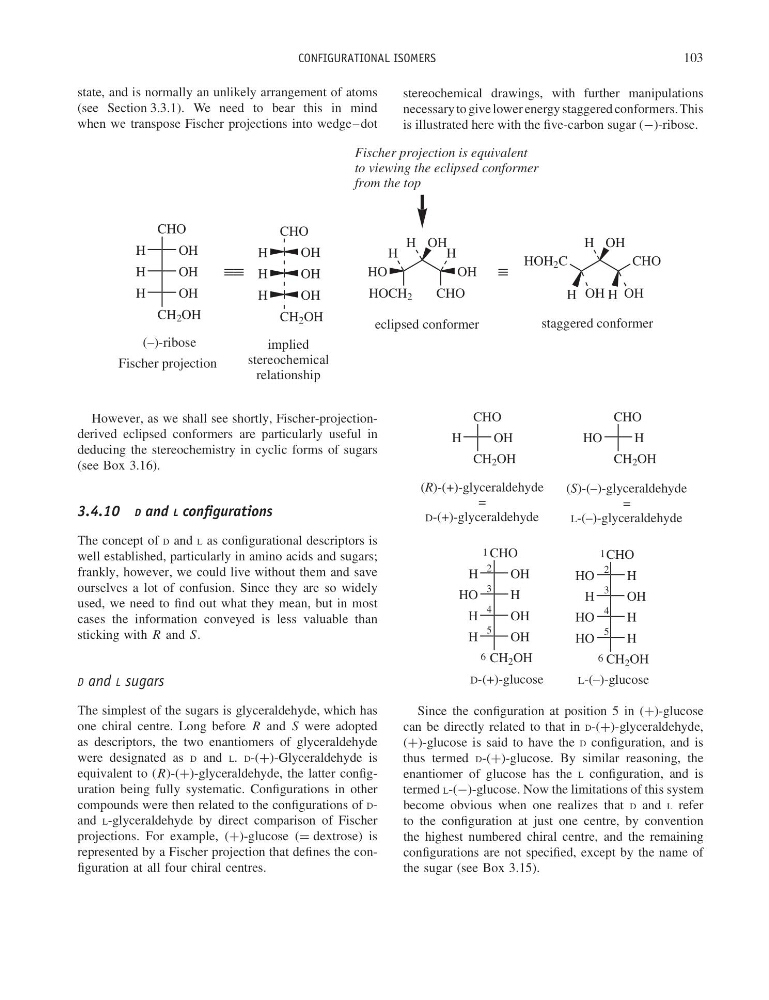
state, and is normally an unlikely arrangement of atoms
(see Section 3.3.1). We need to bear this in mind
when we transpose Fischer projections into wedge–dot
stereochemical drawings, with further manipulations
necessary to give lower energy staggered conformers. This
is illustrated here with the five-carbon sugar (−)-ribose.
H
CHO
OH
H
OH
H
CH 2 OH
OH
(–)-ribose
H
CHO
OH
H
OH
H
CH 2 OH
OH
HO
HOCH 2
OH
CHO
OH
H
H
H
≡≡
Fischer projection is equivalent
to viewing the eclipsed conformer
from the top
≡
HOH 2 C
CHO
OH
OH
H
H
H
OH
eclipsed conformer
staggered conformer
Fischer projection
implied
stereochemical
relationship
However, as we shall see shortly, Fischer-projectionderived eclipsed conformers are particularly useful in
deducing the stereochemistry in cyclic forms of sugars
(see Box 3.16).
3.4.10 D and L configurations
The concept of D and L as configurational descriptors is
well established, particularly in amino acids and sugars;
frankly, however, we could live without them and save
ourselves a lot of confusion. Since they are so widely
used, we need to find out what they mean, but in most
cases the information conveyed is less valuable than
sticking with R and S.
D and L sugars
The simplest of the sugars is glyceraldehyde, which has
one chiral centre. Long before R and S were adopted
as descriptors, the two enantiomers of glyceraldehyde
were designated as D and L. D-(+)-Glyceraldehyde is
equivalent to (R)-(+)-glyceraldehyde, the latter configuration being fully systematic. Configurations in other
compounds were then related to the configurations of Dand L-glyceraldehyde by direct comparison of Fischer
projections. For example, (+)-glucose (= dextrose) is
represented by a Fischer projection that defines the configuration at all four chiral centres.
H
CHO
OH
CH 2 OH
HO
H
CH 2 OH
CHO
(R)-(+)-glyceraldehyde
=
D-(+)-glyceraldehyde
(S)-(–)-glyceraldehyde
=
L-(–)-glyceraldehyde
H
CHO
OH
HO
H
H
OH
H
OH
CH 2 OH
D-(+)-glucose
2
4
3
6
5
1
H
CHO
HO
OH
H
H
HO
H
HO
CH 2 OH
L-(–)-glucose
2
4
3
6
5
1
Since the configuration at position 5 in (+)-glucose
can be directly related to that in D-(+)-glyceraldehyde,
(+)-glucose is said to have the D configuration, and is
thus termed D-(+)-glucose. By similar reasoning, the
enantiomer of glucose has the L configuration, and is
termed L-(−)-glucose. Now the limitations of this system
become obvious when one realizes that D and L refer
to the configuration at just one centre, by convention
the highest numbered chiral centre, and the remaining
configurations are not specified, except by the name of
the sugar (see Box 3.15).
103
state, and is normally an unlikely arrangement of atoms
(see Section 3.3.1). We need to bear this in mind
when we transpose Fischer projections into wedge–dot
stereochemical drawings, with further manipulations
necessary to give lower energy staggered conformers. This
is illustrated here with the five-carbon sugar (−)-ribose.
H
CHO
OH
H
OH
H
CH 2 OH
OH
(–)-ribose
H
CHO
OH
H
OH
H
CH 2 OH
OH
HO
HOCH 2
OH
CHO
OH
H
H
H
≡≡
Fischer projection is equivalent
to viewing the eclipsed conformer
from the top
≡
HOH 2 C
CHO
OH
OH
H
H
H
OH
eclipsed conformer
staggered conformer
Fischer projection
implied
stereochemical
relationship
However, as we shall see shortly, Fischer-projectionderived eclipsed conformers are particularly useful in
deducing the stereochemistry in cyclic forms of sugars
(see Box 3.16).
3.4.10 D and L configurations
The concept of D and L as configurational descriptors is
well established, particularly in amino acids and sugars;
frankly, however, we could live without them and save
ourselves a lot of confusion. Since they are so widely
used, we need to find out what they mean, but in most
cases the information conveyed is less valuable than
sticking with R and S.
D and L sugars
The simplest of the sugars is glyceraldehyde, which has
one chiral centre. Long before R and S were adopted
as descriptors, the two enantiomers of glyceraldehyde
were designated as D and L. D-(+)-Glyceraldehyde is
equivalent to (R)-(+)-glyceraldehyde, the latter configuration being fully systematic. Configurations in other
compounds were then related to the configurations of Dand L-glyceraldehyde by direct comparison of Fischer
projections. For example, (+)-glucose (= dextrose) is
represented by a Fischer projection that defines the configuration at all four chiral centres.
H
CHO
OH
CH 2 OH
HO
H
CH 2 OH
CHO
(R)-(+)-glyceraldehyde
=
D-(+)-glyceraldehyde
(S)-(–)-glyceraldehyde
=
L-(–)-glyceraldehyde
H
CHO
OH
HO
H
H
OH
H
OH
CH 2 OH
D-(+)-glucose
2
4
3
6
5
1
H
CHO
HO
OH
H
H
HO
H
HO
CH 2 OH
L-(–)-glucose
2
4
3
6
5
1
Since the configuration at position 5 in (+)-glucose
can be directly related to that in D-(+)-glyceraldehyde,
(+)-glucose is said to have the D configuration, and is
thus termed D-(+)-glucose. By similar reasoning, the
enantiomer of glucose has the L configuration, and is
termed L-(−)-glucose. Now the limitations of this system
become obvious when one realizes that D and L refer
to the configuration at just one centre, by convention
the highest numbered chiral centre, and the remaining
configurations are not specified, except by the name of
the sugar (see Box 3.15).