

102
STEREOCHEMISTRY
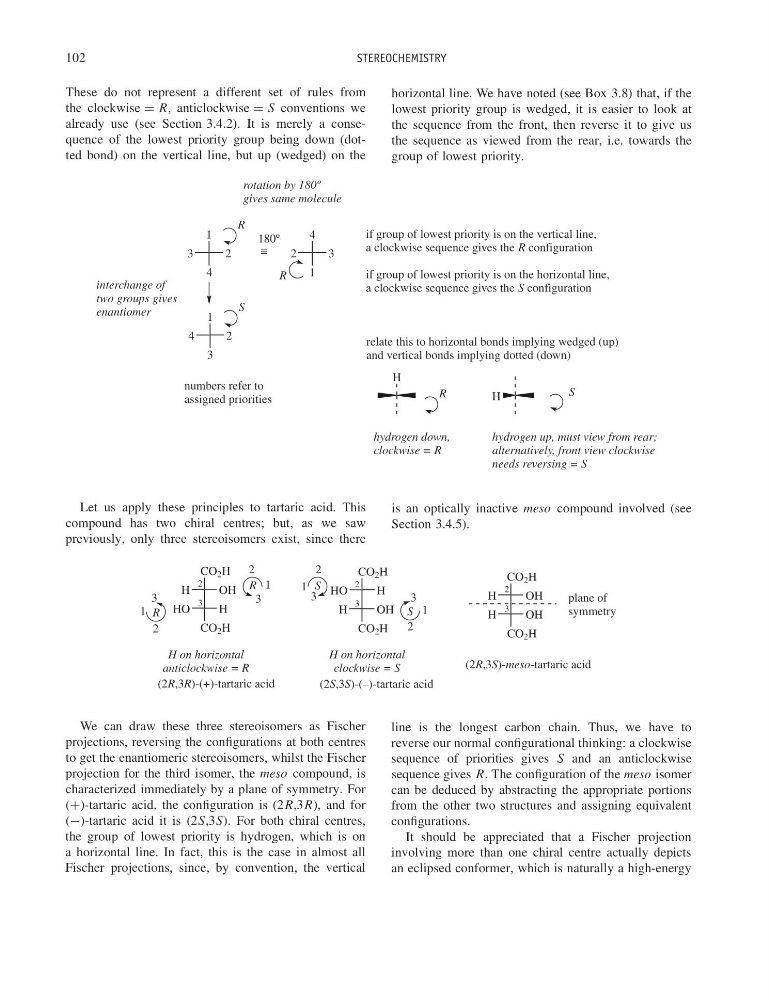
These do not represent a different set of rules from
the clockwise = R, anticlockwise = S conventions we
already use (see Section 3.4.2). It is merely a consequence of the lowest priority group being down (dotted bond) on the vertical line, but up (wedged) on the
horizontal line. We have noted (see Box 3.8) that, if the
lowest priority group is wedged, it is easier to look at
the sequence from the front, then reverse it to give us
the sequence as viewed from the rear, i.e. towards the
group of lowest priority.
1
2
4
3
4
3
1
2
180º
≡
if group of lowest priority is on the vertical line,
a clockwise sequence gives the R configuration
if group of lowest priority is on the horizontal line,
a clockwise sequence gives the S configuration
1
2
3
4
interchange of
two groups gives
enantiomer
rotation by 180º
gives same molecule
relate this to horizontal bonds implying wedged (up)
and vertical bonds implying dotted (down)
hydrogen down,
clockwise = R
hydrogen up, must view from rear;
alternatively, front view clockwise
needs reversing = S
H
H
numbers refer to
assigned priorities
R
R
S
R
S
Let us apply these principles to tartaric acid. This
compound has two chiral centres; but, as we saw
previously, only three stereoisomers exist, since there
is an optically inactive meso compound involved (see
Section 3.4.5).
CO 2 H
OH
H
CO 2 H
H
HO
CO 2 H
H
HO
2
CO 2 H
OH
H
1
1
2
3
2
(2R,3R)-(+)-tartaric acid
3
3
CO 2 H
OH
H
CO 2 H
OH
H
2
2
3
3
(2S,3S)-(–)-tartaric acid
(2R,3S)-meso-tartaric acid
H on horizontal
anticlockwise = R
1
2
3
1
2
3
H on horizontal
clockwise = S
plane of
symmetry
R
R
S
S
We can draw these three stereoisomers as Fischer
projections, reversing the configurations at both centres
to get the enantiomeric stereoisomers, whilst the Fischer
projection for the third isomer, the meso compound, is
characterized immediately by a plane of symmetry. For
(+)-tartaric acid, the configuration is (2R,3R), and for
(−)-tartaric acid it is (2S,3S). For both chiral centres,
the group of lowest priority is hydrogen, which is on
a horizontal line. In fact, this is the case in almost all
Fischer projections, since, by convention, the vertical
line is the longest carbon chain. Thus, we have to
reverse our normal configurational thinking: a clockwise
sequence of priorities gives S and an anticlockwise
sequence gives R. The configuration of the meso isomer
can be deduced by abstracting the appropriate portions
from the other two structures and assigning equivalent
configurations.
It should be appreciated that a Fischer projection
involving more than one chiral centre actually depicts
an eclipsed conformer, which is naturally a high-energy
STEREOCHEMISTRY
These do not represent a different set of rules from
the clockwise = R, anticlockwise = S conventions we
already use (see Section 3.4.2). It is merely a consequence of the lowest priority group being down (dotted bond) on the vertical line, but up (wedged) on the
horizontal line. We have noted (see Box 3.8) that, if the
lowest priority group is wedged, it is easier to look at
the sequence from the front, then reverse it to give us
the sequence as viewed from the rear, i.e. towards the
group of lowest priority.
1
2
4
3
4
3
1
2
180º
≡
if group of lowest priority is on the vertical line,
a clockwise sequence gives the R configuration
if group of lowest priority is on the horizontal line,
a clockwise sequence gives the S configuration
1
2
3
4
interchange of
two groups gives
enantiomer
rotation by 180º
gives same molecule
relate this to horizontal bonds implying wedged (up)
and vertical bonds implying dotted (down)
hydrogen down,
clockwise = R
hydrogen up, must view from rear;
alternatively, front view clockwise
needs reversing = S
H
H
numbers refer to
assigned priorities
R
R
S
R
S
Let us apply these principles to tartaric acid. This
compound has two chiral centres; but, as we saw
previously, only three stereoisomers exist, since there
is an optically inactive meso compound involved (see
Section 3.4.5).
CO 2 H
OH
H
CO 2 H
H
HO
CO 2 H
H
HO
2
CO 2 H
OH
H
1
1
2
3
2
(2R,3R)-(+)-tartaric acid
3
3
CO 2 H
OH
H
CO 2 H
OH
H
2
2
3
3
(2S,3S)-(–)-tartaric acid
(2R,3S)-meso-tartaric acid
H on horizontal
anticlockwise = R
1
2
3
1
2
3
H on horizontal
clockwise = S
plane of
symmetry
R
R
S
S
We can draw these three stereoisomers as Fischer
projections, reversing the configurations at both centres
to get the enantiomeric stereoisomers, whilst the Fischer
projection for the third isomer, the meso compound, is
characterized immediately by a plane of symmetry. For
(+)-tartaric acid, the configuration is (2R,3R), and for
(−)-tartaric acid it is (2S,3S). For both chiral centres,
the group of lowest priority is hydrogen, which is on
a horizontal line. In fact, this is the case in almost all
Fischer projections, since, by convention, the vertical
line is the longest carbon chain. Thus, we have to
reverse our normal configurational thinking: a clockwise
sequence of priorities gives S and an anticlockwise
sequence gives R. The configuration of the meso isomer
can be deduced by abstracting the appropriate portions
from the other two structures and assigning equivalent
configurations.
It should be appreciated that a Fischer projection
involving more than one chiral centre actually depicts
an eclipsed conformer, which is naturally a high-energy