

CONFIGURATIONAL ISOMERS
87
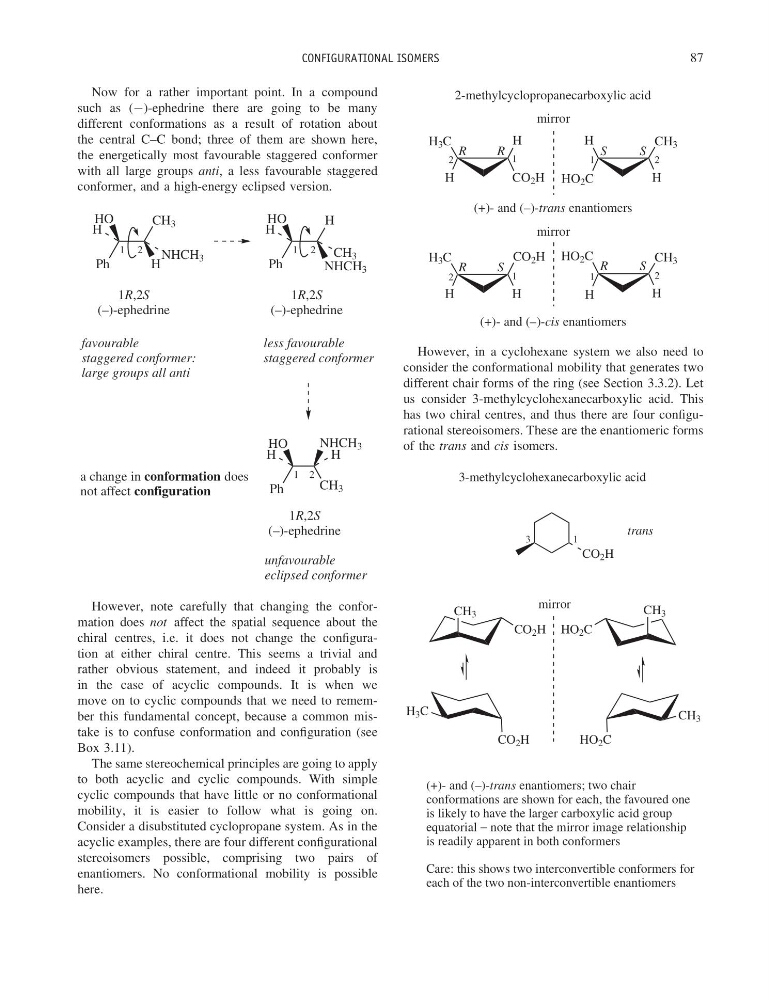
Now for a rather important point. In a compound
such as (−)-ephedrine there are going to be many
different conformations as a result of rotation about
the central C–C bond; three of them are shown here,
the energetically most favourable staggered conformer
with all large groups anti, a less favourable staggered
conformer, and a high-energy eclipsed version.
CH 3
Ph
H
HO
NHCH 3
H
2
1
1R,2S
(–)-ephedrine
favourable
staggered conformer:
large groups all anti
H
Ph
NHCH 3
HO
CH 3
H
2
1
1R,2S
(–)-ephedrine
less favourable
staggered conformer
Ph
HO
H
1
NHCH 3
H
CH 3
2
1R,2S
(–)-ephedrine
unfavourable
eclipsed conformer
a change in conformation does
not affect configuration
However, note carefully that changing the conformation does not affect the spatial sequence about the
chiral centres, i.e. it does not change the configuration at either chiral centre. This seems a trivial and
rather obvious statement, and indeed it probably is
in the case of acyclic compounds. It is when we
move on to cyclic compounds that we need to remember this fundamental concept, because a common mistake is to confuse conformation and configuration (see
Box 3.11).
The same stereochemical principles are going to apply
to both acyclic and cyclic compounds. With simple
cyclic compounds that have little or no conformational
mobility, it is easier to follow what is going on.
Consider a disubstituted cyclopropane system. As in the
acyclic examples, there are four different configurational
stereoisomers possible, comprising two pairs of
enantiomers. No conformational mobility is possible
here.
H 3 C
H
H
CO 2 H
CH 3
H
H
HO 2 C
mirror
(+)- and (–)-trans enantiomers
R
R
S
S
H 3 C
H
CO 2 H
H
CH 3
H
HO 2 C
H
(+)- and (–)-cis enantiomers
R
S
R
S
2-methylcyclopropanecarboxylic acid
2
1
1
2
2
1
1
2
mirror
However, in a cyclohexane system we also need to
consider the conformational mobility that generates two
different chair forms of the ring (see Section 3.3.2). Let
us consider 3-methylcyclohexanecarboxylic acid. This
has two chiral centres, and thus there are four configurational stereoisomers. These are the enantiomeric forms
of the trans and cis isomers.
HO 2 C
CO 2 H
HO 2 C
CO 2 H
mirror
CH 3
CH 3
H 3 C
CH 3
3-methylcyclohexanecarboxylic acid
(+)- and (–)-trans enantiomers; two chair
conformations are shown for each, the favoured one
is likely to have the larger carboxylic acid group
equatorial − note that the mirror image relationship
is readily apparent in both conformers
Care: this shows two interconvertible conformers for
each of the two non-interconvertible enantiomers
CO 2 H
trans
1
3
87
Now for a rather important point. In a compound
such as (−)-ephedrine there are going to be many
different conformations as a result of rotation about
the central C–C bond; three of them are shown here,
the energetically most favourable staggered conformer
with all large groups anti, a less favourable staggered
conformer, and a high-energy eclipsed version.
CH 3
Ph
H
HO
NHCH 3
H
2
1
1R,2S
(–)-ephedrine
favourable
staggered conformer:
large groups all anti
H
Ph
NHCH 3
HO
CH 3
H
2
1
1R,2S
(–)-ephedrine
less favourable
staggered conformer
Ph
HO
H
1
NHCH 3
H
CH 3
2
1R,2S
(–)-ephedrine
unfavourable
eclipsed conformer
a change in conformation does
not affect configuration
However, note carefully that changing the conformation does not affect the spatial sequence about the
chiral centres, i.e. it does not change the configuration at either chiral centre. This seems a trivial and
rather obvious statement, and indeed it probably is
in the case of acyclic compounds. It is when we
move on to cyclic compounds that we need to remember this fundamental concept, because a common mistake is to confuse conformation and configuration (see
Box 3.11).
The same stereochemical principles are going to apply
to both acyclic and cyclic compounds. With simple
cyclic compounds that have little or no conformational
mobility, it is easier to follow what is going on.
Consider a disubstituted cyclopropane system. As in the
acyclic examples, there are four different configurational
stereoisomers possible, comprising two pairs of
enantiomers. No conformational mobility is possible
here.
H 3 C
H
H
CO 2 H
CH 3
H
H
HO 2 C
mirror
(+)- and (–)-trans enantiomers
R
R
S
S
H 3 C
H
CO 2 H
H
CH 3
H
HO 2 C
H
(+)- and (–)-cis enantiomers
R
S
R
S
2-methylcyclopropanecarboxylic acid
2
1
1
2
2
1
1
2
mirror
However, in a cyclohexane system we also need to
consider the conformational mobility that generates two
different chair forms of the ring (see Section 3.3.2). Let
us consider 3-methylcyclohexanecarboxylic acid. This
has two chiral centres, and thus there are four configurational stereoisomers. These are the enantiomeric forms
of the trans and cis isomers.
HO 2 C
CO 2 H
HO 2 C
CO 2 H
mirror
CH 3
CH 3
H 3 C
CH 3
3-methylcyclohexanecarboxylic acid
(+)- and (–)-trans enantiomers; two chair
conformations are shown for each, the favoured one
is likely to have the larger carboxylic acid group
equatorial − note that the mirror image relationship
is readily apparent in both conformers
Care: this shows two interconvertible conformers for
each of the two non-interconvertible enantiomers
CO 2 H
trans
1
3