

88
STEREOCHEMISTRY
mirror
CO 2 H
CO 2 H HO 2 C
HO 2 C
CH 3
H 3 C
CH 3
CH 3
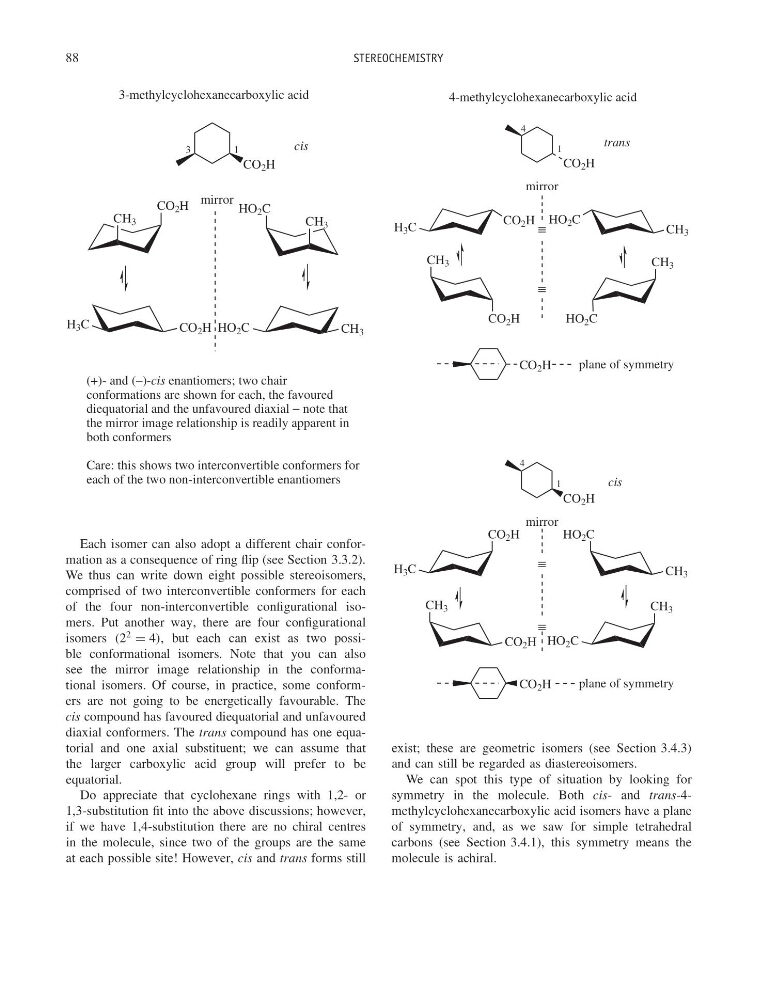
(+)- and (–)-cis enantiomers; two chair
conformations are shown for each, the favoured
diequatorial and the unfavoured diaxial − note that
the mirror image relationship is readily apparent in
both conformers
Care: this shows two interconvertible conformers for
each of the two non-interconvertible enantiomers
CO 2 H
cis
1
3
3-methylcyclohexanecarboxylic acid
Each isomer can also adopt a different chair conformation as a consequence of ring flip (see Section 3.3.2).
We thus can write down eight possible stereoisomers,
comprised of two interconvertible conformers for each
of the four non-interconvertible configurational isomers. Put another way, there are four configurational
isomers (2
2
= 4), but each can exist as two possible conformational isomers. Note that you can also
see the mirror image relationship in the conformational isomers. Of course, in practice, some conformers are not going to be energetically favourable. The
cis compound has favoured diequatorial and unfavoured
diaxial conformers. The trans compound has one equatorial and one axial substituent; we can assume that
the larger carboxylic acid group will prefer to be
equatorial.
Do appreciate that cyclohexane rings with 1,2- or
1,3-substitution fit into the above discussions; however,
if we have 1,4-substitution there are no chiral centres
in the molecule, since two of the groups are the same
at each possible site! However, cis and trans forms still
HO 2 C
CO 2 H
HO 2 C
CO 2 H
mirror
mirror
CO 2 H
CO 2 H HO 2 C
HO 2 C
CO 2 H
CO 2 H
trans
cis
H 3 C
CH 3
CH 3
CH 3
H 3 C
CH 3
CH 3
CH 3
≡
≡
≡
≡
1
4
4
1
4-methylcyclohexanecarboxylic acid
CO 2 H
CO 2 H
plane of symmetry
plane of symmetry
exist; these are geometric isomers (see Section 3.4.3)
and can still be regarded as diastereoisomers.
We can spot this type of situation by looking for
symmetry in the molecule. Both cis- and trans-4methylcyclohexanecarboxylic acid isomers have a plane
of symmetry, and, as we saw for simple tetrahedral
carbons (see Section 3.4.1), this symmetry means the
molecule is achiral.
STEREOCHEMISTRY
mirror
CO 2 H
CO 2 H HO 2 C
HO 2 C
CH 3
H 3 C
CH 3
CH 3
(+)- and (–)-cis enantiomers; two chair
conformations are shown for each, the favoured
diequatorial and the unfavoured diaxial − note that
the mirror image relationship is readily apparent in
both conformers
Care: this shows two interconvertible conformers for
each of the two non-interconvertible enantiomers
CO 2 H
cis
1
3
3-methylcyclohexanecarboxylic acid
Each isomer can also adopt a different chair conformation as a consequence of ring flip (see Section 3.3.2).
We thus can write down eight possible stereoisomers,
comprised of two interconvertible conformers for each
of the four non-interconvertible configurational isomers. Put another way, there are four configurational
isomers (2
2
= 4), but each can exist as two possible conformational isomers. Note that you can also
see the mirror image relationship in the conformational isomers. Of course, in practice, some conformers are not going to be energetically favourable. The
cis compound has favoured diequatorial and unfavoured
diaxial conformers. The trans compound has one equatorial and one axial substituent; we can assume that
the larger carboxylic acid group will prefer to be
equatorial.
Do appreciate that cyclohexane rings with 1,2- or
1,3-substitution fit into the above discussions; however,
if we have 1,4-substitution there are no chiral centres
in the molecule, since two of the groups are the same
at each possible site! However, cis and trans forms still
HO 2 C
CO 2 H
HO 2 C
CO 2 H
mirror
mirror
CO 2 H
CO 2 H HO 2 C
HO 2 C
CO 2 H
CO 2 H
trans
cis
H 3 C
CH 3
CH 3
CH 3
H 3 C
CH 3
CH 3
CH 3
≡
≡
≡
≡
1
4
4
1
4-methylcyclohexanecarboxylic acid
CO 2 H
CO 2 H
plane of symmetry
plane of symmetry
exist; these are geometric isomers (see Section 3.4.3)
and can still be regarded as diastereoisomers.
We can spot this type of situation by looking for
symmetry in the molecule. Both cis- and trans-4methylcyclohexanecarboxylic acid isomers have a plane
of symmetry, and, as we saw for simple tetrahedral
carbons (see Section 3.4.1), this symmetry means the
molecule is achiral.