

86
STEREOCHEMISTRY
We have seen earlier that enantiomers are chemically identical except in optical properties, although
biological properties may be different (see Box 3.7).
On the other hand, diastereoisomers have different
physical and chemical properties, and probably different biological properties as well. As a result, they
are considered a completely different chemical entity,
and are often given a different chemical name. The
(1S,2S) and (1R,2R) isomers are thus known as (+)pseudoephedrine and (−)-pseudoephedrine respectively.
Interestingly, (+)-pseudoephedrine has similar biological properties to (−)-ephedrine, and it is used as a bronchodilator and decongestant drug in the same way as
ephedrine.
One more useful piece of terminology can be
introduced here. This is the term epimer. An epimer
is a diastereoisomer that differs in chirality at only one
centre. Thus, (−)-pseudoephedrine is the 2-epimer of
(−)-ephedrine, and (+)-pseudoephedrine is the 1-epimer
of (−)-ephedrine.
The epimer terminology is of greater value when
there are more than two chiral centres in the molecule.
Suppose we have a compound with three chiral centres,
at positions 2, 3, and 4 in some unspecified carbon
chain, with configurations 2R,3R,4S. There would thus
exist a total of 2
3
= 8 configurational isomers. The
enantiomer would have the configuration 2S,3S,4R, i.e.
changing the configuration at all centres. The 2S,3R,4S
diastereoisomer we could then refer to as ‘the 2-epimer’,
and the 2R,3S,4S diastereoisomer as ‘the 3-epimer’,
since we have changed the stereochemistry at just one
centre, keeping other configurations the same.
Box 3.10
Drawing enantiomers and epimers: 6-aminopenicillanic acid
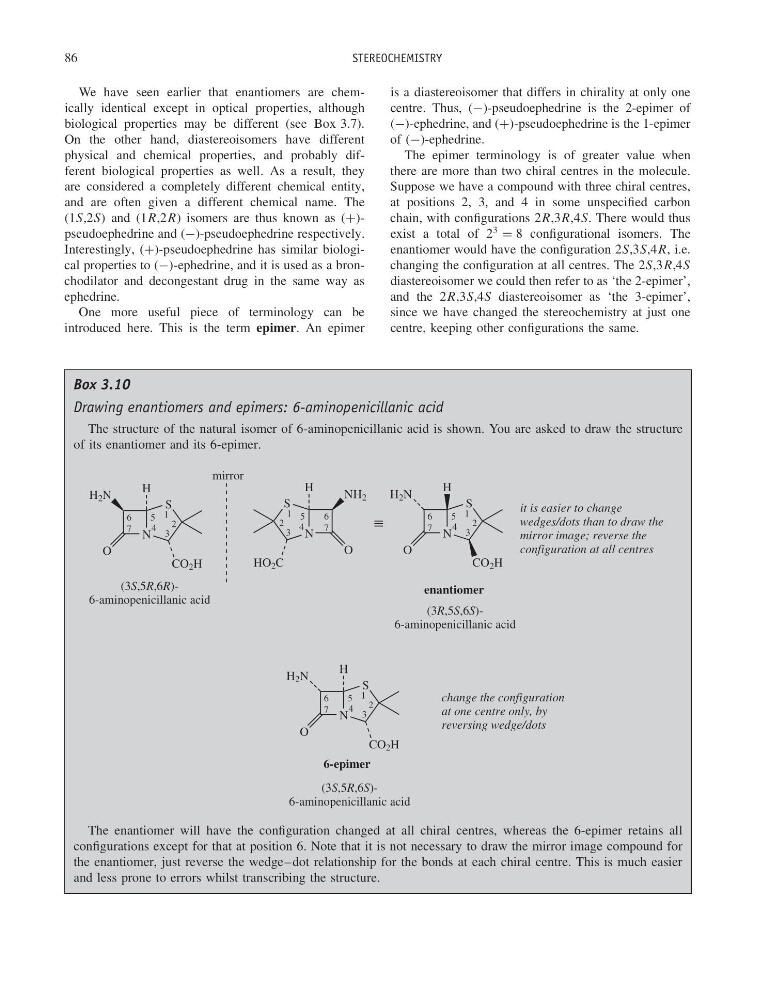
The structure of the natural isomer of 6-aminopenicillanic acid is shown. You are asked to draw the structure
of its enantiomer and its 6-epimer.
N
S
O
H 2 N
CO 2 H
H
2
3
4
5
7
1
6
(3S,5R,6R)6-aminopenicillanic acid
N
S
O
NH 2
HO 2 C
H
2
3
4
5
7
1
6
(3R,5S,6S)6-aminopenicillanic acid
enantiomer
N
S
O
H 2 N
CO 2 H
H
2
3
4
5
7
1
6
≡
it is easier to change
wedges/dots than to draw the
mirror image; reverse the
configuration at all centres
N
S
O
H 2 N
CO 2 H
H
2
3
4
5
7
1
6
(3S,5R,6S)6-aminopenicillanic acid
6-epimer
change the configuration
at one centre only, by
reversing wedge/dots
mirror
The enantiomer will have the configuration changed at all chiral centres, whereas the 6-epimer retains all
configurations except for that at position 6. Note that it is not necessary to draw the mirror image compound for
the enantiomer, just reverse the wedge–dot relationship for the bonds at each chiral centre. This is much easier
and less prone to errors whilst transcribing the structure.
STEREOCHEMISTRY
We have seen earlier that enantiomers are chemically identical except in optical properties, although
biological properties may be different (see Box 3.7).
On the other hand, diastereoisomers have different
physical and chemical properties, and probably different biological properties as well. As a result, they
are considered a completely different chemical entity,
and are often given a different chemical name. The
(1S,2S) and (1R,2R) isomers are thus known as (+)pseudoephedrine and (−)-pseudoephedrine respectively.
Interestingly, (+)-pseudoephedrine has similar biological properties to (−)-ephedrine, and it is used as a bronchodilator and decongestant drug in the same way as
ephedrine.
One more useful piece of terminology can be
introduced here. This is the term epimer. An epimer
is a diastereoisomer that differs in chirality at only one
centre. Thus, (−)-pseudoephedrine is the 2-epimer of
(−)-ephedrine, and (+)-pseudoephedrine is the 1-epimer
of (−)-ephedrine.
The epimer terminology is of greater value when
there are more than two chiral centres in the molecule.
Suppose we have a compound with three chiral centres,
at positions 2, 3, and 4 in some unspecified carbon
chain, with configurations 2R,3R,4S. There would thus
exist a total of 2
3
= 8 configurational isomers. The
enantiomer would have the configuration 2S,3S,4R, i.e.
changing the configuration at all centres. The 2S,3R,4S
diastereoisomer we could then refer to as ‘the 2-epimer’,
and the 2R,3S,4S diastereoisomer as ‘the 3-epimer’,
since we have changed the stereochemistry at just one
centre, keeping other configurations the same.
Box 3.10
Drawing enantiomers and epimers: 6-aminopenicillanic acid
The structure of the natural isomer of 6-aminopenicillanic acid is shown. You are asked to draw the structure
of its enantiomer and its 6-epimer.
N
S
O
H 2 N
CO 2 H
H
2
3
4
5
7
1
6
(3S,5R,6R)6-aminopenicillanic acid
N
S
O
NH 2
HO 2 C
H
2
3
4
5
7
1
6
(3R,5S,6S)6-aminopenicillanic acid
enantiomer
N
S
O
H 2 N
CO 2 H
H
2
3
4
5
7
1
6
≡
it is easier to change
wedges/dots than to draw the
mirror image; reverse the
configuration at all centres
N
S
O
H 2 N
CO 2 H
H
2
3
4
5
7
1
6
(3S,5R,6S)6-aminopenicillanic acid
6-epimer
change the configuration
at one centre only, by
reversing wedge/dots
mirror
The enantiomer will have the configuration changed at all chiral centres, whereas the 6-epimer retains all
configurations except for that at position 6. Note that it is not necessary to draw the mirror image compound for
the enantiomer, just reverse the wedge–dot relationship for the bonds at each chiral centre. This is much easier
and less prone to errors whilst transcribing the structure.