

VII.3. La convexification d’une fonction
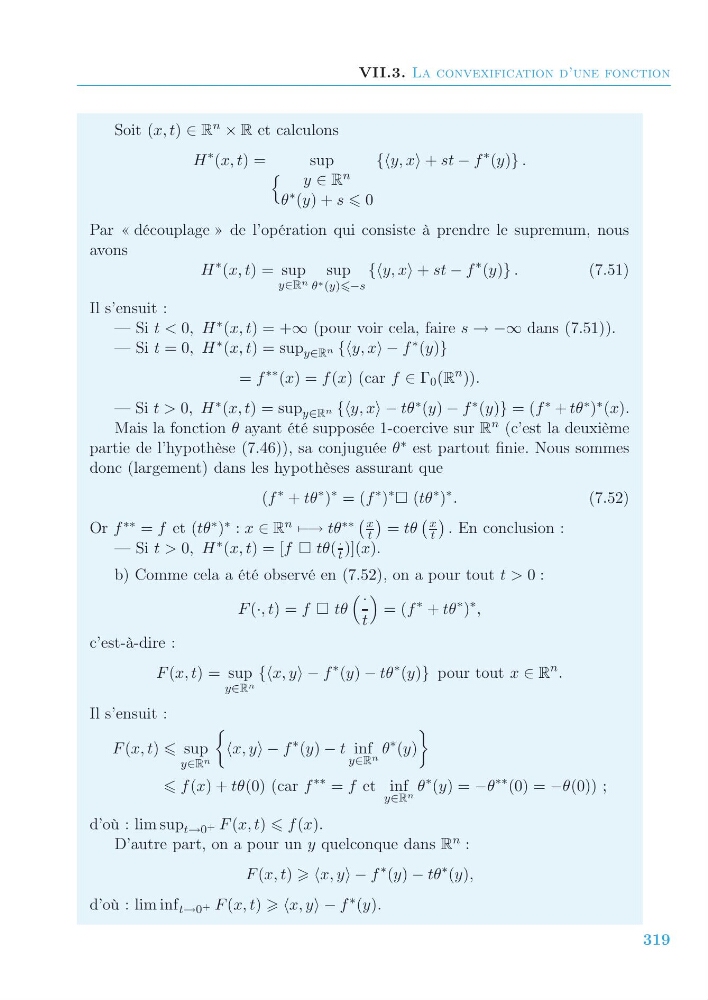
Soit (x, t) ∈ R n × R et calculons
H
∗ (x, t) =
sup
y ∈ R n
θ ∗ (y) + s 0
{{y, x + st − f
∗ (y)} .
Par « découplage » de l’opération qui consiste à prendre le supremum, nous
avons
H
∗ (x, t) = sup
y∈R n
sup
θ ∗ (y)−s
{{y, x + st − f
∗ (y)} .
(7.51)
Il s’ensuit :
— Si t < 0, H ∗ (x, t) = +∞ (pour voir cela, faire s → −∞ dans (7.51)).
— Si t = 0, H ∗ (x, t) = sup y∈R n {{y, x − f ∗ (y)}
= f
∗∗ (x) = f (x) (car f ∈ Γ 0 (R
n )).
— Si t > 0, H ∗ (x, t) = sup y∈R n {{y, x − tθ ∗ (y) − f ∗ (y)} = (f ∗ + tθ ∗ ) ∗ (x).
Mais la fonction θ ayant été supposée 1-coercive sur R n (c’est la deuxième
partie de l’hypothèse (7.46)), sa conjuguée θ ∗ est partout finie. Nous sommes
donc (largement) dans les hypothèses assurant que
(f
∗ + tθ
∗ )
∗ = (f
∗ )
∗
(tθ
∗ )
∗ .
(7.52)
Or f ∗∗ = f et (tθ ∗ ) ∗ : x ∈ R n −→ tθ ∗∗ x
t
= tθ
x
t
. En conclusion :
— Si t > 0, H ∗ (x, t) = [f tθ(
·
t )](x).
b) Comme cela a été observé en (7.52), on a pour tout t > 0 :
F (·, t) = f tθ
·
t
= (f
∗ + tθ
∗ )
∗ ,
c’est-à-dire :
F (x, t) = sup
y∈R n
{{x, y − f
∗ (y) − tθ
∗ (y)} pour tout x ∈ R
n .
Il s’ensuit :
F (x, t) sup
y∈R n
x, y − f
∗ (y) − t inf
y∈R n
θ
∗ (y)
f (x) + tθ(0) (car f
∗∗ = f et inf
y∈R n
θ
∗ (y) = −θ
∗∗ (0) = −θ(0)) ;
d’où : lim sup t→0 + F (x, t) f (x).
D’autre part, on a pour un y quelconque dans R n :
F (x, t) x, y − f
∗ (y) − tθ
∗ (y),
d’où : lim inf t→0 + F (x, t) x, y − f ∗ (y).
319
Soit (x, t) ∈ R n × R et calculons
H
∗ (x, t) =
sup
y ∈ R n
θ ∗ (y) + s 0
{{y, x + st − f
∗ (y)} .
Par « découplage » de l’opération qui consiste à prendre le supremum, nous
avons
H
∗ (x, t) = sup
y∈R n
sup
θ ∗ (y)−s
{{y, x + st − f
∗ (y)} .
(7.51)
Il s’ensuit :
— Si t < 0, H ∗ (x, t) = +∞ (pour voir cela, faire s → −∞ dans (7.51)).
— Si t = 0, H ∗ (x, t) = sup y∈R n {{y, x − f ∗ (y)}
= f
∗∗ (x) = f (x) (car f ∈ Γ 0 (R
n )).
— Si t > 0, H ∗ (x, t) = sup y∈R n {{y, x − tθ ∗ (y) − f ∗ (y)} = (f ∗ + tθ ∗ ) ∗ (x).
Mais la fonction θ ayant été supposée 1-coercive sur R n (c’est la deuxième
partie de l’hypothèse (7.46)), sa conjuguée θ ∗ est partout finie. Nous sommes
donc (largement) dans les hypothèses assurant que
(f
∗ + tθ
∗ )
∗ = (f
∗ )
∗
(tθ
∗ )
∗ .
(7.52)
Or f ∗∗ = f et (tθ ∗ ) ∗ : x ∈ R n −→ tθ ∗∗ x
t
= tθ
x
t
. En conclusion :
— Si t > 0, H ∗ (x, t) = [f tθ(
·
t )](x).
b) Comme cela a été observé en (7.52), on a pour tout t > 0 :
F (·, t) = f tθ
·
t
= (f
∗ + tθ
∗ )
∗ ,
c’est-à-dire :
F (x, t) = sup
y∈R n
{{x, y − f
∗ (y) − tθ
∗ (y)} pour tout x ∈ R
n .
Il s’ensuit :
F (x, t) sup
y∈R n
x, y − f
∗ (y) − t inf
y∈R n
θ
∗ (y)
f (x) + tθ(0) (car f
∗∗ = f et inf
y∈R n
θ
∗ (y) = −θ
∗∗ (0) = −θ(0)) ;
d’où : lim sup t→0 + F (x, t) f (x).
D’autre part, on a pour un y quelconque dans R n :
F (x, t) x, y − f
∗ (y) − tθ
∗ (y),
d’où : lim inf t→0 + F (x, t) x, y − f ∗ (y).
319