

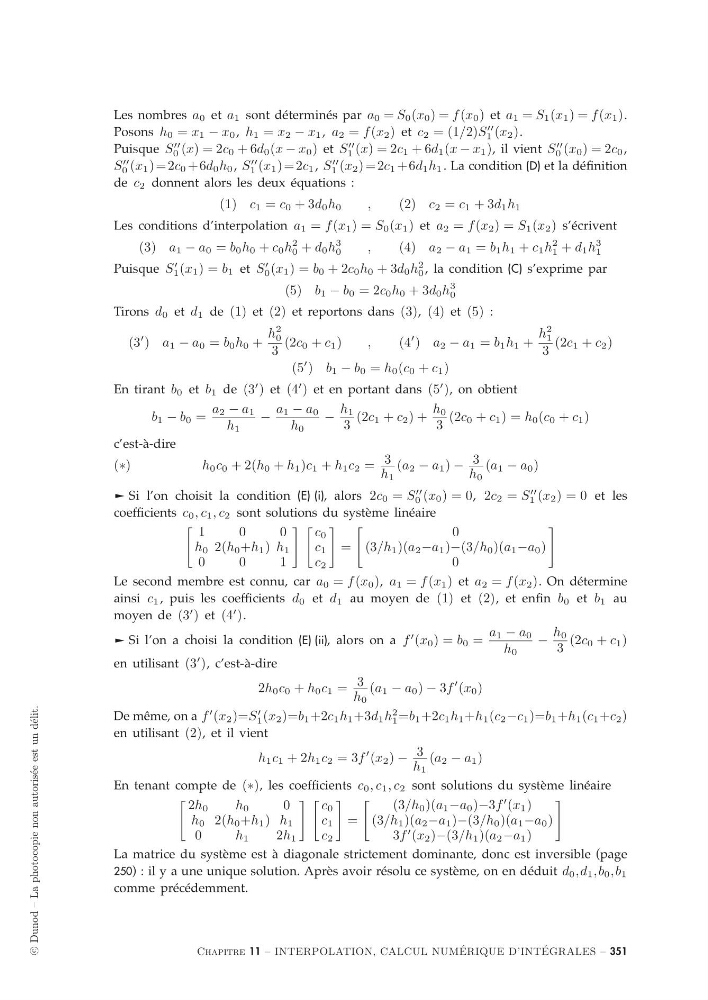
Les nombres a 0 et a 1 sont déterminés par a 0 = S 0 (x 0 ) = f (x 0 ) et a 1 = S 1 (x 1 ) = f (x 1 ).
Posons h 0 = x 1 − x 0 , h 1 = x 2 − x 1 , a 2 = f (x 2 ) et c 2 = (1/2)S
1 (x 2 ).
Puisque S
0 (x) = 2c 0 + 6d 0 (x − x 0 ) et S
1 (x) = 2c 1 + 6d 1 (x − x 1 ), il vient S
0 (x 0 ) = 2c 0 ,
S
0 (x 1 )=2c 0 +6d 0 h 0 , S
1 (x 1 )=2c 1 , S
1 (x 2 )=2c 1 +6d 1 h 1 . La condition (D) et la définition
de c 2 donnent alors les deux équations :
(1) c 1 = c 0 + 3d 0 h 0
,
(2) c 2 = c 1 + 3d 1 h 1
Les conditions d’interpolation a 1 = f (x 1 ) = S 0 (x 1 ) et a 2 = f (x 2 ) = S 1 (x 2 ) s’écrivent
(3) a 1 − a 0 = b 0 h 0 + c 0 h
2
0 + d 0 h
3
0
,
(4) a 2 − a 1 = b 1 h 1 + c 1 h
2
1 + d 1 h
3
1
Puisque S
1 (x 1 ) = b 1 et S
0 (x 1 ) = b 0 + 2c 0 h 0 + 3d 0 h
2
0 , la condition (C) s’exprime par
(5) b 1 − b 0 = 2c 0 h 0 + 3d 0 h
3
0
Tirons d 0 et d 1 de (1) et (2) et reportons dans (3), (4) et (5) :
(3
) a 1 − a 0 = b 0 h 0 +
h
2
0
3
(2c 0 + c 1 )
,
(4
) a 2 − a 1 = b 1 h 1 +
h
2
1
3
(2c 1 + c 2 )
(5
) b 1 − b 0 = h 0 (c 0 + c 1 )
En tirant b 0 et b 1 de (3
) et (4
) et en portant dans (5
), on obtient
b 1 − b 0 =
a 2 − a 1
h 1
−
a 1 − a 0
h 0
−
h 1
3
(2c 1 + c 2 ) +
h 0
3
(2c 0 + c 1 ) = h 0 (c 0 + c 1 )
c’est-à-dire
(∗)
h 0 c 0 + 2(h 0 + h 1 )c 1 + h 1 c 2 = 3
h 1
(a 2 − a 1 ) − 3
h 0
(a 1 − a 0 )
® Si l’on choisit la condition (E) (i), alors 2c 0 = S
0 (x 0 ) = 0, 2c 2 = S
1 (x 2 ) = 0 et les
coefficients c 0 , c 1 , c 2 sont solutions du système linéaire
1
0
0
h 0 2(h 0 +h 1 ) h 1
0
0
1
c 0
c 1
c 2
=
0
(3/h 1 )(a 2 −a 1 )−(3/h 0 )(a 1 −a 0 )
0
Le second membre est connu, car a 0 = f (x 0 ), a 1 = f (x 1 ) et a 2 = f (x 2 ). On détermine
ainsi c 1 , puis les coefficients d 0 et d 1 au moyen de (1) et (2), et enfin b 0 et b 1 au
moyen de (3
) et (4
).
® Si l’on a choisi la condition (E) (ii), alors on a f
(x 0 ) = b 0 =
a 1 − a 0
h 0
−
h 0
3
(2c 0 + c 1 )
en utilisant (3
), c’est-à-dire
2h 0 c 0 + h 0 c 1 = 3
h 0
(a 1 − a 0 ) − 3f
(x 0 )
De même, on a f
(x 2 )=S
1 (x 2 )=b 1 +2c 1 h 1 +3d 1 h
2
1 =b 1 +2c 1 h 1 +h 1 (c 2 −c 1 )=b 1 +h 1 (c 1 +c 2 )
en utilisant (2), et il vient
h 1 c 1 + 2h 1 c 2 = 3f
(x 2 ) − 3
h 1
(a 2 − a 1 )
En tenant compte de (∗), les coefficients c 0 , c 1 , c 2 sont solutions du système linéaire
2h 0
h 0
0
h 0 2(h 0 +h 1 ) h 1
0
h 1
2h 1
c 0
c 1
c 2
=
(3/h 0 )(a 1 −a 0 )−3f
(x 1 )
(3/h 1 )(a 2 −a 1 )−(3/h 0 )(a 1 −a 0 )
3f
(x 2 )−(3/h 1 )(a 2 −a 1 )
La matrice du système est à diagonale strictement dominante, donc est inversible (page
250) : il y a une unique solution. Après avoir résolu ce système, on en déduit d 0 ,d 1 ,b 0 ,b 1
comme précédemment.
Chapitre 11 – INTERPOLATION, CALCUL NUM ´
ERIQUE D’INT ´
EGRALES – 351
Posons h 0 = x 1 − x 0 , h 1 = x 2 − x 1 , a 2 = f (x 2 ) et c 2 = (1/2)S
1 (x 2 ).
Puisque S
0 (x) = 2c 0 + 6d 0 (x − x 0 ) et S
1 (x) = 2c 1 + 6d 1 (x − x 1 ), il vient S
0 (x 0 ) = 2c 0 ,
S
0 (x 1 )=2c 0 +6d 0 h 0 , S
1 (x 1 )=2c 1 , S
1 (x 2 )=2c 1 +6d 1 h 1 . La condition (D) et la définition
de c 2 donnent alors les deux équations :
(1) c 1 = c 0 + 3d 0 h 0
,
(2) c 2 = c 1 + 3d 1 h 1
Les conditions d’interpolation a 1 = f (x 1 ) = S 0 (x 1 ) et a 2 = f (x 2 ) = S 1 (x 2 ) s’écrivent
(3) a 1 − a 0 = b 0 h 0 + c 0 h
2
0 + d 0 h
3
0
,
(4) a 2 − a 1 = b 1 h 1 + c 1 h
2
1 + d 1 h
3
1
Puisque S
1 (x 1 ) = b 1 et S
0 (x 1 ) = b 0 + 2c 0 h 0 + 3d 0 h
2
0 , la condition (C) s’exprime par
(5) b 1 − b 0 = 2c 0 h 0 + 3d 0 h
3
0
Tirons d 0 et d 1 de (1) et (2) et reportons dans (3), (4) et (5) :
(3
) a 1 − a 0 = b 0 h 0 +
h
2
0
3
(2c 0 + c 1 )
,
(4
) a 2 − a 1 = b 1 h 1 +
h
2
1
3
(2c 1 + c 2 )
(5
) b 1 − b 0 = h 0 (c 0 + c 1 )
En tirant b 0 et b 1 de (3
) et (4
) et en portant dans (5
), on obtient
b 1 − b 0 =
a 2 − a 1
h 1
−
a 1 − a 0
h 0
−
h 1
3
(2c 1 + c 2 ) +
h 0
3
(2c 0 + c 1 ) = h 0 (c 0 + c 1 )
c’est-à-dire
(∗)
h 0 c 0 + 2(h 0 + h 1 )c 1 + h 1 c 2 = 3
h 1
(a 2 − a 1 ) − 3
h 0
(a 1 − a 0 )
® Si l’on choisit la condition (E) (i), alors 2c 0 = S
0 (x 0 ) = 0, 2c 2 = S
1 (x 2 ) = 0 et les
coefficients c 0 , c 1 , c 2 sont solutions du système linéaire
1
0
0
h 0 2(h 0 +h 1 ) h 1
0
0
1
c 0
c 1
c 2
=
0
(3/h 1 )(a 2 −a 1 )−(3/h 0 )(a 1 −a 0 )
0
Le second membre est connu, car a 0 = f (x 0 ), a 1 = f (x 1 ) et a 2 = f (x 2 ). On détermine
ainsi c 1 , puis les coefficients d 0 et d 1 au moyen de (1) et (2), et enfin b 0 et b 1 au
moyen de (3
) et (4
).
® Si l’on a choisi la condition (E) (ii), alors on a f
(x 0 ) = b 0 =
a 1 − a 0
h 0
−
h 0
3
(2c 0 + c 1 )
en utilisant (3
), c’est-à-dire
2h 0 c 0 + h 0 c 1 = 3
h 0
(a 1 − a 0 ) − 3f
(x 0 )
De même, on a f
(x 2 )=S
1 (x 2 )=b 1 +2c 1 h 1 +3d 1 h
2
1 =b 1 +2c 1 h 1 +h 1 (c 2 −c 1 )=b 1 +h 1 (c 1 +c 2 )
en utilisant (2), et il vient
h 1 c 1 + 2h 1 c 2 = 3f
(x 2 ) − 3
h 1
(a 2 − a 1 )
En tenant compte de (∗), les coefficients c 0 , c 1 , c 2 sont solutions du système linéaire
2h 0
h 0
0
h 0 2(h 0 +h 1 ) h 1
0
h 1
2h 1
c 0
c 1
c 2
=
(3/h 0 )(a 1 −a 0 )−3f
(x 1 )
(3/h 1 )(a 2 −a 1 )−(3/h 0 )(a 1 −a 0 )
3f
(x 2 )−(3/h 1 )(a 2 −a 1 )
La matrice du système est à diagonale strictement dominante, donc est inversible (page
250) : il y a une unique solution. Après avoir résolu ce système, on en déduit d 0 ,d 1 ,b 0 ,b 1
comme précédemment.
Chapitre 11 – INTERPOLATION, CALCUL NUM ´
ERIQUE D’INT ´
EGRALES – 351